


For my cycling partners and I, the bicycle trek we took last month marked the high point of a six-month biking regimen and an indelible journey into the less densely inhabited and traveled Taiwan. Challenging and awe-inspiring routes, including the New Northern (北部橫貫公路), Central (新中橫公路) and Southern (南橫公路) Cross-Island Highways, span the Central Mountain Range (中央山脈).
Our own adventure began with a last-minute change of plans. Because of an approaching typhoon, we decided to switch from the New Northern to the Southern Cross-Island Highway, which chisels its way from Tainan through Kaohsiung to Taitung.
The new plan got off to a rocky start, as we presumed a 10:55pm weeknight train from Taipei to Chihshang (池上), the eastern entry to the southern route, would be empty. It turned out to be fully booked. Luckily, four seats opened half an hour before our desired departure time. After wedging our dismantled, bagged bikes into a cranny at the end of the aisle, we dozed until we rolled into Chihshang at 5am.

Photo: Perry Svensson, Taipei Times
CHIHSHANG TO LIDAO
Bikes assembled and bags laden with food and water, we hit Highway 20 (台20線) around 8am. One hour of pedaling later, we were overwhelmed by an imposing view across the gorges along the Hsinwulu River (新武呂溪). Layers of mountains and rolling mists rose into the sky, making us feel we were in a just-finished Chinese landscape painting.
Dim tunnels through the area's mountains breathe an air of mystique; they seem to be passages to a time when villagers lived in Shangri-La, enclosed in clouds and surrounded by bizarrely shaped monoliths on the bed of a turquoise river.

Photo: Perry Svensson, Taipei Times
The cool morning drizzle became dripping rain around noon. Falling rocks and landslide-prone terrain surrounded us, casting a shadow of danger that didn't lift until the end of the journey.
Four kilometers and six hours after leaving Chihshang, we reached Lidao (利稻), an Aboriginal village wrapped in mountain fogs at about 1,000m above sea level. From there, some cyclists push straight on to the Daguanshan Yakou pass (大關山埡口), which at an altitude of 2,731m is the highest point of the highway.
We opted for a hearty dinner and bottle of home-brewed millet wine prepared by the hostess of Hsile Minsu (喜樂民宿), an unpretentious bed-and-breakfast.
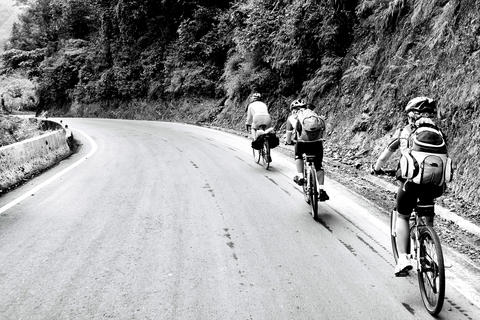
Photo: Perry Svensson, Taipei Times
LIDAO TO MEISHAN
After a good night's sleep, we felt fresh and ready for the demanding ride ahead. The 29km, 1,700m climb to Daguanshan Yakou was flanked with lush flora that has inspired hundreds of words delineating the varied shades, curves and scents of trees. The sun broke through clouds at times, giving spectacular views of the surrounding mountains. Just as often, wispy fog rolled in, blinding us, forcing us to notice the quietude of the mountain and the sounds of insects and birds. For most of that leg of the trip, though, my breathing was the loudest sound I could hear, and the rhythm of it put me into an extended "Zen moment."
As the locals predicted, the rain started around noon. Riding up the steep incline that was the last 10km in pouring rain demanded all the willpower we had left after hours of gradual climbing. Around 3pm, we reached the summit, wet and cold, but ecstatic.
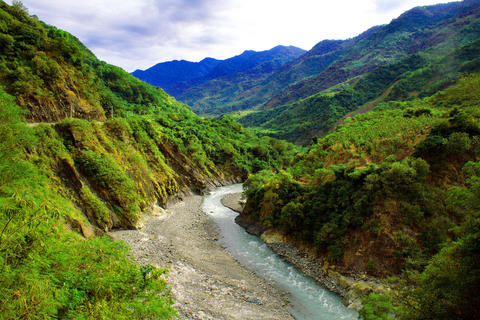
Photo: Perry Svensson, Taipei Times
After a brief rest, we took on the dark and drippy Daguanshan Tunnel (大關山隧道), which barrels downhill for its entire 615m length.
In the Cypress Valley (檜谷), we stopped briefly to take in the giant red cypresses that make the mountain air sweet.
The rain eventually stopped, but thick fog set in, blocking the natural wonders of Yushan National Park (玉山國家公園) from view.
Cycling downhill in low visibility induced repeated adrenalin rushes. Every pore screamed and the senses of hearing and touch were much more acute, like being in a trance, and being fully aware of it.
Night seemed to fall prematurely, hiding potholes and stones on the slippery road. Pouring rain resumed, threatening to wash us away with mudslides. Instead of going to our intended stop at Baolai (寶來), we took refuge in Meishan (梅山), some 30km past Yakou.
Our day ended with hospitable Paiwan and Bunun women treating us to rounds of beer and homemade rice wine at their restaurant.
MEISHAN TO TAINAN CITY
Spending the night in Meishan turned out to be a wise decision. The next day, I pushed myself to the limit, cursing all the way, riding the last 10km to Baolai up and down through the hills.
On the route to Tainan, the picturesque green hills and valleys continued along the Laonong River (荖農溪). Aboriginal villages dotted the Yushan Mountain Range (玉山), where life strolls along at a leisurely pace.
But the crisp mountain damp was replaced by tropical heat as we descended across Kaohsiung County (高雄縣). The two-day seclusion from modernity came to a crashing end as we approached Tainan and the sounds and smells of civilization. From there, we caught the High Speed Rail back to Taipei.
In hindsight, we agreed that we should have bagged our bikes and taken a bus from Liukui (六龜) or Jiasian (甲仙) into Tainan or Kaohsiung City to save us from the torrid, polluted and unpleasant last leg of the journey.
The barrage of noise and scents on the road clouded our cleared senses, reminding me of a myth about the god Hun Tun (渾沌). Two of the god's friends wanted to give him a present as a gesture of gratitude for his hospitality. They decided to carve the eyes and ears out of Hun Tun's body so that he could sense the world. But Hun Tun couldn't take the pandemonium of smells, sounds and sights flooding in - and died.
GETTING THERE
You can start the trek across the Southern Cross-Island Highway (南橫公路) from Tainan (台南) on the West Coast or Chihshang (池上) on the East Coast. From Taipei, one-way train tickets to Chihshang on the Chukuang Express (莒光號) cost around NT$500. The High Speed Rail from Taipei to Tainan costs NT$1,350. Cheaper, but more time-consuming options for getting to Tainan include the train for around NT$700 and the bus for around NT$500.
WHERE TO STAY
Once you venture into the mountains on the Southern Cross-Island Highway, there are three main posts offering overnight accommodation. In Lidao (利稻), several bed and breakfasts offer rooms for around NT$1,000. In Motian (摩天), the Motian Farm House (摩天農場) costs NT$1,500 per double room. In Yakou (埡口), the Yakou Guesthouse (埡口山莊) runs NT$2,200 for a double and NT$3,200 for a four-person room. In the lower altitudes, the most popular places to spend the night are Meishan (梅山) and Baolai (寶來), both of which offer a variety of accommodation choices.
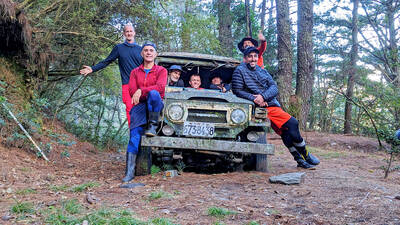
The year was 1991. A Toyota Land Cruiser set out on a 67km journey up the Junda Forest Road (郡大林道) toward an old loggers’ camp, at which point the hikers inside would get out and begin their ascent of Jade Mountain (玉山). Little did they know, they would be the last group of hikers to ever enjoy this shortcut into the mountains. An approaching typhoon soon wiped out the road behind them, trapping the vehicle on the mountain and forever changing the approach to Jade Mountain. THE CONTEMPORARY ROUTE Nowadays, the approach to Jade Mountain from the north side takes an

Last week Joseph Nye, the well-known China scholar, wrote on the Australian Strategic Policy Institute’s website about how war over Taiwan might be averted. He noted that years ago he was on a team that met with then-president Chen Shui-bian (陳水扁), “whose previous ‘unofficial’ visit to the US had caused a crisis in which China fired missiles into the sea and the US deployed carriers off the coast of Taiwan.” Yes, that’s right, mighty Chen caused that crisis all by himself. Neither the US nor the People’s Republic of China (PRC) exercised any agency. Nye then nostalgically invoked the comical specter

Relations between Taiwan and the Czech Republic have flourished in recent years. However, not everyone is pleased about the growing friendship between the two countries. Last month, an incident involving a Chinese diplomat tailing the car of vice president-elect Hsiao Bi-khim (蕭美琴) in Prague, drew public attention to the People’s Republic of China’s (PRC) operations to undermine Taiwan overseas. The trip was not Hsiao’s first visit to the Central European country. It was meant to be low-key, a chance to meet with local academics and politicians, until her police escort noticed a car was tailing her through the Czech capital. The
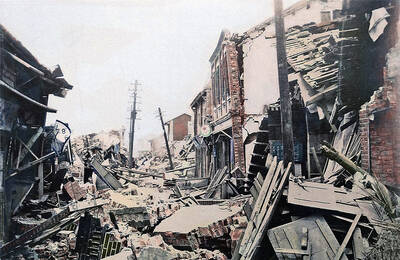
April 15 to April 21 Yang Kui (楊逵) was horrified as he drove past trucks, oxcarts and trolleys loaded with coffins on his way to Tuntzechiao (屯子腳), which he heard had been completely destroyed. The friend he came to check on was safe, but most residents were suffering in the town hit the hardest by the 7.1-magnitude Hsinchu-Taichung Earthquake on April 21, 1935. It remains the deadliest in Taiwan’s recorded history, claiming around 3,300 lives and injuring nearly 12,000. The disaster completely flattened roughly 18,000 houses and damaged countless more. The social activist and


 RSS
RSS