


I bless the day 3M invented Post-It notes. I don't think I could survive without them. They decorate my computer, reminding me how to do things like create a folder, undo an error or save an attachment without opening it. They adorn my refrigerator and kitchen cabinets to help me remember what to buy, what to order and when I have to be where.
Also on my refrigerator is a cartoon by Arnie Levin in The New Yorker showing two elephants. One, covered with notes, says to the other, "As I get older, I find I rely more and more on these sticky notes to remind me."
I have notes that say, "Take Lunch," "Take Phone," "Turn Off Computer!" lest I forget such important tasks when I leave home.
Why do I still remember the symbols for all the elements known when I took chemistry 48 years ago, but don't recall what I wrote about yesterday?
When I complained to my 30-something son that I cannot seem to remember anything unless I write it down and stare at it, he said reassuringly, "Mom, by now you've got so much crammed into your head, something is bound to fall out!"
And I know I'm not alone among the over-50 generation. A good friend, two-and-a-half years my senior, endured a six-hour battery of neuropsychological tests because she feared encroaching Alzheimer's disease (she got an all clear). We tease each other about always having to go everywhere together, because we each supply half a memory.
If my husband precedes me in death, my memory of the movies and plays I have seen will die with him. Though eight years my senior, he remembers not only what we have seen, but also where and when.
And why don't I have a politician's memory for names? As a reporter for the Minneapolis Tribune in 1965, I covered Hubert Humphrey's first visit to his home state as vice president. Everywhere he went, he greeted people by name and asked about their relatives, also by name. And seven hours after being introduced to a half-dozen reporters, he said before departing for Washington: "Goodbye, Miss Brody. I'll give your regards to Brooklyn next time I'm there."
When I'm introduced to a new person, the name is gone from my memory before the handshake is over. Probably it was never there to start with, because I've known since childhood that I'm a visual, not an aural, learner. If a new acquaintance has no name tag, a verbally stated name goes in one ear and out the other, bypassing my brain's memory cells.
All through school, I took voluminous notes and underlined every important sentence in my textbooks. During exams, I could visualize the answers on their respective pages. No matter how hard I tried to learn just by listening, the lesson was out of my head by the time I left the classroom.
BLOCKING AND BLANKING
Few of us escape the experience of walking from one room to another and not remembering why or what for. Chances are an extraneous thought in that brief trek blocked out its original purpose. But if you go back to the first room, you nearly always recall your mission. It's annoying, but not really embarrassing, unlike blanking on the name of someone you know well.
Like the time I tried to introduce my stepmother of 25 years to another guest at my party and could not for the life of me think of her first name. "Sandra, I'd like you to meet my motherhuh, huh, Mrs. Brody," I finally blurted out.
In Carved in Sand, an enlightening and rather reassuring new book on fading memory in midlife, author Cathryn Jakobson Ramin speaks of "'blocking' (or 'blanking') when names will not come to mind and words dart in and out of consciousness." Ramin, like me, has often been stopped cold in the midst of writing when unable to think of what she knows is the perfect word.
Her research found that "word-retrieval failures occur not because of the loss of relevant memories, but because irrelevant ones are activated."
Daniel Schacter, a psychologist and memory expert at Harvard and the author of The Seven Sins of Memory, notes that the concept of blocking exists in 51 languages and that 45 of them have a specific name for it. In English, it's called "tip of the tongue," lapses that become increasingly common and challenging from midlife onward.
"People can produce virtually everything they know about a person or everything they know about a word, except its label," Schacter wrote. My friends and I often find ourselves talking about "you know who" and "thingamajigs."
HOW to COPE
Mnemonics can be useful, if you can remember them and what they stand for. When my seven-year-old grandson told me to "Never Eat Shredded Wheat," which he knows I like, he laughed and said it helped him remember "north, east, south and west." To remember what I have to do or buy when I can't write it down, I try to concoct an unforgettable mnemonic like "Babies Are Little Children" for bananas, apples, lettuce and cereal.
Whenever possible, I associate a new name with a tangible object: "Cucumber" for Kirby, the lifeguard at the Y; "ravioli" for Ralph, who sits at the desk; and "sherry" for Sherry, the locker room attendant.
For fellow Y members, after learning a name, I use it every chance I get: "Hi, Jeanette," "So long, Sue, have a nice day," "Cynthia, you're early today," and "Aviva, how's your new job?"
And I continue to say their names aloud even after I think that they are etched in stone in my memory.
At a dinner where I'm to be seated with a table of strangers, I check the list of others at the table in advance to help me remember their names when we are introduced. And for groups that meet infrequently, I campaign for name tags. No one should have to remember the names of people she sees once or twice a year.
Though I have long worked in a state of organized chaos (I know where everything is, as long as no one moves it), I needed a better system as I advanced in years. Now, every potentially important piece of paper must go in a labeled file (even if that file has only one thing in it), and the files stored alphabetically in a labeled drawer or box, lest they never be found again.
Also, I resist all urges to reorganize my files - or my clothes, shoes, groceries or tools - because I seem to remember only the first place I put something. Move it to a new location, and it is lost until and unless I stumble upon it accidentally.
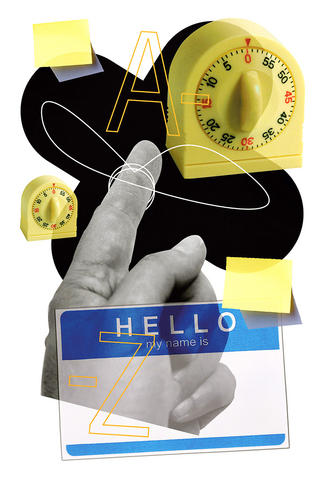
Finally, to remember when things must be done like move the car, pick up the grandchildren and turn off the oven, I invested heavily in good kitchen timers and scattered them about the house. The best I have found is made by West Bend. The model number is 40005X, and it runs for a very long time on one AAA battery.
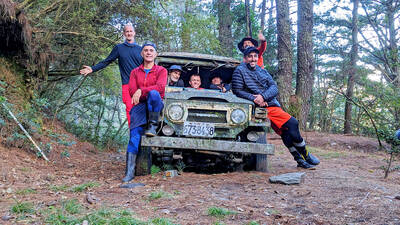
The year was 1991. A Toyota Land Cruiser set out on a 67km journey up the Junda Forest Road (郡大林道) toward an old loggers’ camp, at which point the hikers inside would get out and begin their ascent of Jade Mountain (玉山). Little did they know, they would be the last group of hikers to ever enjoy this shortcut into the mountains. An approaching typhoon soon wiped out the road behind them, trapping the vehicle on the mountain and forever changing the approach to Jade Mountain. THE CONTEMPORARY ROUTE Nowadays, the approach to Jade Mountain from the north side takes an

Last week Joseph Nye, the well-known China scholar, wrote on the Australian Strategic Policy Institute’s website about how war over Taiwan might be averted. He noted that years ago he was on a team that met with then-president Chen Shui-bian (陳水扁), “whose previous ‘unofficial’ visit to the US had caused a crisis in which China fired missiles into the sea and the US deployed carriers off the coast of Taiwan.” Yes, that’s right, mighty Chen caused that crisis all by himself. Neither the US nor the People’s Republic of China (PRC) exercised any agency. Nye then nostalgically invoked the comical specter
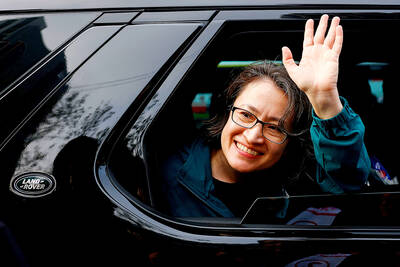
Relations between Taiwan and the Czech Republic have flourished in recent years. However, not everyone is pleased about the growing friendship between the two countries. Last month, an incident involving a Chinese diplomat tailing the car of vice president-elect Hsiao Bi-khim (蕭美琴) in Prague, drew public attention to the People’s Republic of China’s (PRC) operations to undermine Taiwan overseas. The trip was not Hsiao’s first visit to the Central European country. It was meant to be low-key, a chance to meet with local academics and politicians, until her police escort noticed a car was tailing her through the Czech capital. The
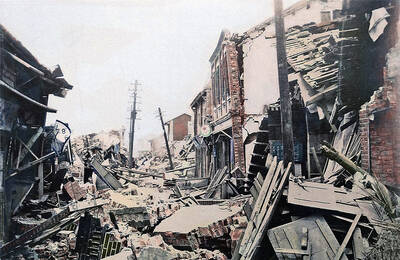
April 15 to April 21 Yang Kui (楊逵) was horrified as he drove past trucks, oxcarts and trolleys loaded with coffins on his way to Tuntzechiao (屯子腳), which he heard had been completely destroyed. The friend he came to check on was safe, but most residents were suffering in the town hit the hardest by the 7.1-magnitude Hsinchu-Taichung Earthquake on April 21, 1935. It remains the deadliest in Taiwan’s recorded history, claiming around 3,300 lives and injuring nearly 12,000. The disaster completely flattened roughly 18,000 houses and damaged countless more. The social activist and


 RSS
RSS