


National Taiwan University (臺灣大學, NTU) recently commemorated its 80th anniversary by opening six of its 12 academic museums to the public and plans to open another three next year.
"The collections in each museum were originally for research purposes," said Tsai Chiung-min (蔡烔民), a researcher at NTU's Center of Digital Archives. "For this reason, we didn't make them accessible to the public."
If public museums use their collections to attract visitors who are after general knowledge, research museums serve the opposite function by keeping specimens or artifacts for the exclusive use of experts.
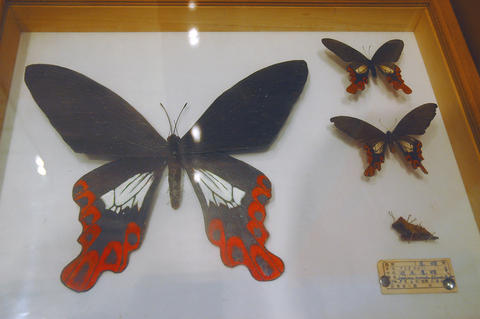
PHOTO: NOAH BUCHAN, TAIPEI TIMES
To make the museums visitor friendly, Tsai said, the university renovated and expanded existing facilities - mostly dusty basements and messy storerooms.
"In the past," he said, "we feared that people would say, 'Why is it not clean enough? Why is it not like a regular museum?'"
Historical significance
A first stop on any visit should be the Gallery of NTU's History (校史館) because it includes a brief introduction to each museum. Located a few minutes' walk from NTU's main gate at the Gongguan MRT station, the Gallery is housed on the second floor of a Japanese-era colonial building.
The exhibition displays books, pictures and files documenting some of Taiwan's most momentous events including the White Terror era, the 1970s Student Protest Movement, Taiwan's withdrawal from the UN and NTU's direct elections for student representatives, to name a few.
One section, Services to Society, showcases research at the university that has provided practical benefits to humankind. The Pursuit of Excellence section highlights public figures.
The Gallery's Chuan Lyu Exhibition Hall (川流廳) houses the Window to University Museums section, where artifacts, pictures and specimens are used to give a brief introduction to each museum. The hall also features interactive displays and video presentations.
Around campus
The department of anthropology has two museums, one in the Exhibition Hall of Archaeology and one in the Exhibition Hall of Ethnology. The first collection consists of Aboriginal artifacts collected between the 1920s and 1960s and focuses on the burial customs and tombs of prehistoric Taiwan.
The collections in the Exhibition Hall of Ethnology date from 1895 and were moved to NTU when it opened in 1928. To promote ethnological research, two Japanese anthropologists systematically collected specimens including clothing, woodcarving, ceramics, daily utensils and ceremonial objects of Taiwan's Aboriginal tribes, which are on display.
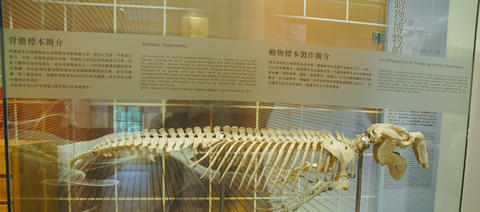
On the first floor of the Life Science Building, the Museum of Zoology contains more than 100 mounted specimens and skeletons of birds, mammals, reptiles and fish. The museum currently features a special exhibit, A New Experience of Life Science, and displays toothed whales, baleen whales and Asian elephants - all accompanied by the sounds made by these giants.
A bronze statue of a farmer points the way to the Agricultural Exhibition Hall. Opened in 1964, the hall is as much a tribute to Taiwan's agricultural progress as it is a museum. It is also a worthy stop for plant lovers as it shows in detail the diversity of plants and trees found on NTU's sprawling campus.
The Exhibition Hall of Geological Collections houses a rich collection of the island's fossils, minerals and rock samples as well as specimens collected and purchased from other countries. The museum features a special exhibit about hokutolite, the only mineral in the world named after a place in Taiwan (it is the Japanese pronunciation of Beitou).
The mineral was assumed to have radioactive properties - Nobel laureate and former Academia Sinica president Lee Yuan-tseh (李遠哲) wrote his master's thesis on the topic - and was used as part of linear accelerator experiments in the department of physics. Highlights of the research and Taiwan's first accelerator can be found at the Heritage Hall of Physics.
Though the Insect Museum and Herbarium of National Taiwan University will not open to the public until next year, enthusiasts can still get an idea of what to expect from the displays at the Chuan Lyu Hall.
The prehistoric artifacts, minerals, fossils, specimens of plants, animals and insects, combined with the variety of laboratory instruments and equipment will interest a wide variety of scholars and laypeople. Taken together, they provide an in-depth look at the development of NTU's sciences and humanities over the past century.

In late October of 1873 the government of Japan decided against sending a military expedition to Korea to force that nation to open trade relations. Across the government supporters of the expedition resigned immediately. The spectacle of revolt by disaffected samurai began to loom over Japanese politics. In January of 1874 disaffected samurai attacked a senior minister in Tokyo. A month later, a group of pro-Korea expedition and anti-foreign elements from Saga prefecture in Kyushu revolted, driven in part by high food prices stemming from poor harvests. Their leader, according to Edward Drea’s classic Japan’s Imperial Army, was a samurai
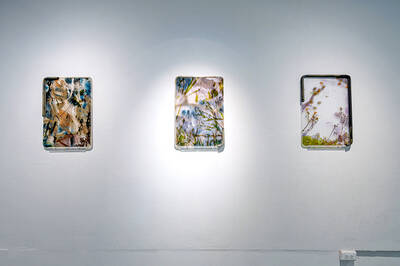
Located down a sideroad in old Wanhua District (萬華區), Waley Art (水谷藝術) has an established reputation for curating some of the more provocative indie art exhibitions in Taipei. And this month is no exception. Beyond the innocuous facade of a shophouse, the full three stories of the gallery space (including the basement) have been taken over by photographs, installation videos and abstract images courtesy of two creatives who hail from the opposite ends of the earth, Taiwan’s Hsu Yi-ting (許懿婷) and Germany’s Benjamin Janzen. “In 2019, I had an art residency in Europe,” Hsu says. “I met Benjamin in the lobby
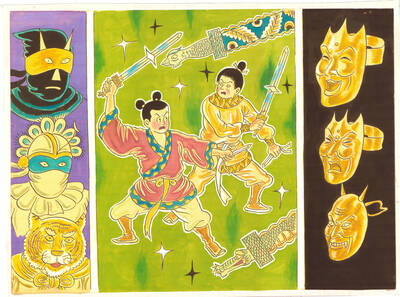
April 22 to April 28 The true identity of the mastermind behind the Demon Gang (魔鬼黨) was undoubtedly on the minds of countless schoolchildren in late 1958. In the days leading up to the big reveal, more than 10,000 guesses were sent to Ta Hwa Publishing Co (大華文化社) for a chance to win prizes. The smash success of the comic series Great Battle Against the Demon Gang (大戰魔鬼黨) came as a surprise to author Yeh Hung-chia (葉宏甲), who had long given up on his dream after being jailed for 10 months in 1947 over political cartoons. Protagonist

A fossil jawbone found by a British girl and her father on a beach in Somerset, England belongs to a gigantic marine reptile dating to 202 million years ago that appears to have been among the largest animals ever on Earth. Researchers said on Wednesday the bone, called a surangular, was from a type of ocean-going reptile called an ichthyosaur. Based on its dimensions compared to the same bone in closely related ichthyosaurs, the researchers estimated that the Triassic Period creature, which they named Ichthyotitan severnensis, was between 22-26 meters long. That would make it perhaps the largest-known marine reptile and would


 RSS
RSS