


The nightclub in the basement of the Riksgransen Hotel is full of surprises. The first is the US$24 bill for two pints of lager. Then the barman pulls back a curtain to reveal that, even though it's 10pm, because it is May and we are so far north, outside it's broad daylight. But the coup de grace is when a helicopter lands right outside and four weary but beaming skiers unfurl themselves from its cramped cockpit and clomp inside for a drink.
Riksgransen is the world's most northerly ski resort, a frozen border post between Sweden and Norway, 300km north of the Arctic Circle. Such latitude gives it a key selling point - a ski season extending until late June. When the snows melt in Chamonix, St Anton and Verbier, the ski bums who can't face heading home migrate here to prolong winter for a few more precious weeks.
But there is another, lesser-known, reason for making the pilgrimage this far north. Ironic as it may seem given Scandinavia's reputation for ruinous prices, Riksgransen is probably the cheapest and easiest place in the world to get a taste of heliskiing.
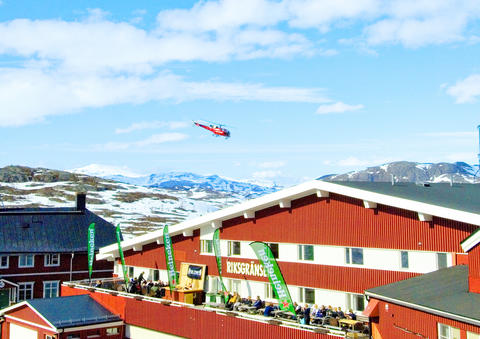
PHOTO: COURTESY OF MATTIAS JOHANSSON
For any skier or snowboarder who has ventured off-piste and felt the addictive thrill of floating in light powder snow, heliskiing is the stuff of fantasy. Rather than queuing for busy cable cars and chairlifts, heliskiers are whisked away to remote peaks, below which kilometer after kilometer of virgin powder awaits. The only drawback is that the cost of chartering helicopters means that it's an activity pretty much reserved for those who work in banking. The majority of Britons who go heliskiing do so in British Columbia, Canada, signing up for a week's package that costs around US$8,000 per person, plus another US$2,000 for flights, transfers, drinks and so on.
In Riksgransen, however, things are far more low-key. You can do as many helicopter lifts as you like, typically paying just US$100 a time, including a guide and hire of transceivers, shovels and probes. Most take a three-lift package, which will take a full afternoon and allow you to ski the biggest peaks of the area.
There's no need to book months ahead either - you just sign up at the hotel reception desk in the morning, leaving your mobile number, then head out to the pistes. An hour before your helicopter slot, the guides ring to call you back to the helipad, right outside the hotel.
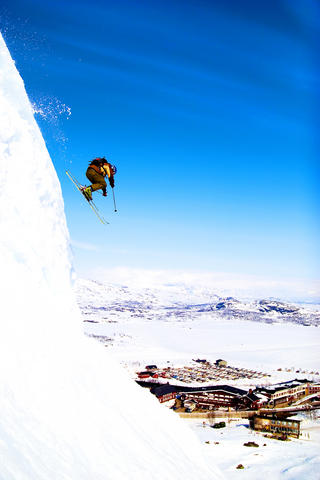
PHOTO: COURTESY OF MATTIAS JOHANSSON
SMALL-SCALE RESORT
It has to be said that the pistes here are rather limited - there are only six lifts - but then Riksgransen isn't really a resort in the conventional sense. There's just one hotel, around which a cluster of red wooden outbuildings have grown up, and a maximum capacity of about 600 people. The whole place owes its existence not to skiing, but to the single-track railway that runs through its center, built to transport iron ore from the mines of Kiruna in the south to the port of Narvik, on Norway's Atlantic coast.
The railway was completed in 1902, when rails being built from the Swedish and Norwegian sides finally met at Riksgransen. To celebrate, a hotel and elaborate wooden station were built, and the railway company started trying to promote it as a tourist destination. Initial attempts foundered (there was, after all, no real reason to get off the train) until the country's first ski school was established here in 1934. Its popularity has slowly grown ever since, although today it still feels more like a frontier outpost than a town.
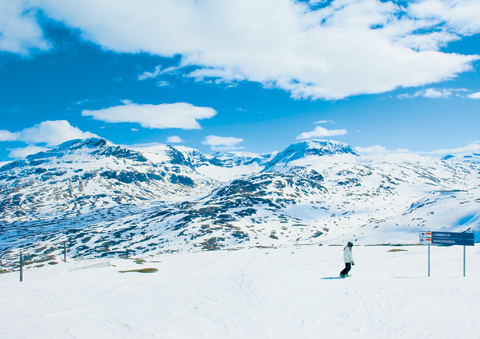
PHOTO: COURTESY OF MATTIAS JOHANSSON
When our call comes, we rush down from the pistes and gather excitedly at the empty helipad. Soon the little red helicopter comes into view across the frozen lake that fills the wide valley floor. As it gets closer, I start to suspect there's a reason heliskiing here is so cheap; to be blunt it doesn't exactly look new.
Most helicopters I've been in before have been all lightweight fiberglass and carbon. This is made from painted metal and rivets and glass and has big silver door handles that look as if they've been borrowed from an Austin Allegro. Later inquiries reveal it's an Alouette 3 of a type first built in 1970, but Krister, our guide, assures us that the exhaustive maintenance regime means its age makes no difference.
Soon the rotors are spinning, smacking the air with a slow thud, thud, thud that gradually speeds up into a frantic whirr. Then we're soaring up over the hotel, leaving behind the few skiers on the pistes and heading off into the Arctic wilderness. We touch down on the 1,463m summit of Vassitjakka, clamber out and crouch in the snow as the pilot lifts off and veers sharply away to pick up the next group. There's a moment of exquisite silence as we take in the view stretching over kilometer after kilometer of white Arctic plateau, past the ancient blue ice of glaciers and down, in the far distance, to the half-frozen fjords of Norway. Then everyone's bashing snow off their boots, clipping into bindings, banging poles and talking about the run ahead.
ARCTIC THRILLS
It doesn't disappoint. We carve huge high-speed arcs in the buttery spring snow, leaving enormous S-shaped signatures on what had been an untouched mountainside. The initial steep slopes level and open out into a wide hidden bowl, devoid of any sign of human life. While the big helicopters in Canada can carry groups of up to 10 clients, the Alouette has space for just five, so our group is small enough not to destroy the peace.
Halfway down, a family of reindeer are pulling at an exposed clump of grass, and Krister warns us to give them a wide berth in case they panic and scatter into our paths. We take our time, each choosing a separate route, then regrouping at the bottom, where Krister radios for the helicopter to collect us for two more wonderful runs. There hasn't been any new snow for a couple of weeks, but the temperatures here and the lack of other skiers means that conditions are still great. To be honest though, the real thrill is less about the helicopter and the powder snow, more about the feeling of skiing in a tiny group in a wilderness utterly unlike the Alps.
When we land back at the hotel, the party is in full swing. On the terrace young free riders from around Europe are drinking and soaking up a rare interlude of Arctic sun. Though there's only one hotel, it does a good job of catering to everyone. So while the best rooms in the Meteorologen Lodge, a boutiquey place housed in Riksgransen's oldest building, go for around US$400 a night, there are also bunk-bedded rooms for young ski bums costing US$80 per person per night. In the Lapplandia restaurant, the tasting menu includes lightly smoked leg of reindeer with chanterelle sformato, followed by rowanberry granita, and will set you back US$80, but there's also a coffee shop and small food store selling far cheaper fare to satisfy the young, impoverished snow addict.
We ease off our boots and head back to the nightclub to count our krone. We've saved so much on the heliskiing we can afford another beer ... just.
Rooms at the Riksgransen Hotel (www.riksgransen.nu) cost from US$80 per person per night. VisitSweden (www.visitsweden.com) has further details.

In late October of 1873 the government of Japan decided against sending a military expedition to Korea to force that nation to open trade relations. Across the government supporters of the expedition resigned immediately. The spectacle of revolt by disaffected samurai began to loom over Japanese politics. In January of 1874 disaffected samurai attacked a senior minister in Tokyo. A month later, a group of pro-Korea expedition and anti-foreign elements from Saga prefecture in Kyushu revolted, driven in part by high food prices stemming from poor harvests. Their leader, according to Edward Drea’s classic Japan’s Imperial Army, was a samurai

The following three paragraphs are just some of what the local Chinese-language press is reporting on breathlessly and following every twist and turn with the eagerness of a soap opera fan. For many English-language readers, it probably comes across as incomprehensibly opaque, so bear with me briefly dear reader: To the surprise of many, former pop singer and Democratic Progressive Party (DPP) ex-lawmaker Yu Tien (余天) of the Taiwan Normal Country Promotion Association (TNCPA) at the last minute dropped out of the running for committee chair of the DPP’s New Taipei City chapter, paving the way for DPP legislator Su
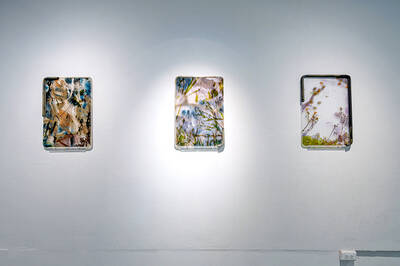
Located down a sideroad in old Wanhua District (萬華區), Waley Art (水谷藝術) has an established reputation for curating some of the more provocative indie art exhibitions in Taipei. And this month is no exception. Beyond the innocuous facade of a shophouse, the full three stories of the gallery space (including the basement) have been taken over by photographs, installation videos and abstract images courtesy of two creatives who hail from the opposite ends of the earth, Taiwan’s Hsu Yi-ting (許懿婷) and Germany’s Benjamin Janzen. “In 2019, I had an art residency in Europe,” Hsu says. “I met Benjamin in the lobby
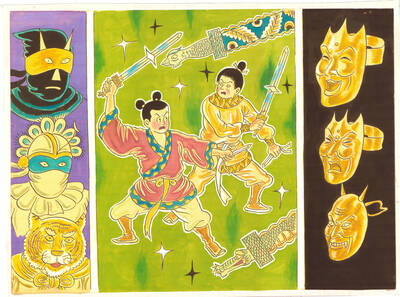
April 22 to April 28 The true identity of the mastermind behind the Demon Gang (魔鬼黨) was undoubtedly on the minds of countless schoolchildren in late 1958. In the days leading up to the big reveal, more than 10,000 guesses were sent to Ta Hwa Publishing Co (大華文化社) for a chance to win prizes. The smash success of the comic series Great Battle Against the Demon Gang (大戰魔鬼黨) came as a surprise to author Yeh Hung-chia (葉宏甲), who had long given up on his dream after being jailed for 10 months in 1947 over political cartoons. Protagonist


 RSS
RSS