


If you have ever been to a Jewish wedding, you know that sooner or later the ominous notes of Hava Nagila will sound, and you will be expected to dance the hora. And if you don't really know how to dance the hora, you will nevertheless be compelled to join hands with others, stumble around in a circle, give little kicks and pretend to enjoy yourself, all the while wondering if there's a word in Yiddish that means "one who stares pathetically at the feet of others because one is still trying to figure out how to dance the hora."
I am pleased and relieved to report that my flailing days are through. This month, in a freewheeling symposium at the University of Michigan on the evolutionary value of art and why we humans spend so much time at it, a number of the presenters supplemented their standard PowerPoint presentations with hands-on activities. Some members of the audience might have liked folding the origami boxes or scrawling messages on the floor, but for me the high point came when a neurobiologist taught us how to dance the hora. As we stepped together in klezmeric, well-schooled synchrony, I felt free and exhilarated. I felt competent and loved. I felt like calling my mother. I felt, it seems, just as a dancing body should.
Pleasure and purpose
In the main presentation at the conference, Ellen Dissanayake, an independent scholar affiliated with the University of Washington, Seattle, offered her sweeping thesis of the evolution of art, nimbly blending familiar themes with the radically new. By her reckoning, the artistic impulse is a human birthright, a trait so ancient, universal and persistent that it is almost surely innate.
But while some researchers have suggested that our artiness arose accidentally, as a by-product of large brains that evolved to solve problems and were easily bored, Dissanayake argues that the creative drive has all the earmarks of being an adaptation on its own. The making of art consumes enormous amounts of time and resources, she observed, an extravagance you wouldn't expect of an evolutionary afterthought. Art also gives us pleasure, she said, and activities that feel good tend to be those that evolution deems too important to leave to chance.
What might that deep-seated purpose of art-making be? Geoffrey Miller and other theorists have proposed that art serves as a sexual display, a means of flaunting one's talented palette of genes. Again, Dissanayake has other ideas. To contemporary Westerners, she said, art may seem detached from the real world, an elite stage on which proud peacocks and designated visionaries may well compete for high stakes. But among traditional cultures and throughout most of human history, she said, art has also been a profoundly communal affair, of harvest dances, religious pageants, quilting bees, the passionate town rivalries that gave us the spires of Chartres, Reims and Amiens.
A rallying point
Art, she and others have proposed, did not arise to spotlight the few, but rather to summon the many to come join the parade - a proposal not surprisingly shared by our hora teacher, Steven Brown of Simon Fraser University. Through singing, dancing, painting, telling fables of neurotic mobsters who visit psychiatrists, and otherwise engaging in what Dissanayake calls "artifying," people can be quickly and ebulliently drawn together, and even strangers persuaded to treat one another as kin. Through the harmonic magic of art, the relative weakness of the individual can be traded up for the strength of the hive, cohered into a social unit ready to take on the world.
As David Sloan Wilson, an evolutionary theorist at Binghamton University, said, the only social elixir of comparable strength is religion, another impulse that spans cultures and time.
A slender, soft-spoken woman with a bouncy gray pageboy, a grandchild and an eclectic background, Dissanayake was trained as a classical pianist but became immersed in biology and anthropology when she and her husband moved to Sri Lanka to study elephants. She does not have a doctorate, but she has published widely, and her books - the most recent one being Art and Intimacy: How the Arts Began - are considered classics among Darwinian theorists and art historians alike.
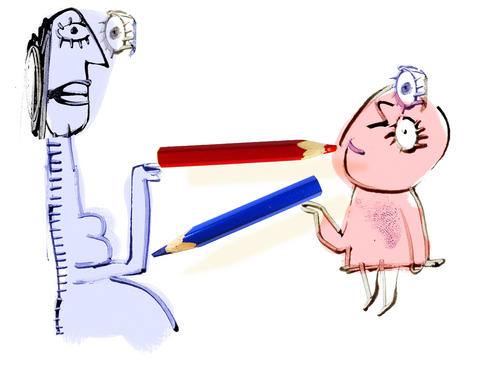
Perhaps the most radical element of Dissanayake's evolutionary framework is her idea about how art got its start. She suggests that many of the basic phonemes of art, the stylistic conventions and tonal patterns, the mental clay, staples and pauses with which even the loftiest creative works are constructed, can be traced back to the most primal of collusions - the intimate interplay between mother and child.
After studying hundreds of hours of interactions between infants and mothers from many different cultures, Dissanayake and her collaborators have identified universal operations that characterize the mother-infant bond. They are visual, gestural and vocal cues that arise spontaneously and unconsciously between mothers and infants, but that nevertheless abide by a formalized code: the calls and responses, the swooping bell tones of motherese, the widening of the eyes, the exaggerated smile, the repetitions and variations, the laughter of the baby met by the mother's emphatic refrain. The rules of engagement have a pace and a set of expected responses, and should the rules be violated, the pitch prove too jarring, the delays between coos and head waggles too long or too short, mother or baby may grow fretful or bored.
To Dissanayake, the tightly choreographed rituals that bond mother and child look a lot like the techniques and constructs at the heart of much of our art. "These operations of ritualization, these affiliative signals between mother and infant, are aesthetic operations, too," she said in an interview. "And aesthetic operations are what artists do. Knowingly or not, when you are choreographing a dance or composing a piece of music, you are formalizing, exaggerating, repeating, manipulating expectation and dynamically varying your theme." You are using the tools that mothers everywhere have used for hundreds of thousands of generations.
In art, as in love, as in dancing the hora, if you don't know the moves, you really can't fake them.

In late October of 1873 the government of Japan decided against sending a military expedition to Korea to force that nation to open trade relations. Across the government supporters of the expedition resigned immediately. The spectacle of revolt by disaffected samurai began to loom over Japanese politics. In January of 1874 disaffected samurai attacked a senior minister in Tokyo. A month later, a group of pro-Korea expedition and anti-foreign elements from Saga prefecture in Kyushu revolted, driven in part by high food prices stemming from poor harvests. Their leader, according to Edward Drea’s classic Japan’s Imperial Army, was a samurai
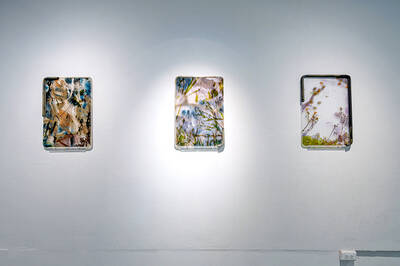
Located down a sideroad in old Wanhua District (萬華區), Waley Art (水谷藝術) has an established reputation for curating some of the more provocative indie art exhibitions in Taipei. And this month is no exception. Beyond the innocuous facade of a shophouse, the full three stories of the gallery space (including the basement) have been taken over by photographs, installation videos and abstract images courtesy of two creatives who hail from the opposite ends of the earth, Taiwan’s Hsu Yi-ting (許懿婷) and Germany’s Benjamin Janzen. “In 2019, I had an art residency in Europe,” Hsu says. “I met Benjamin in the lobby
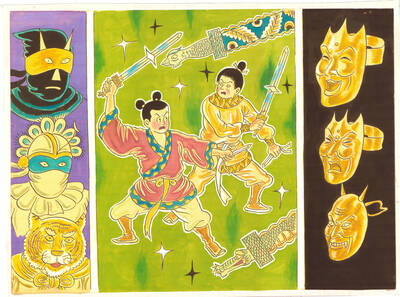
April 22 to April 28 The true identity of the mastermind behind the Demon Gang (魔鬼黨) was undoubtedly on the minds of countless schoolchildren in late 1958. In the days leading up to the big reveal, more than 10,000 guesses were sent to Ta Hwa Publishing Co (大華文化社) for a chance to win prizes. The smash success of the comic series Great Battle Against the Demon Gang (大戰魔鬼黨) came as a surprise to author Yeh Hung-chia (葉宏甲), who had long given up on his dream after being jailed for 10 months in 1947 over political cartoons. Protagonist

A fossil jawbone found by a British girl and her father on a beach in Somerset, England belongs to a gigantic marine reptile dating to 202 million years ago that appears to have been among the largest animals ever on Earth. Researchers said on Wednesday the bone, called a surangular, was from a type of ocean-going reptile called an ichthyosaur. Based on its dimensions compared to the same bone in closely related ichthyosaurs, the researchers estimated that the Triassic Period creature, which they named Ichthyotitan severnensis, was between 22-26 meters long. That would make it perhaps the largest-known marine reptile and would


 RSS
RSS