


Britons are getting lessons in how the principles of arranged marriage could help strengthen their increasingly complicated relationships in a new television program.
In Arrange Me a Marriage, presenter Aneela Rahman, a Scottish Asian whose own 15-year marriage was "kind of arranged," takes a series of unhappily single 30-somethings and gives them tips on how to find a long-term partner.
But instead of telling them to hang around pubs and nightclubs, the usual route for many young people, she enlists the help of their family and friends and tells them to focus on a partner's education, background and relatives.
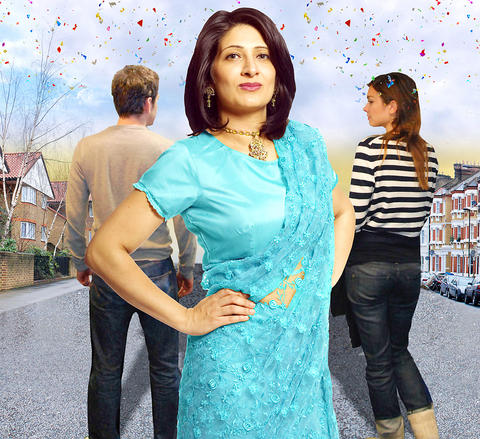
PHOTO: AFP
Rahman, a bubbly, attractive 39-year-old with no previous television experience, said her aim in creating the show was not only to help people find happiness, but also to promote cross-cultural understanding in Britain.
"It's part of life, it's part of what we grow up with in the Asian culture, something that is talked about all the time," said Rahman, whose parents moved to Scotland from Pakistan.
"I'm hoping that non-Asian people can understand Asian people a little bit better as to what they're doing when it comes to trying to help make introductions for the children."
Arranged marriage is still a controversial subject here - five years ago, former cabinet minister David Blunkett whipped up a storm by suggesting that Asian families should set up arranged marriages within Britain only and not find partners overseas.
And there is still some confusion about the difference between arranged marriage and forced marriage - a distinction which Rahman is keen to make clear in her primetime show.
She said that many of the people featured on the program had pursued relationships with incompatible partners whose family backgrounds and aspirations do not tie up with their own.
"You've got to be quite pragmatic and open about what you're looking for in somebody because it's a lifelong decision," she added.
Such a clear-sighted approach has provoked horror among some reviewers - Christina Patterson in the Independent wrote that Rahman practiced match-making on "live, human guinea pigs".
With heavy sarcasm, she added: "Obviously, what we need in the 21st century, in a multicultural society, is clearer demarcations of culture and class. Stick with your own ... arrange me a marriage, but first, find me a clone."
Another reviewer, Poorna Shetty in the London Paper, accused the show of watering down Asian culture to make it "more palatable to an English audience."
"Fact: arranged marriages in Asian communities have a high success rate because the family pressure to stay together is so intense," she added.
"I'd go so far as to say it (the show) is damaging in terms of educating non-Asians about arranged marriages, not least in Rahman's statements that class and money are the most important things."
Whether or not the show is heavy-handed, there is little question that Britons have turned their backs on the traditional concept of marriage.
Although divorce rates are currently at a 30-year low, experts say this is because many do not now choose to marry, preferring cohabitation.
Denise Knowles of Relate, Britain's largest relationship counseling network, underlined this trend by saying that there was now "not the stigma attached to living in sin - it's become more acceptable to live together".
She added that an increasing focus on consumerism in society meant that many people focused on material gains at the expense of relationships.
But despite the show's suggestion that it is introducing a new approach to modern relationships, Knowles argues that many of the principles of arranged marriage also have deep roots in Britain.
She pointed out that Tudor royals in the 16th century often had arranged marriages, while it was also a common concept among the aristocracy until very recently.
Knowles also suggested that modern innovations such as online dating and marriage agencies were "arrangements" to some extent.
"Even a blind date you could say is an arrangement - 'I've got this pal so let's get them together,'" she said.
"When you're given lots of choice you have to take responsibility for that and maybe people are looking at relationship breakdown and thinking 'I need someone to get someone to make some choices for me.'"

Last week Joseph Nye, the well-known China scholar, wrote on the Australian Strategic Policy Institute’s website about how war over Taiwan might be averted. He noted that years ago he was on a team that met with then-president Chen Shui-bian (陳水扁), “whose previous ‘unofficial’ visit to the US had caused a crisis in which China fired missiles into the sea and the US deployed carriers off the coast of Taiwan.” Yes, that’s right, mighty Chen caused that crisis all by himself. Neither the US nor the People’s Republic of China (PRC) exercised any agency. Nye then nostalgically invoked the comical specter

April 15 to April 21 Yang Kui (楊逵) was horrified as he drove past trucks, oxcarts and trolleys loaded with coffins on his way to Tuntzechiao (屯子腳), which he heard had been completely destroyed. The friend he came to check on was safe, but most residents were suffering in the town hit the hardest by the 7.1-magnitude Hsinchu-Taichung Earthquake on April 21, 1935. It remains the deadliest in Taiwan’s recorded history, claiming around 3,300 lives and injuring nearly 12,000. The disaster completely flattened roughly 18,000 houses and damaged countless more. The social activist and

Over the course of former President Ma Ying-jeou’s (馬英九) 11-day trip to China that included a meeting with Chinese Communist Party (CCP) leader Xi Jinping (習近平) a surprising number of people commented that the former president was now “irrelevant.” Upon reflection, it became apparent that these comments were coming from pro-Taiwan, pan-green supporters and they were expressing what they hoped was the case, rather than the reality. Ma’s ideology is so pro-China (read: deep blue) and controversial that many in his own Chinese Nationalist Party (KMT) hope he retires quickly, or at least refrains from speaking on some subjects. Regardless

Approaching her mid-30s, Xiong Yidan reckons that most of her friends are on to their second or even third babies. But Xiong has more than a dozen. There is Lucky, the street dog from Bangkok who jumped into a taxi with her and never left. There is Sophie and Ben, sibling geese, who honk from morning to night. Boop and Pan, both goats, are romantically involved. Dumpling the hedgehog enjoys a belly rub from time to time. The list goes on. Xiong nurtures her brood from her 8,000 square meter farm in Chiang Dao, a mountainous district in northern Thailand’s


 RSS
RSS