


On the day of a performance he never eats spicy food, avoids cold drinks and, most important of all, keeps clear of air-conditioning in all possible circumstances.
So said Jose Carreras last week in exclusive comments to Taipei Times in advance of his Taiwan tour, which begins on Sunday.
He also said that, though he's been here several times before, this time he'll be performing in cities new to him, and he's excited by the prospect. He'll be giving one concert each in Kaohsiung, Tainan, Taichung and Taipei.
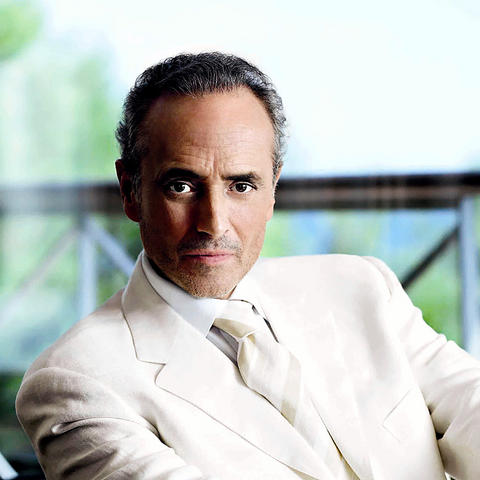
PHOTO: COURTESY OF KHAM ARTS
Carreras came to fame beyond the world of classical music via the Three Tenors concerts, beginning in 1990. Of these, it could be said that Pavarotti was the "Old Showman," Domingo, the "Father Figure" and Carreras, the "Romantic Young Brother." (He was 11 years younger than Pavarotti and is five years younger than Domingo). This, fundamentally, is why his Taipei concert is being held this time, not in the 2,000-seat National Concert Hall, but in the Taipei Arena, which has a maximum capacity of 15,000.
When I asked Carreras last week if, following the death of Pavarotti, there would be any more Three Tenors concerts with a different line-up, he replied that these were now historical events and could never be repeated.
Barcelona-born Carreras became celebrated in the operatic world during the 1970s. His lyrical tenor voice combined strength with a remarkable sweetness, and he was soon singing opposite such famous names as Montserrat Caballe, Teresa Berganza, Mirella Freni and Agnes Baltsa, and alongside Joan Pons, Leo Nucci, Ingvar Wixell and Piero Cappuccilli.
But it appears that he's never sung in a Wagner opera - his Italian-style tenor voice isn't made for those kind of titanic roles. And this, perhaps, represents a problem. If you have a lyric tenor voice, then you play romantic young lovers. So what do you do when you're 61, as Carreras is now?
The answer seems to be "You sing Neapolitan folk songs." These are certainly going to make a major showing in his Taiwan concerts next week. And they're beautiful things, the sort of music Andrea Bocelli has become associated with, and Bocelli is someone whose strengths don't include opera (his 2003 recording of Tosca with Fiorenza Cedolins was a rare embarrassment).
Carreras, by contrast, has a long career as a major operatic star behind him. He has, for example, recorded a total of 18 complete operas. His 1988 recording for a film of La Boheme with Barbara Hendricks may not be widely celebrated but it's among the very best versions of this much-recorded work. (Because of the onset of leukemia, Carreras was unable to appear in the film itself, and someone else mimed the role to Carreras' voice).
One of Carreras' most recent appearances in an opera premiere was in 1999. Then he sang the leading role with the Washington State Opera in Sly, a work by Wolf-Ferrari dating from 1927 based on the Prologue to Shakespeare's The Taming of the Shrew. Carreras had earlier sung the part in Zurich in what was essentially the rediscovery of a long-neglected opera. It went on to be mounted by the Metropolitan Opera, and was recorded by the Gran Teatre del Liceu in Barcelona in 2001 (still its only modern recording). That recording was conducted by Carreras' nephew, David Gimenez. It was highly praised, and it is Gimenez who will be conducting next week's Taiwan concerts. The orchestra will be the Kaohsiung City Symphony Orchestra.
But Carreras is also famous as someone who successfully fought a terrible disease and came back with flying colors. After enduring chemotherapy, radiation therapy and bone marrow transplants for leukemia during the mid-1980s, he was declared cured, and resumed his career before an astonished and delighted world. He now donates huge sums annually to therapy and research via his Jose Carreras International Leukemia Foundation.
The program will be the same for all four Taiwan concerts. Carreras will open with two numbers, followed by an orchestral interlude. He will then sing two more, followed again by another piece from the orchestra. Two more songs from Carreras will then conclude the first half. The second half will follow the same pattern - six Carreras items interspersed by two orchestral ones. In addition there will, presumably, be some encores.
Among Carreras' items will be such well-known favorites as Chitarra Romana (Roman guitar), Lucio Dalla's Caruso, and Gasteldon's Musica Proibita.
Among the orchestral items are the concluding Farandole from Bizet's Second L'Arlesienne Suite and the much-loved Intermezzo from Mascagni's opera Cavalleria Rusticana.
While it's true that Carreras will not be singing pure operatic items on these occasions, the more popular "light classical" items he will be presenting have two advantages. First, they are recognition of his popularity beyond the strictly classical field. And second, they accord appropriately with the vocal range of a man of Carreras' age.
These concerts will, above all else, be celebrations of a long career and a famous musical personality. Jose Carreras is now laden with honors, with opera houses named after him, and even a stamp issued (by Austria) to commemorate his debut. Skeptics may argue that there are today dozens of tenors with equally vigorous voices. But this is not the point. What's important is that the man you are witnessing is a great hero, both in art and life. The Three Tenors concerts may be past history, but Jose Carreras is a living legend.

Last week Joseph Nye, the well-known China scholar, wrote on the Australian Strategic Policy Institute’s website about how war over Taiwan might be averted. He noted that years ago he was on a team that met with then-president Chen Shui-bian (陳水扁), “whose previous ‘unofficial’ visit to the US had caused a crisis in which China fired missiles into the sea and the US deployed carriers off the coast of Taiwan.” Yes, that’s right, mighty Chen caused that crisis all by himself. Neither the US nor the People’s Republic of China (PRC) exercised any agency. Nye then nostalgically invoked the comical specter
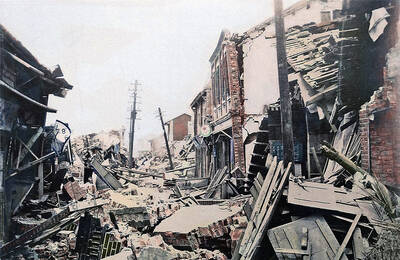
April 15 to April 21 Yang Kui (楊逵) was horrified as he drove past trucks, oxcarts and trolleys loaded with coffins on his way to Tuntzechiao (屯子腳), which he heard had been completely destroyed. The friend he came to check on was safe, but most residents were suffering in the town hit the hardest by the 7.1-magnitude Hsinchu-Taichung Earthquake on April 21, 1935. It remains the deadliest in Taiwan’s recorded history, claiming around 3,300 lives and injuring nearly 12,000. The disaster completely flattened roughly 18,000 houses and damaged countless more. The social activist and

Over the course of former President Ma Ying-jeou’s (馬英九) 11-day trip to China that included a meeting with Chinese Communist Party (CCP) leader Xi Jinping (習近平) a surprising number of people commented that the former president was now “irrelevant.” Upon reflection, it became apparent that these comments were coming from pro-Taiwan, pan-green supporters and they were expressing what they hoped was the case, rather than the reality. Ma’s ideology is so pro-China (read: deep blue) and controversial that many in his own Chinese Nationalist Party (KMT) hope he retires quickly, or at least refrains from speaking on some subjects. Regardless

Approaching her mid-30s, Xiong Yidan reckons that most of her friends are on to their second or even third babies. But Xiong has more than a dozen. There is Lucky, the street dog from Bangkok who jumped into a taxi with her and never left. There is Sophie and Ben, sibling geese, who honk from morning to night. Boop and Pan, both goats, are romantically involved. Dumpling the hedgehog enjoys a belly rub from time to time. The list goes on. Xiong nurtures her brood from her 8,000 square meter farm in Chiang Dao, a mountainous district in northern Thailand’s


 RSS
RSS