


It seems as if the people who make skis and boards are slipping on peels and going head over heels.
They're all taking traditional notions of how to make snowboards and skis and flipping them upside down, quite literally.
You're going to be hearing terms like "reverse camber" or "zero-camber" and "rocker" the next time you go to your favorite ski or snowboard shop, especially if you're a powder hound. So let us explain.
Traditionally, when you lay a ski or snowboard flat on its base, the tip and tail will be touching the ground, but not the middle � the place where you put your feet will be above ground to some extent.
This arc, or camber, harkens back to dark ages of skiing, when the standard method of changing direction was the parallel turn, which always reminded me of someone bouncing down the mountain with a pogo stick up his or her derriere. The camber shape was designed to spread the load over the length of the ski and provide a bit of spring to make the ski pop up for the turn.
Snowboards have always been built that way too, their makers figuring if it worked for skis, it must work too for a single plank, with the rider weighting the center of the board when entering a turn to get some pop on the transition.
Well, somebody � I don't know who � said, "Wait just a second, a snowboard is not a ski!"
Around the same time, some free-thinking big mountain free-skier said, "Wouldn't it be cool if the skis would ride on top of the pow and we didn't have to jackrabbit the turn?"
So they started making skis and boards bent the other way, with a "rocker."
One of the most colorful manifestations around here of this contrary philosophy is Peter Saari, a co-founder of Mervin, the formerly Seattle-based maker of Lib-Tech and Gnu snowboards.
"We've thrown the camber concept out completely and focused on bringing the area under your feet to life," Saari says. "Finally we have geometry designed around the sport of snowboarding."
Except that ski makers are adopting this rocker design as well, to varying extents, for their powder planks.
These new boards and skis are bent the other way, with the tips and tails higher than the waist, or built flat with "zero camber."
The idea is that you turn with your feet, so the area just below should make the most contact with the snow.
"Basically it makes the ski plane in powder snow," says Tim Petrick of K2, who helped design the company's new zero-camber Apache Coomba, a ski built in honor of the late big mountain skier Doug Coombs. "It's just much easier to float to the surface. The drawback, of course, is a reduction in hard-snow performance."
K2 also offers rockered skis � the Seth and the Pontoon. By and large, these are powder-focused rides, especially in the case of skis.
However, by adding a more pronounced arc in the side of the ski or snowboard � called a sidecut � as well as various methods of strengthening the tips and tails, both are said to turn as well on hardpack.
Saari goes even further when talking about Lib-Tech's new Skate Banana, the flagship of a line of snowboards with rocker shapes. He says they ride better everywhere on the mountain � in pow, on hardpack, around the park.
"When you put rocker in the board, you can ride a shorter board in powder and suddenly you can ride backwards in powder," he says. "When you're riding downhill you get full edge contact. When you get on boxes, the tips and tail are virtually catch-free. They're also a lot easier for beginners. It's a more intuitive turn; you just have to tip it.
"We think it's kind of the final evolution of snowboard design."
Before you write that off as huff, puff and hype, remember that Mervin is known for innovation. Three years ago it introduced the "Magne-Traction" edge, a ripple shape designed to increase edge contact with the snow. The Mag-Trac is now offered on a host of Mervin boards and they are highly regarded, selling like hotcakes at a grange hall fundraiser.
In fact, the Banana comes with the Mag-Trac edge and was chosen as one of <> magazine's top eight boards for 2008. Its testers cited the "tremendous edge hold."
Other plank-shapers are not convinced.
"I think any innovation in the snowboard world is a great thing, but here's the big but: they're specific to conditions," says Todd King, director of the snowboard division of Burton, which this year is offering a new twist of its own with a soft-base binding. "We've had riders on them and they've been sketchy on hard-packed conditions. On the East Coast, we're known for our ice. It's a different type of ride."
K2 snowboard wizard Jeff Mechura says the company's reverse-camber Gyrator is made for the deep � but it's sidecut enough that it will carve on the hard.
"It's surf-inspired technology that provides ultimate flotation in softer snow. You couldn't bury the tip if you tried," he says. "If you're going to stay en piste in hard snow, we definitely have better boards for that purpose. (But) we add a nice amount of sidecut underfoot, so when you go to arc it on hard snow, it's going to be a forgiving board."
Call me a caveman, I've tried neither riding a banana nor even magging the trac. But it's cool to have options. So take a look at these hot new skis and snowboards.
Lib Tec Skate Banana
It's designed to ride more like a skateboard or surfboard, with a rocker shape like a kayak. Mervin Manufacturing is betting its "banana technology" represents the future of snowboarding. The Banana is the flagship fruit in a line of four Mervin boards with a rocker shape. Testers for Outsider magazine scored the Skate Banana as one of the top boards for 2008, noting its "effortless" turns on hardpack and "catch-free balance while pressing boxes, jibs and rails." All that in a board that rides best in the fresh. However, some of its testers called it a bit "slippery underfoot." Well, it is called a banana after all. The company also offers rocker shapes in four other boards. (lib-tech.com)
K2 Gyrator
Redesigned with a rocker shape in 2007, the Gyrator is made to float on the fluff like a bigger, wider board. This concave shape eliminates the need to ride the deep from the backseat, allowing a centered stance. A deep sidecut, and a core lightened at the tip and tail, keep it carving decently inbounds as well, while the fiberglass-wrapped carbon and Kevlar laminates keep it strong. This ride also ranked among the top eight snowboards for 2008 by Outside. (k2snowboards.com)
Burton X8
The big deal here is the X8's channeled binding mount and soft, cushiony Burton "extra sensory technology" binding plate, which is said to provide up close and personal contact between the board and your dogs. The goal is better response, and it's coupled with a "negative core profile," which means it's thinner underfoot for more flex and thus subtle foot-steer possibilities. It is a park board made to ride all over, enhanced with just two binding mount screws that stay in the channel and allow quick stance adjustments. Transworld Snowboarding scored it one of the top 10 park boards for 2008 and Outside issued it top-eight props. (burton.com)
Black Diamond Verdict
The judgments have been rendered and the Verdict is in: Black Diamond has a pretty hot rocket in this redesigned free-ride ski that will do pretty much everything. You can use any kind of binding: traditional, randonee, even tele. It's designed as backcountry ski � light, medium-wide at 102 millimeters underfoot, but torsionally strong enough with a poplar core and sculpted tip, so that it's smooth and chatter-free on hardpack. Skiing magazine rated it a "Killer Deal" in the big mountain expert category and Outside pinned a Gear of the Year medal on it among backcountry skis. Black Diamond 's ski director Thomas Laakso says the Verdict is helping blur distinctions: "It's a free-ride ski, but some of the magazines are reviewing it in the alpine category. We don't discriminate." (bdel.com)
Head Monster 88
This is another crossover ski, ranked by Outside magazine as its Gear of the Year among alpine skis. Ski magazine testers scored it in the free-ride category, way high in stability, speed and flotation. I just like the graphics, borrowed from the Bella Coola thunderbird totem. A spruce core wrapped with metal fibers activated piezoelectrically stiffens the ski torsionally when it's stressed, smoothing out the ride. It's a strong ski for a variety of conditions � fresh, crud and ice � like we have here in the Northwest. (head.com)
K2 Apache Coomba
Doug Coombs, a highly regarded free skier, was helping K2 design this big-mountain ski until he was killed last year in an accident on the steeps of La Grave, France. K2 finished the ski and named it for him, and a portion of the proceeds goes to a fund to help his widow and young son. A pretty sharp sidecut makes this ski hold OK on the groomers, and the wide, 102mm waist and zero camber make it a rocket on top of powder. A "triaxial" fiberglass braiding process over the core along with linear carbon strands controls longitudinal stiffness. All told, it's a great ski for those who like to ride the lifts in search of powder stashes and are willing to take backcountry lines. Both Outside and Skiing magazine offered props. (k2skis.com)

In late October of 1873 the government of Japan decided against sending a military expedition to Korea to force that nation to open trade relations. Across the government supporters of the expedition resigned immediately. The spectacle of revolt by disaffected samurai began to loom over Japanese politics. In January of 1874 disaffected samurai attacked a senior minister in Tokyo. A month later, a group of pro-Korea expedition and anti-foreign elements from Saga prefecture in Kyushu revolted, driven in part by high food prices stemming from poor harvests. Their leader, according to Edward Drea’s classic Japan’s Imperial Army, was a samurai
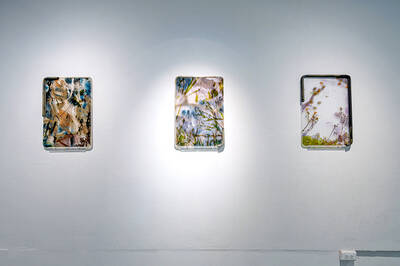
Located down a sideroad in old Wanhua District (萬華區), Waley Art (水谷藝術) has an established reputation for curating some of the more provocative indie art exhibitions in Taipei. And this month is no exception. Beyond the innocuous facade of a shophouse, the full three stories of the gallery space (including the basement) have been taken over by photographs, installation videos and abstract images courtesy of two creatives who hail from the opposite ends of the earth, Taiwan’s Hsu Yi-ting (許懿婷) and Germany’s Benjamin Janzen. “In 2019, I had an art residency in Europe,” Hsu says. “I met Benjamin in the lobby
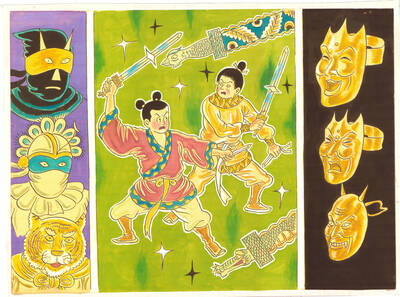
April 22 to April 28 The true identity of the mastermind behind the Demon Gang (魔鬼黨) was undoubtedly on the minds of countless schoolchildren in late 1958. In the days leading up to the big reveal, more than 10,000 guesses were sent to Ta Hwa Publishing Co (大華文化社) for a chance to win prizes. The smash success of the comic series Great Battle Against the Demon Gang (大戰魔鬼黨) came as a surprise to author Yeh Hung-chia (葉宏甲), who had long given up on his dream after being jailed for 10 months in 1947 over political cartoons. Protagonist

Peter Brighton was amazed when he found the giant jackfruit. He had been watching it grow on his farm in far north Queensland, and when it came time to pick it from the tree, it was so heavy it needed two people to do the job. “I was surprised when we cut it off and felt how heavy it was,” he says. “I grabbed it and my wife cut it — couldn’t do it by myself, it took two of us.” Weighing in at 45 kilograms, it is the heaviest jackfruit that Brighton has ever grown on his tropical fruit farm, located


 RSS
RSS