


That Hairspray is good-hearted is no surprise. Adam Shankman's film, lovingly adapted from the Broadway musical, preserves the inclusive, celebratory spirit of John Waters's 1988 movie, in which bigger-boned, darker-skinned and otherwise different folk take exuberant revenge on the bigots and the squares who conspire to keep them down. The surprise may be that this Hairspray, stuffed with shiny showstoppers, Kennedy-era Baltimore beehives and a heavily padded John Travolta in drag, is actually good.
Appropriately enough for a movie with such a democratic sensibility, there is plenty of credit to go around. Shankman, drawing on long experience as a choreographer, avoids the kind of vulgar overstatement that so often turns the joy of live musical theater into torment at the multiplex. The songs, by Marc Shaiman and Scott Wittman, are usually adequate, occasionally inspired and only rarely inane. And they are sung with impeccable diction and unimpeachable conviction by a lively young cast that includes Nikki Blonsky, Amanda Bynes, Zac Efron and the phenomenally talented Elijah Kelley.
Of course there are better-known, more-seasoned performers on hand as well, notably Queen Latifah, Michelle Pfeiffer, Christopher Walken and Travolta. But Hairspray is fundamentally a story about being young - about the triumph of youth culture, about the optimistic, possibly dated belief that the future will improve on the present - and its heart is very much with its teenage heroes and the fresh-faced actors who play them.
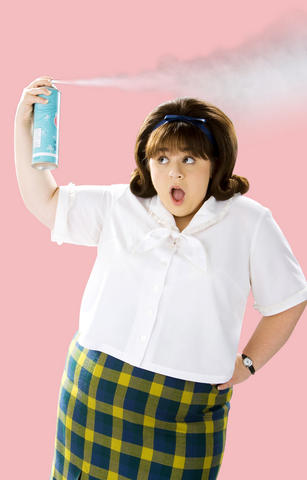
PHOTO: COURTESY OF GROUP POWER
Blonsky, a ball of happy, mischievous energy, is Tracy Turnblad, a hefty Baltimore high school student whose dream is to dance with the city's most telegenic teenyboppers on The Corny Collins Show. Bynes plays Penny Pingleton, Tracy's timid best friend, whose prim mother (Allison Janney) won't even let Penny watch the show, much less appear on it. Pingleton can scarcely imagine that her daughter will eventually fall for Seaweed (Kelley), part of a group of black kids whom Tracy befriends in the detention hall after school.
As Penny and Seaweed test the taboo against interracial romance, Tracy and Link Larkin (Efron), a Corny Collins dreamboat, take on the tyranny of slenderness. That Hairspray cheerfully conflates racial prejudice with fat-phobia is the measure of its guileless, deliberately simplified politics. Upholding both forms of discrimination is Velma Von Tussle (Pfeiffer), a television station executive who uses The Corny Collins Show - against the wishes of Corny (James Marsden) himself - as a way of maintaining the color line and promoting the celebrity of her blond, smiley daughter, Amber (Brittany Snow).
Hairspray does not seriously propose that Tracy and her new African-American friends face equivalent forms of injustice. But it does make the solidarity between them feel like an utterly natural, intuitive response to the meanness and arrogance of their common enemies. "Welcome to the Sixties," Tracy sings to her mother, conjuring up the New Frontier hopefulness of that decade's early years rather than the violence and paranoia of its denouement.
In freezing history at a moment of high possibility - a moment whose glorious popular culture encompasses West Side Story and the Twist, early Motown and Phil Spector's Wall of Sound - Hairspray is at once knowingly corny and unabashedly utopian. On The Corny Collins Show Seaweed and his friends are relegated to a once-a-month Negro Day, presided over by Motormouth Maybelle (Queen Latifah). Tracy envisions a future when, as she puts it, "every day is Negro Day."
What is missing from Hairspray is anything beyond the faintest whisper of camp. The original Hairspray may have been Waters' most wholesome, least naughty film, but there was no containing the volcanic audacity of Divine, who created the role of Edna Turnblad. Divine, who was born Harris Glen Milstead and who died shortly after the first Hairspray was released, belonged to an era when drag performance still carried more than a touch of the louche and the dangerous, and was one of the artists who helped push it into the cultural mainstream.
Perhaps wisely, Travolta does not try to duplicate the outsize, deliberately grotesque theatricality of Divine's performance or to mimic the Mermanesque extravagance of Harvey Fierstein's Broadway turn, choosing instead to tackle the role of Edna as an acting challenge. The odd result is that she becomes the most realistic, least stereotypical character in the film, and the only one who speaks in a recognizable (if not always convincing) Baltimore accent. ("Ahm tryna orn," she complains when she's trying to iron.)
A shy, unsophisticated, working-class woman, Edna is ashamed of her physical size even as she seems to hide inside it, as if seeking protection from the noise and indignity of the world outside. It is Tracy who pulls her out of her shell, and without entirely letting go of Edna's timidity, Travolta explores the exhibitionistic and sensual sides of her personality.
Walken's gallantry in the role of Edna's devoted husband, Wilbur, is unforced and disarmingly sincere, and their duet, (You're) Timeless to Me, is one of the film's musical high points. Another is Without Love, in which the two young couples express their yearning with the help of some ingenious and amusing special effects.
There are, to be sure, less thrilling moments, and stretches in which the pacing falters. But the overall mood of Hairspray is so joyful, so full of unforced enthusiasm, that only the most ferocious cynic could resist it. It imagines a world in which no one is an outsider and no one is a square, and invites everyone in. How can you refuse?
FILM NOTES:
Hairspray
DIRECTED BY: Adam Shankman
STARRING: John Travolta, (Edna Turnblad), Michelle Pfeiffer (Velma Von Tussle), Christopher Walken (Wilbur Turnblad), Amanda Bynes (Penny Pingleton), James Marsden (Corny Collins), Queen Latifah (Motormouth Maybelle), Brittany Snow (Amber Von Tussle), Zac Efron (Link Larkin), Elijah Kelley (Seaweed), Allison Janney (Prudy Pingleton), Jerry Stiller (Pinky), Paul Dooley (Spritzer), Nikki Blonsky (Tracy Turnblad)
RUNNING TIME: 107 minutes
TAIWAN RELEASE: Today

Last week Joseph Nye, the well-known China scholar, wrote on the Australian Strategic Policy Institute’s website about how war over Taiwan might be averted. He noted that years ago he was on a team that met with then-president Chen Shui-bian (陳水扁), “whose previous ‘unofficial’ visit to the US had caused a crisis in which China fired missiles into the sea and the US deployed carriers off the coast of Taiwan.” Yes, that’s right, mighty Chen caused that crisis all by himself. Neither the US nor the People’s Republic of China (PRC) exercised any agency. Nye then nostalgically invoked the comical specter

Relations between Taiwan and the Czech Republic have flourished in recent years. However, not everyone is pleased about the growing friendship between the two countries. Last month, an incident involving a Chinese diplomat tailing the car of vice president-elect Hsiao Bi-khim (蕭美琴) in Prague, drew public attention to the People’s Republic of China’s (PRC) operations to undermine Taiwan overseas. The trip was not Hsiao’s first visit to the Central European country. It was meant to be low-key, a chance to meet with local academics and politicians, until her police escort noticed a car was tailing her through the Czech capital. The
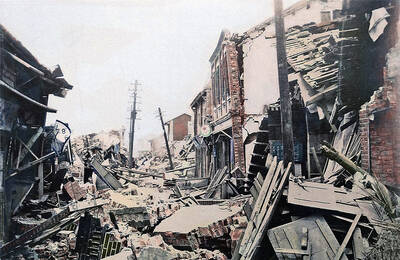
April 15 to April 21 Yang Kui (楊逵) was horrified as he drove past trucks, oxcarts and trolleys loaded with coffins on his way to Tuntzechiao (屯子腳), which he heard had been completely destroyed. The friend he came to check on was safe, but most residents were suffering in the town hit the hardest by the 7.1-magnitude Hsinchu-Taichung Earthquake on April 21, 1935. It remains the deadliest in Taiwan’s recorded history, claiming around 3,300 lives and injuring nearly 12,000. The disaster completely flattened roughly 18,000 houses and damaged countless more. The social activist and

Over the course of former President Ma Ying-jeou’s (馬英九) 11-day trip to China that included a meeting with Chinese Communist Party (CCP) leader Xi Jinping (習近平) a surprising number of people commented that the former president was now “irrelevant.” Upon reflection, it became apparent that these comments were coming from pro-Taiwan, pan-green supporters and they were expressing what they hoped was the case, rather than the reality. Ma’s ideology is so pro-China (read: deep blue) and controversial that many in his own Chinese Nationalist Party (KMT) hope he retires quickly, or at least refrains from speaking on some subjects. Regardless


 RSS
RSS