


In Robert Harris' amusingly acerbic new novel, a scribe for hire follows a ghost named Michael James McAra to Martha's Vineyard. McAra is a ghost for one obvious reason - he fell off the Vineyard ferry and drowned - and also for another. He had been cobbling together the memoir of a former British prime minister. Harris calls this charismatic politician Adam Lang, then makes him sound like former British prime minister Tony Blair.
The unnamed narrator is a ghostwriter too, and a cynical one. "We had endured rock stars who believed themselves messiahs with a mission to save the planet," he says of himself and his trusty laptop. "We had survived footballers whose monosyllabic grunts would make a silverback gorilla sound as if he were reciting Shakespeare. We had put up with soon-to-be-forgotten actors who had egos the size of a Roman emperor's, and entourages to match." So this seasoned pro is the right guy to do a high-stakes job on short notice.
The first part of The Ghost skewers the publishing business for creating and coddling hack memoirists. When the narrator is summoned to his publisher's offices in London, he finds a steel and glass structure "nestled among the pebble-dash housing estates like an abandoned spacecraft after a fruitless mission to find intelligent life."
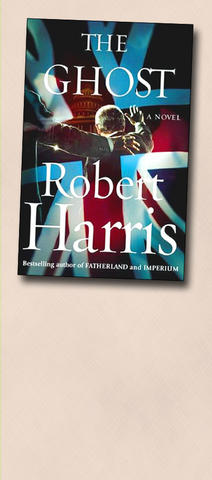
When he is put through a metal detector, he asks: "Who're you expecting to bomb you? Random House?" But the need for security is no joke. Terrorism is a real factor in The Ghost, if only because Harris (whose glossily commercial novels include Fatherland, Imperium and Pompeii) is sufficiently formulaic and commercial to know that his story needs pretexts for action as well as caustic prose.
The memoir's tall, tweedy editor is a sad casualty of what bestseller-dom has become. "In a happier era," Harris writes, "he would have smoked a pipe and offered tiny advances to minor academics over large lunches in Soho. Now, his midday meal was a plastic tray of salad taken at his desk overlooking the M4, and he received his orders direct from the head of sales and marketing, a girl of about 16."
Even the ex-prime minister understands this new business model. So he won't cancel his book contract and refund his advance on account of a ghostwriter's death. The deal was made in this politician's heyday. He knows he is worth less money now that he's over the hill.
The new ghost is sent to join Lang at the American estate of their billionaire publisher so that they can work in intense seclusion. "No black-shawled women stared mournfully out to sea, waiting for their menfolk to come home," the writer observes about Martha's Vineyard and the widows' walks on its quaint rooftops, "presumably because the menfolk were all on Wall Street." The house affords both the promise of an old-fashioned cloistered mystery setting and an ocean view conveying "the general sensation of being world dictator."
So far, so good. Then along come the stock characters, like Lang's strangely embittered wife and his slinky personal assistant, an overly devoted young woman who looks "as if she worked at a cosmetics counter in a department store and had been obliged to demonstrate all the products at once."
Also on the scene is the lamely written manuscript the dead writer left behind. "This was a crock of nothing," the new hire observes in amazement. "No human being could pass through life and feel so little." Inevitably, the wife asks the new ghost for his opinion, and he replies diplomatically.
"'It's fixable,' I said, which I suppose it was: Even Hiroshima was fixed eventually."
When the rewrite begins, The Ghost is still able to sustain its tartness. Citing a real handbook on ghostwriting by Andrew Crofts, it demonstrates some entertaining tricks of the trade. A good ghost, for instance, supplies his or her own memories, because the famous person may have been too busy being successful to recall anything. When concocting Lang's childhood appearance in a Christmas pageant, the ghost researches which real pageants were put on in the place where Lang lived as a boy. Then he gives the ex-prime minister a choice of roles. Wise man? Too much. Sheep? Wrong message. "A guiding star?" "Perfect!"
It's a pity that The Ghost can't continue in this entertaining vein. But the price of Harris' marketing wisdom is a trumped-up plot with a timely emphasis on terrorism. While the writing project is under way, Lang is suddenly accused of having authorized the illegal use of British special forces to seize four suspected al-Qaeda terrorists in Pakistan and turn them over to the CIA to be tortured. Then the International Criminal Court in The Hague considers an investigation.
Lang's memoir is now red-hot in every way, and the ghost finds himself on the trail of clues about Lang's past. The novel's cleverest action maneuver involves the use of an SUVs global positioning system to retrace someone else's travels along this same investigative path.
The Ghost never recovers its dry restraint. It degenerates into a commonplace mystery, a book that its protagonist might have held in contempt when his safety and detachment were still intact. It also insists on the kind of political timeliness that is more apt to become dated than Harris' observations about debased popular culture.
By the time The Ghost has introduced water boarding, spies and a shadowy, Halliburton-like corporate entity, it has undergone a complete sea change from its promising early pages. A ghostwriter might have fixed it, but apparently none was around.

In late October of 1873 the government of Japan decided against sending a military expedition to Korea to force that nation to open trade relations. Across the government supporters of the expedition resigned immediately. The spectacle of revolt by disaffected samurai began to loom over Japanese politics. In January of 1874 disaffected samurai attacked a senior minister in Tokyo. A month later, a group of pro-Korea expedition and anti-foreign elements from Saga prefecture in Kyushu revolted, driven in part by high food prices stemming from poor harvests. Their leader, according to Edward Drea’s classic Japan’s Imperial Army, was a samurai
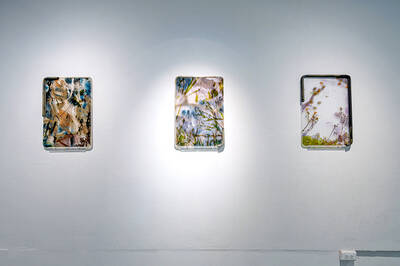
Located down a sideroad in old Wanhua District (萬華區), Waley Art (水谷藝術) has an established reputation for curating some of the more provocative indie art exhibitions in Taipei. And this month is no exception. Beyond the innocuous facade of a shophouse, the full three stories of the gallery space (including the basement) have been taken over by photographs, installation videos and abstract images courtesy of two creatives who hail from the opposite ends of the earth, Taiwan’s Hsu Yi-ting (許懿婷) and Germany’s Benjamin Janzen. “In 2019, I had an art residency in Europe,” Hsu says. “I met Benjamin in the lobby
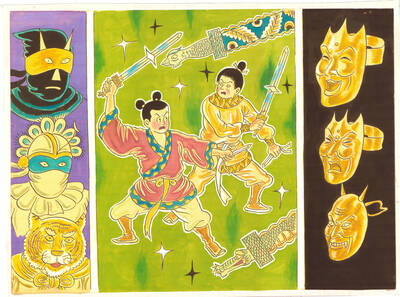
April 22 to April 28 The true identity of the mastermind behind the Demon Gang (魔鬼黨) was undoubtedly on the minds of countless schoolchildren in late 1958. In the days leading up to the big reveal, more than 10,000 guesses were sent to Ta Hwa Publishing Co (大華文化社) for a chance to win prizes. The smash success of the comic series Great Battle Against the Demon Gang (大戰魔鬼黨) came as a surprise to author Yeh Hung-chia (葉宏甲), who had long given up on his dream after being jailed for 10 months in 1947 over political cartoons. Protagonist

A fossil jawbone found by a British girl and her father on a beach in Somerset, England belongs to a gigantic marine reptile dating to 202 million years ago that appears to have been among the largest animals ever on Earth. Researchers said on Wednesday the bone, called a surangular, was from a type of ocean-going reptile called an ichthyosaur. Based on its dimensions compared to the same bone in closely related ichthyosaurs, the researchers estimated that the Triassic Period creature, which they named Ichthyotitan severnensis, was between 22-26 meters long. That would make it perhaps the largest-known marine reptile and would


 RSS
RSS