


SCI Greene County Prison, on the outskirts of Waynesburg, Pennsylvania, sits low in the rural landscape so that it's easy from the restaurants and petrol stations on the main road to miss the barbed wire coiled in endless circles. Inside, the plush leather chairs that squat on shiny floors make it feel more like a private hospital than a maximum security institution. But the black men in prison jumpsuits cleaning the floor, eyes downcast, dispel any such illusions. Signs spell out the rules: no hoods, no unauthorized persons, only US$20 in cash allowed.
Death row - or at least the visiting area - is a curiously ordinary place. A central waiting room where a guard watches the goings-on. Institutional doors opening to small boxes, each furnished with a table and chair. But then, inside the visiting room, there is the shock of a grown man in an orange jumpsuit, his hands cuffed, the space small enough for him to reach out and touch both walls. And between us a layer of thick, reinforced glass.
Mumia Abu-Jamal has lived at SCI Greene since January 1995. Convicted and sentenced to death in 1982 for the murder of a police officer in his hometown, Philadelphia, he spends his days in solitary confinement, in a room he has described as smaller than most people's bathrooms. When I arrive, he puts his fist to the glass in greeting. He is a tall, broad man with dreadlocked hair, still dark, and a beard slightly graying at the edges. He has lively eyes.
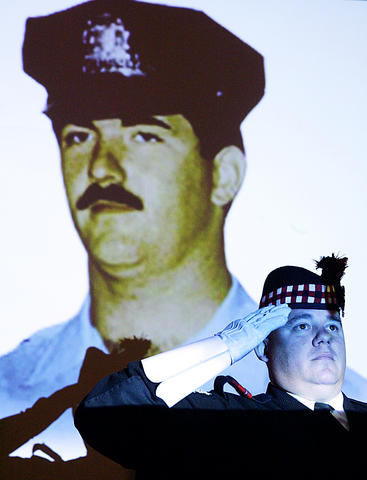
It is hard to know how to begin a conversation with Abu-Jamal, revered for his activism around the world as much as he is reviled as a cop killer by some in his home country. He is careful about who he agrees to see and rarely talks to the mainstream media - this is the first time he has granted an interview to a British newspaper. We start with the basics - the everyday restrictions of prison life. Visits: one a week - though it is difficult for his family to make the 1,056km, 11-hour round-trip journey from Philadelphia. Money: a stipend of less than US$20 per month. Phone calls: three a week lasting 15 minutes each - but a quarter of an hour to Philadelphia costs US$5.69.
This being Abu-Jamal, a campaigning journalist who has written five books about injustice while in prison, it is not long before we are on to the bigger questions: why SCI Greene, which takes most of its 1,700 inmates from Philadelphia, was built "the farthest you can be from Philly and still be in the state of Pennsylvania."
"I believe it is intentional," he says. "I could count the times on my hand when I have seen this whole visiting area full." And why Global Tel Net, the firm that provides the prison phone calls, is allowed to charge so much of people who have so little. His conclusion is characteristically pithy: "The poorest pay the most."
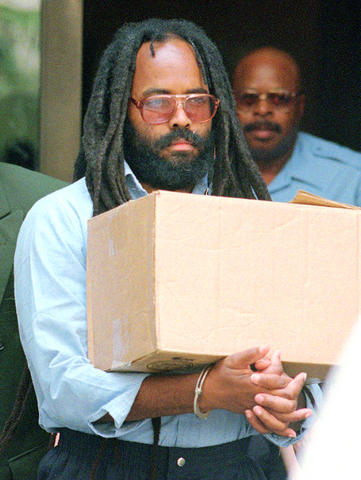
Abu-Jamal has eight children, the eldest of whom is 38, and several grandchildren. How does he keep in touch? "Some grandchildren I have not seen. That's difficult. You try to keep contact through the phone, you write. I send cards that I draw and paint. To let them know the old man still loves them." Abu-Jamal's father, William, died when he was nine; his mother Edith died in February 1990 - eight years after he was imprisoned. He goes very quiet telling me this, and there doesn't seem much point asking how it felt not to be able to sit with her at the end.
Abu-Jamal has been locked up since he was 27. He is now 53. The story of how he ended up here has been told often. As a teenager he had been active in the Black Panther party but by 1981, with most of the party's leaders either dead or in jail, he had become a well- respected radio reporter and president of the Philadelphia chapter of the Association of Black Journalists. Radio journalism was not well paid, however, and Abu-Jamal supplemented his income by driving a taxi at night.
In the early hours of Dec. 9, 1981, he was out in his cab when he saw his brother, Billy Cook, being stopped by a police officer, Daniel Faulkner. A struggle ensued, during which Cook says Faulkner assaulted him. Abu-Jamal got out of his cab. Minutes later, Faulkner had been shot dead and Abu-Jamal was slumped nearby with a bullet wound to the chest, his own gun not far away.
Doubts arise
At his trial in 1982 it appeared an open and shut case. A former Black Panther with a history of antipathy towards the police (although no criminal record). A white police officer dead. A succession of eye-witnesses who testified that Abu-Jamal was the killer. And the icing on the cake: a confession made by Abu-Jamal himself at the hospital where he was taken for treatment.
But some inconvenient facts were obscured: Abu-Jamal's gun was never tested to see whether it had been fired; his hands were never swabbed to establish whether he had fired it; and his gun's bullets were never solidly linked to those that killed Faulkner. The crime scene was never secured.
Of the three witnesses, one has since admitted to lying under police pressure, another has disappeared amid evidence that she too was under duress, and the third initially told police that he had seen the killer run away, but changed his story. Evidence from others who said they saw a third man running away was played down.
Evidence of Abu-Jamal's confession was equally shaky. Although two witnesses testified to hearing him shout, "I shot the motherfucker and I hope the motherfucker dies," the doctors who treated him insist that his medical condition made such a thing impossible. Neither of the two police officers who claimed to have heard the confession reported it until more than two months after the shooting - after Abu-Jamal had made allegations of being abused by police during his arrest. On the contrary, one noted in his log at the time that "the negro male made no comment" in the hospital.
The trial judge, Albert Sabo, was a former member of the powerful police union, the Fraternal Order of Police, known to favor prosecutors. He overturned permission Abu-Jamal had obtained to represent himself, excluded him from much of his own trial and presided over jury selection in which the majority of black candidates were removed. A court stenographer overheard Sabo telling a colleague: "I'm going to help them fry the nigger."
There were other irregularities, so many that Amnesty International concluded in 2000 that the trial was "in violation of minimum international standards," adding, "the interests of justice would best be served by the granting of a new trial to Mumia Abu-Jamal."
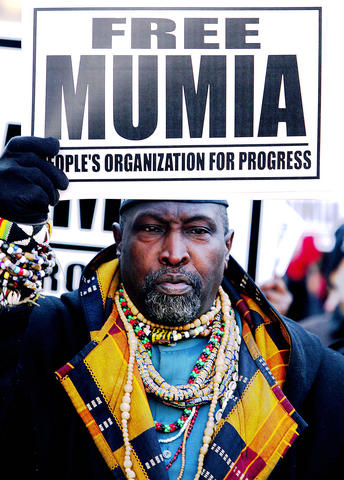
In the 25 years since, Abu-Jamal has appealed against his conviction many times, and many times has had his pleas rejected. He has had two dates set for his execution, only for them to be overturned by legal pressure. He is now awaiting the outcome of his latest appeal, this time by the second highest court in the US. His lead lawyer, Robert Bryan, describes it as "the first time in 25 years that Mumia has had a chance at a free and fair trial." Abu-Jamal is more circumspect. "I have learned not to do predictions," he says. "It's not helpful, psychologically. I don't sit and fret about things."
Instead, he spends his days writing about prison life and social struggles around the world. He takes reams of notes from books sent in by supporters, so that he can refer to them when they are taken away (he is allowed only seven in his cell). "I confess, I am a nerd," he says, laughing. He uses his weekly phone calls to record radio commentaries that are broadcast around the world.
Then there are the speeches he records - he spoke at the World Congress Against the Death Penalty this year and the Million Man March in 1995 - the cards he paints for his family and his drawing. He is currently working on his sixth book, Jailhouse Lawyers, about those prisoners who, like himself, help prepare legal cases with other inmates. He uses a beaten-up typewriter; he has never seen a computer. Asked about the work of which he is proudest, he cites his 2004 book, We Want Freedom, a history of the Black Panther party.
Abu-Jamal spends 22 hours a day alone in his cell - except on weekends, when it's 24. For two hours between 7am and 9am every weekday, he has the option of going out into the yard. It is 18m2 and fenced on all sides, including overhead. Because "air is precious," he rarely refuses, but not everyone takes up the offer. "People have different ways," he says. "I know some guys who play chess for hours and hours, shouting the moves between cells. Some guys argue with other guys. Some guys used to enjoy smut books, but they've stopped those now. A lot of guys don't come out. I think it's depression. You get tired of seeing the same old faces. The role of television is the illusion of company, noise. I call it the fifth wall and the second window: the window of illusion."
Many of the younger prisoners call him "papa" or "old head" and it is clear that he is touched. "When you are out in the yard, it's dudes joshing," he says. "Guys being guys, playing ball. You have this machismo." One of the things that seems to keep him going are these relationships with other guys in "the hole." "Many of them have inspired me and taught me ... about how things are on the street now, how young people are talking and walking."
I ask how prison has changed him. "In ways I could not have imagined," he says. "It has made me immensely patient. I was not before. It has given me an introspection that I hadn't had before and even a kind of compassion I hadn't had before."
In Abu-Jamal's company, it is easy to forget that you are inside prison walls. As he talks, one is pulled into a world of urgent work that needs doing. With characteristic eloquence, he calls Hurricane Katrina "a rude awakening from an illusion," watching television "a profoundly ignorizing experience" and observes that much commercial hip-hop contains "no distinction, except in beat and tone, to a Chrysler advert." "If the message is, I am cool because I am rich, and if you get rich, you can be cool like me, that's a pretty fucked-up message." On American politics, he is damning. "You would think that a country that goes to war allegedly to spread democracy would practice it in its own country."
Born Wesley Cook in the Philadelphia projects, he adopted the name Mumia as a 14-year-old. The following year, aged 15, he helped found the Philadelphia branch of the Black Panther party after being handed a copy of their newspaper in the street. "I was like, whoah," he says. "It just thrilled me. I was like, this is heaven. This is great. Everything. It was the truth. Uncut, unalloyed. It was everything. It fit me."
He spent long days helping with party activities, which included free children's breakfast programs and the monitoring of police, whose corruption at that time has since become notorious (at least a third of the officers involved in Abu-Jamal's investigations have since been found to have engaged in corrupt activities, including the fabrication of evidence to frame suspects).
Mostly, as the party's lieutenant of information, he wrote, gathering stories for the Black Panther, the party's newsletter. "It was great fun," he remembers now. "You worked six and seven days a week and 18 hours a day for no pay ... When I tell young people that now they are like, what was that last part? Are you crazy, man? But because we were socialists we didn't want pay. We wanted to serve our people, free our people, stop the homicide and make revolution. We thought about the party morning, noon and night. It was a very busy but fulfilling life for thousands of people across the country. We were serving our people and what could be better than that?"
Subject to relentless disruption by the FBI's Counter Intelligence Program, which targeted radical and progressive organizations, and riven by internal disagreements, the Black Panthers imploded in the early 1970s. For Abu-Jamal it was a personal tragedy. "Despair," he says when asked how it felt. "A profound despair."
love and life
He is adamant that the party's message is still relevant today. "Millions of black people are more isolated in economic, social and political terms than they were 30 years ago," he says. "I remember a photograph of an elderly black woman (after Katrina) who had wrapped herself in the American flag and I remember looking at it and being so struck by it. Maybe she wasn't thinking visually, she was probably very cold and hungry, but I couldn't help thinking, what does citizenship mean? Are you a citizen if in the wealthiest country on earth you are left to starve, to sink or swim, to drown at the time of the flood?"
If Abu-Jamal's latest appeal is successful he could be a granted a retrial or have the death penalty overturned. If it is not, his execution could quickly follow. He does not sound afraid. "I spend my days preparing for life, not preparing for death," he says. "I believe in life, I believe in freedom, so my mind is not consumed with death. It's with love, life and those things. In many ways, on many days, only my body is here, because I am thinking about what's happening around the world."
As we leave, people emerge from other visiting rooms into the central area. All I can think of is my last view after saying goodbye to Abu-Jamal: a row of men, all black, standing behind glass. Their hands cuffed, their faces smiling goodbye to their families, their voices shouting greetings to each other. In a couple of minutes, each man will trek back to a cell no bigger than your bathroom, with no company but their own. But for now, just for now, there is the sight of life. And they're drinking it in.

In late October of 1873 the government of Japan decided against sending a military expedition to Korea to force that nation to open trade relations. Across the government supporters of the expedition resigned immediately. The spectacle of revolt by disaffected samurai began to loom over Japanese politics. In January of 1874 disaffected samurai attacked a senior minister in Tokyo. A month later, a group of pro-Korea expedition and anti-foreign elements from Saga prefecture in Kyushu revolted, driven in part by high food prices stemming from poor harvests. Their leader, according to Edward Drea’s classic Japan’s Imperial Army, was a samurai

Located down a sideroad in old Wanhua District (萬華區), Waley Art (水谷藝術) has an established reputation for curating some of the more provocative indie art exhibitions in Taipei. And this month is no exception. Beyond the innocuous facade of a shophouse, the full three stories of the gallery space (including the basement) have been taken over by photographs, installation videos and abstract images courtesy of two creatives who hail from the opposite ends of the earth, Taiwan’s Hsu Yi-ting (許懿婷) and Germany’s Benjamin Janzen. “In 2019, I had an art residency in Europe,” Hsu says. “I met Benjamin in the lobby
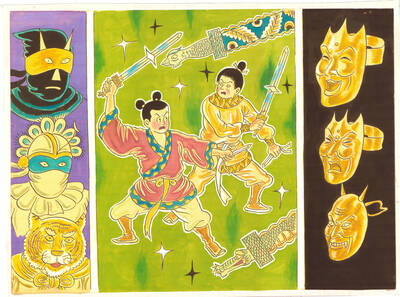
April 22 to April 28 The true identity of the mastermind behind the Demon Gang (魔鬼黨) was undoubtedly on the minds of countless schoolchildren in late 1958. In the days leading up to the big reveal, more than 10,000 guesses were sent to Ta Hwa Publishing Co (大華文化社) for a chance to win prizes. The smash success of the comic series Great Battle Against the Demon Gang (大戰魔鬼黨) came as a surprise to author Yeh Hung-chia (葉宏甲), who had long given up on his dream after being jailed for 10 months in 1947 over political cartoons. Protagonist

Peter Brighton was amazed when he found the giant jackfruit. He had been watching it grow on his farm in far north Queensland, and when it came time to pick it from the tree, it was so heavy it needed two people to do the job. “I was surprised when we cut it off and felt how heavy it was,” he says. “I grabbed it and my wife cut it — couldn’t do it by myself, it took two of us.” Weighing in at 45 kilograms, it is the heaviest jackfruit that Brighton has ever grown on his tropical fruit farm, located


 RSS
RSS