


The story is old - the action takes place in the Tang Dynasty over 1,000 years ago and was first immortalized on stage by the poet Bai Pu (白樸, 1226-1306) during the Yuan Dynasty - but the form it will take in Chen May-tchi's (陳玫琪) opera The Firmiana Rain (梧桐雨), which will have its world premiere at the National Theater Taipei on Thursday, is avant-garde.
With a score that incorporates ancient Chinese music, a Western orchestra, a libretto in Mandarin, French and German, a Japanese director, a Taiwanese gezai opera (歌仔戲) performer and more, this Taiwan-Japan coproduction is billed as a "modern romantic opera."
The Firmiana Rain follows the grand romance between the Emperor Tang Xuanzong (唐玄宗) and the imperial concubine Lady Yang (楊貴妃), the resulting political upheaval and rebellion led by the general An Lu-shan (安祿山), and the death of Yang by her own hand (but at the ruler's insistence), as the only solution to the political crisis. The title refers to the sound of water dropping on the large leaves of the firmiana tree, which forms the backdrop to the emperor's thoughts as he reflects on the sacrifice he made for political expediency. Although it was Yang's nepotism and her family's corruption that was largely responsible for the crisis in the first place, this great betrayal has enshrined her as one of the great tragic heroines of Chinese literature.
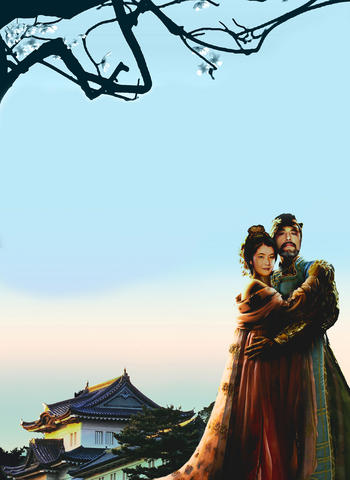
PHOTO: COURTESY OF NTCH
While the basic story has been rendered by many of China's great poets, composer Chen's version has raised a few eyebrows.
Musically, the work is a continuation of Chen's interest in unconventional combinations. The score incorporates Chinese instruments such as the pipa (琵琶), a kind of Chinese lute, and the bamboo flute and references the music that would have been played at the court of the emperor. Chen drew inspiration from her studies of ancient music from the royal courts of China, Japan and Korea. A concert extract in 2002 for Showcasing American Composers won critical acclaim, and was responsible for the work being picked up for full production in Asia.
With this staged production, Chen's ambitions to transverse artistic divides are fully revealed. While this is still an opera in the Western tradition, The Firmiana Rain pushes many boundaries. Its libretto is primarily in Mandarin, but the formal scenes at the court are sung in French and the anger of the barbarian general An Lu-shan, when brought in chains before the emperor, is sung in German. "The Tang court was already a great melting pot," Chen said. "It was quite natural for members of the court to absorb influences from Asia Minor and India. China was already quite an international society. We have simply translated that into more modern terms."
With the involvement of Tang Mei-yun (唐美雲), one of Taiwan's best-known gezai opera singers and Liu Fu-hsueh (劉復學) of the National Gouguang Opera Company (國立國光劇團), the melting pot concept has been carried to an extreme in this current production.
The inclusion of these performers means that The Firmiana Rain is not only innovative in terms of Western opera, it also requires a high level of cooperation and tolerance for the demands of vastly different performance traditions.
In an interview with the Taipei Times, Tang said she had adjusted her regular performance style, most notably having to work to a predefined score. "There is much more physical movement in our style of performance," she said. "In Western opera, they [performers] focus more exclusively on the singing."
"With the traditional actors and actresses, usually they have to improvise a lot," Chen said. "It's really interesting to see performers from different traditions work together. We provide the structure, but they have the liberty to do their own thing."
"They come from totally different oral traditions and have an instinct about what they have to do. Once they get a feel for the music and the rhythm, they just do things very naturally," she added.
In the hectic rehearsals preceding the opening next week, everyone is still learning how best to work together. "It's all about opening up new horizons," said Tang, who is also an innovator in her own field.
To add to the difficulties, the coproduction sees soprano Kimiko Hata and baritone Kouichi Taira perform in the central roles of Xuanzong and Lady Yang, respectively, which required them to learn the libretto phonetically through months of intensive coaching.
Chen Wu-kang (陳武康), the show's choreographer and artistic director of M Dans (驫舞劇場), in an off-the-cuff comment during rehearsals, said that so many artistic boundaries had been crossed, so many conventions overturned, that he felt he could cast off all constraints in choreographing the dances for the show. "I felt that if it could be overturned, then we might as well," he said.
One issue that does stand out above all else is the way The Firmiana Rain sees Asians taking control of a Western operatic tradition.
"We Asians are doing an Asian story. It's not like Europeans are doing an Asian story (such as Turandot or Madame Butterfly). Hopefully this method is more first hand, instead of chinoiserie. ... The music itself has many elements, but it's a total integration and not a collage," Chen said.
Reflecting on his own work in opera, Sugao said: "I think the opera world is looking for a way to go. If you do only Mozart, Puccini, Verdi, you are getting nowhere. ... We need to create new operas such as this. I hope this will be successful in finding a new way for operas."
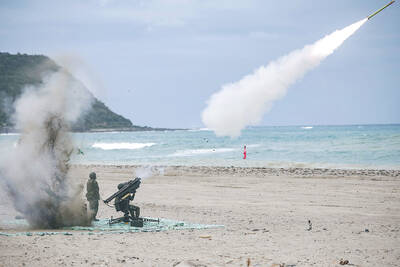
In late October of 1873 the government of Japan decided against sending a military expedition to Korea to force that nation to open trade relations. Across the government supporters of the expedition resigned immediately. The spectacle of revolt by disaffected samurai began to loom over Japanese politics. In January of 1874 disaffected samurai attacked a senior minister in Tokyo. A month later, a group of pro-Korea expedition and anti-foreign elements from Saga prefecture in Kyushu revolted, driven in part by high food prices stemming from poor harvests. Their leader, according to Edward Drea’s classic Japan’s Imperial Army, was a samurai
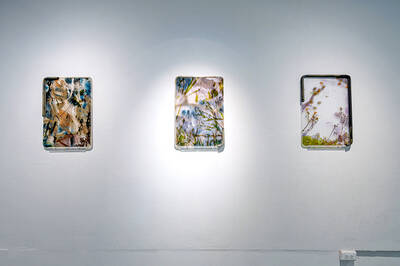
Located down a sideroad in old Wanhua District (萬華區), Waley Art (水谷藝術) has an established reputation for curating some of the more provocative indie art exhibitions in Taipei. And this month is no exception. Beyond the innocuous facade of a shophouse, the full three stories of the gallery space (including the basement) have been taken over by photographs, installation videos and abstract images courtesy of two creatives who hail from the opposite ends of the earth, Taiwan’s Hsu Yi-ting (許懿婷) and Germany’s Benjamin Janzen. “In 2019, I had an art residency in Europe,” Hsu says. “I met Benjamin in the lobby
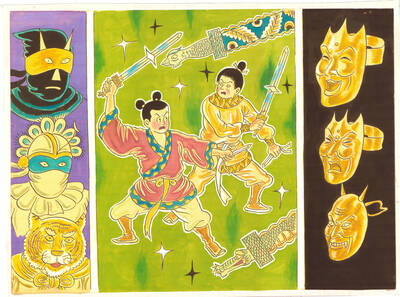
April 22 to April 28 The true identity of the mastermind behind the Demon Gang (魔鬼黨) was undoubtedly on the minds of countless schoolchildren in late 1958. In the days leading up to the big reveal, more than 10,000 guesses were sent to Ta Hwa Publishing Co (大華文化社) for a chance to win prizes. The smash success of the comic series Great Battle Against the Demon Gang (大戰魔鬼黨) came as a surprise to author Yeh Hung-chia (葉宏甲), who had long given up on his dream after being jailed for 10 months in 1947 over political cartoons. Protagonist

A fossil jawbone found by a British girl and her father on a beach in Somerset, England belongs to a gigantic marine reptile dating to 202 million years ago that appears to have been among the largest animals ever on Earth. Researchers said on Wednesday the bone, called a surangular, was from a type of ocean-going reptile called an ichthyosaur. Based on its dimensions compared to the same bone in closely related ichthyosaurs, the researchers estimated that the Triassic Period creature, which they named Ichthyotitan severnensis, was between 22-26 meters long. That would make it perhaps the largest-known marine reptile and would


 RSS
RSS