


With Bobby, Emilio Estevez, writer and director (as well as one of a huge ensemble of actors), sets himself a large and honorable task. It is important to appreciate this in spite of his movie's evident shortcomings.
Intentions do count for something, and Estevez's seem to me entirely admirable. He tries, by means of the familiar technique of weaving together story lines connected only by coincidences of time and place, to produce a feeling of collective life. Beyond that, he tries to link the intimate stories of nearly two dozen characters to a large and consequential public event - the assassination of Robert F. Kennedy - and to capture the heady combination of anxiety, anger, hope and idealism that supposedly characterized the US in 1968.
All of the action in Bobby takes place at the Ambassador Hotel in Los Angeles on June 4, 1968, the day Kennedy, a late entry into the presidential race, won California's Democratic primary. After midnight, as Kennedy made his way from a ballroom through the hotel's kitchen, he was fatally shot, a calamity that casts its shadow backward over the more mundane doings of the day. In every scene of Estevez's film, portent hangs heavy in the air.
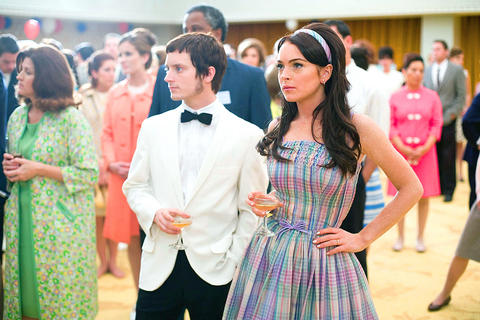
PHOTO: COURTESY OF WARNER BROTHERS
The candidate himself is a tangential figure, present mainly through archival news clips and audio recordings, in which he talks, with a quiet eloquence that sounds almost outlandish to present-day ears, about the problems of poverty, prejudice, pollution and war. His assassin also barely figures in the story. Instead Bobby uses both Kennedy's candidacy and his murder as a kind of prism, through which the aspirations and confusions of a cross section of Americans might be filtered.
Not all their concerns are political. Yes, the Mexican-American kitchen workers (Freddy Rodriguez and Jacob Vargas) argue about social justice with the wise black cook (Laurence Fishburne) and trade scowls with their bigoted boss (Christian Slater). And a young woman (Lindsay Lohan) prepares to marry a young man (Elijah Wood) to keep him out of Vietnam, even though she doesn't know him very well. But at least as much attention is paid to the vague discontent experienced by a middle-aged couple (Martin Sheen and Helen Hunt), to the mutterings of the hotel's retired doorman (Anthony Hopkins), and to the adventures of a pair of young campaign workers (Brian Geraghty and Shia LaBeouf), who skip out on their canvassing duties to drop acid for the first time.
There's much more. There's Demi Moore, playing a boozy chantoozy with the kind of manic gusto you expect from drag performers. (She behaves like a cast member in the Wigstock road-show production of A Woman Under the Influence: The Musical.) Estevez self-effacingly takes the role of her husband, who minds the lap dog and wears an ascot, sure signs of emasculation. Meanwhile the hotel manager (William Macy), married to one of the hairdressers (Sharon Stone), carries on an affair with a young switchboard operator (Heather Graham). A black Kennedy staff member (Nick Cannon) embodies the aspirations of his race.
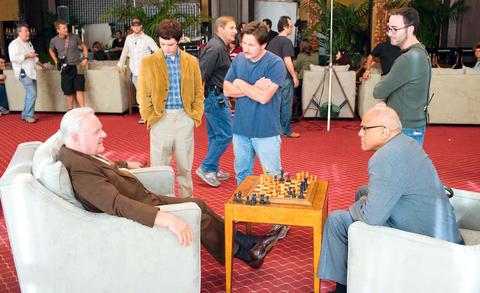
And so on. As if to make sure that we understand this movie's pedigree, Estevez throws in a clumsy reference to Grand Hotel. He also nods vigorously in the direction of Robert Altman, stitching his disparate narrative threads together with floating cameras, long, twisty tracking shots and snappy cuts. These techniques give Bobby a degree of fluidity and momentum, but the multiple story lines coalesce in a manner more reminiscent of The Towering Inferno - or an episode of Fantasy Island - than Nashville. Each story rises toward an epiphany that is quickly overwhelmed by the gunshots in the kitchen.
The actors seem more like very special guest stars than like real, vintage 1968 Americans, and their period-appropriate get-ups - the narrow lapels and skinny ties, the sheath dresses and piled-up hairdos - are more distracting than convincing. Some of the stories feel too obviously melodramatic, while others are vague to the point of inscrutability. In the Vietnam- and drug-related plots, the point is hammered home too hard, while other narratives wind toward no discernible point at all.
Nonetheless the ambition behind Bobby is large and serious. Along with many other Americans who grew up in the wake of the 1960s - for whom figures like the Reverend Martin Luther King Jr. and Kennedy were always more myth than flesh and blood - Estevez, who was six years old when Kennedy was shot, seems preoccupied with understanding what it was like to live through some of that decade's galvanizing events.
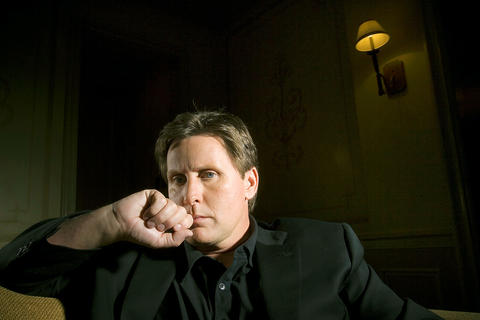
The pulse of history is most audible not in the fictional portions of the movie, but in the moments, especially at the end, when the documentary record takes over. The sound of Kennedy's voice, even as it takes you out of the movie, throws you into a past that seems both terribly remote and uncannily alive. When you hear his patient, meditative speeches, from which every note of demagoguery or pandering has been purged, you glimpse the film Estevez set out to make - the one you may wish you were watching.

Last week Joseph Nye, the well-known China scholar, wrote on the Australian Strategic Policy Institute’s website about how war over Taiwan might be averted. He noted that years ago he was on a team that met with then-president Chen Shui-bian (陳水扁), “whose previous ‘unofficial’ visit to the US had caused a crisis in which China fired missiles into the sea and the US deployed carriers off the coast of Taiwan.” Yes, that’s right, mighty Chen caused that crisis all by himself. Neither the US nor the People’s Republic of China (PRC) exercised any agency. Nye then nostalgically invoked the comical specter
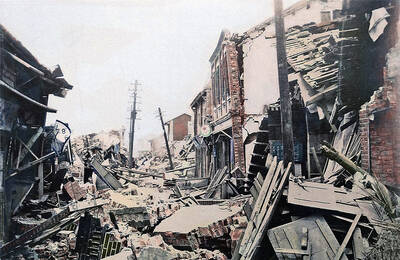
April 15 to April 21 Yang Kui (楊逵) was horrified as he drove past trucks, oxcarts and trolleys loaded with coffins on his way to Tuntzechiao (屯子腳), which he heard had been completely destroyed. The friend he came to check on was safe, but most residents were suffering in the town hit the hardest by the 7.1-magnitude Hsinchu-Taichung Earthquake on April 21, 1935. It remains the deadliest in Taiwan’s recorded history, claiming around 3,300 lives and injuring nearly 12,000. The disaster completely flattened roughly 18,000 houses and damaged countless more. The social activist and

Over the course of former President Ma Ying-jeou’s (馬英九) 11-day trip to China that included a meeting with Chinese Communist Party (CCP) leader Xi Jinping (習近平) a surprising number of people commented that the former president was now “irrelevant.” Upon reflection, it became apparent that these comments were coming from pro-Taiwan, pan-green supporters and they were expressing what they hoped was the case, rather than the reality. Ma’s ideology is so pro-China (read: deep blue) and controversial that many in his own Chinese Nationalist Party (KMT) hope he retires quickly, or at least refrains from speaking on some subjects. Regardless

Approaching her mid-30s, Xiong Yidan reckons that most of her friends are on to their second or even third babies. But Xiong has more than a dozen. There is Lucky, the street dog from Bangkok who jumped into a taxi with her and never left. There is Sophie and Ben, sibling geese, who honk from morning to night. Boop and Pan, both goats, are romantically involved. Dumpling the hedgehog enjoys a belly rub from time to time. The list goes on. Xiong nurtures her brood from her 8,000 square meter farm in Chiang Dao, a mountainous district in northern Thailand’s


 RSS
RSS