


And you thought the premise of The Lovely Bones was tough to take. In Alice Sebold's first novel, a runaway bestseller in 2002, she made her fetching, 14-year-old narrator omniscient in every sense: The girl had been murdered in a corn field by a serial killer, and for the duration of the story got to spy on her family, postmortem, from a pretty good seat in heaven. But the novel's dark center was also what made it bearable. If Sebold began with the unthinkable - the killing of a child - she also created a supple and merciful perspective that outlived the cruelty of its central premise.
As with The Lovely Bones, The Almost Moon delivers its most dramatic news straight out of the gate. "When all is said and done," 49-year-old Helen Knightly tells us in her opening sentence, "killing my mother came easily." So we have a matricidal narrator this time around, a corpse who's almost as much trouble dead as she was alive, and no little-girl promises of a sweetly imagined afterlife - just the torment and regret and stunningly rendered memories of a lifetime of trouble.
Advance notices of The Almost Moon have tended to carry a caveat, suggesting that Sebold's topic is too unrelentingly grim to promise the sort of reception that The Lovely Bones warranted. For my money it's a better novel. It's brilliantly paced, it's brutally honest, and the Gordian knot at its core - an abusive mother and her traumatically attached daughter - is depicted with such generous intelligence that the fineness of the novel more than surpasses its own horror show of circumstance. Sebold has managed to give us a sympathetic protagonist who smothers her mother in the opening pages, and yet the decades that led up to this black moment are delivered without a shred of sentimentality or melodramatic overkill. It's a tightrope walk of character building: Helen is funny, tough, and utterly trustworthy as a narrator; her mother is equal parts demonic and pathetic - she's Livia Soprano, ruining her child's life as she rules over her court of gloom. And worse.

The novel opens on an October morning in the suburbs of Philadelphia, when Helen has stopped by her mother's suffocating house to provide some obligatory care. Clair Knightly is 88, has survived colon cancer, and suffers from a dementia made worse by a lifetime of mental illness. "It's a hard day, Helen," either parent would tell their only child throughout her youth, their code phrase for Clair having slipped the ties of sanity: She might be hiding in the linen closet, or brandishing some new weapon, be it actual or emotional. A lingerie model who had left her career to marry Daniel Knightly, who worked at the water-treatment plant, Clair spent Helen's childhood mooning over old photos of herself, punishing everyone around her for the hideous sorrows of her life; she was agoraphobic, violent, and - maybe worst of all - utterly unpredictable. Until his death (the details of which emerge gradually), the father tried to care for his child and endure his wife, occasionally escaping into his own parallel universe.
But Helen's ending of her mother's life is not so simple as an enough-already mercy killing. If all the rages and needs of a lifetime have led her to this moment, she also has memories of just enough beauty and hope - cruel illusions - to keep her in the ring forever.
When it wasn't a hard day, Helen would sit at her mother's knee with Clair's old fashion portfolio, begging for stories about her glamorous past; she improved on her mother's vanity by becoming a life model for the art department at a local college. Helen married an artist who fell in love with her form; they had two daughters of their own before splitting up years ago. Now Jake is the one Helen calls for help. He's always been a cheerful, easygoing fellow; now he shows up at the crime scene wearing a T-shirt that reads, "Life is good." "If there was a reason for our divorce," Helen reflects, "it was this in a nutshell. On this point, we had always disagreed."
Which should suggest that, along with its terrifying truths and vortex of ambivalence, The Almost Moon can be mordantly funny. A symmetry of madness and coping has defined Helen's life: She grew up in a pretend world with a mother who put empty, prettily wrapped gift boxes under the Christmas tree; until the end, though, she has buffed her mother's calluses and painted her toenails the coral color she likes. But if Helen has finally triumphed over her mother's tyranny, she suffers no illusion that this is the end of the story. The daughter has gone from prisoner to executioner.
The title of The Almost Moon comes from an exchange Helen had with her father when she was just old enough to glimpse her mother's madness. "Mom's different, right?" she asks, with the heartbreaking understatement of a child. His answer is both fitting and kind. "I like to think that your mother is almost whole," he tells her. "So much in life is about almosts, not quites." "Like the moon," she answers, simply and fearlessly, because, madness or no, she knows that a mother has an unassailable position in the sky. The riveting question throughout The Almost Moon is what Helen, having systematically smothered her mother, will do now. But the real dramatic tension of this haunting, searing novel belongs to the past: By the time Helen picks up that pillow for her felonious liberation, most of the crimes have long since been committed.

Last week Joseph Nye, the well-known China scholar, wrote on the Australian Strategic Policy Institute’s website about how war over Taiwan might be averted. He noted that years ago he was on a team that met with then-president Chen Shui-bian (陳水扁), “whose previous ‘unofficial’ visit to the US had caused a crisis in which China fired missiles into the sea and the US deployed carriers off the coast of Taiwan.” Yes, that’s right, mighty Chen caused that crisis all by himself. Neither the US nor the People’s Republic of China (PRC) exercised any agency. Nye then nostalgically invoked the comical specter

Relations between Taiwan and the Czech Republic have flourished in recent years. However, not everyone is pleased about the growing friendship between the two countries. Last month, an incident involving a Chinese diplomat tailing the car of vice president-elect Hsiao Bi-khim (蕭美琴) in Prague, drew public attention to the People’s Republic of China’s (PRC) operations to undermine Taiwan overseas. The trip was not Hsiao’s first visit to the Central European country. It was meant to be low-key, a chance to meet with local academics and politicians, until her police escort noticed a car was tailing her through the Czech capital. The
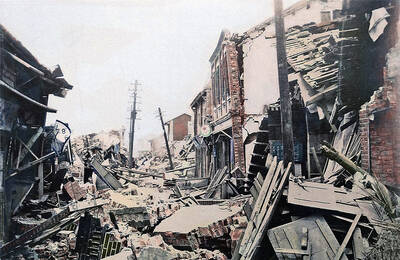
April 15 to April 21 Yang Kui (楊逵) was horrified as he drove past trucks, oxcarts and trolleys loaded with coffins on his way to Tuntzechiao (屯子腳), which he heard had been completely destroyed. The friend he came to check on was safe, but most residents were suffering in the town hit the hardest by the 7.1-magnitude Hsinchu-Taichung Earthquake on April 21, 1935. It remains the deadliest in Taiwan’s recorded history, claiming around 3,300 lives and injuring nearly 12,000. The disaster completely flattened roughly 18,000 houses and damaged countless more. The social activist and

Over the course of former President Ma Ying-jeou’s (馬英九) 11-day trip to China that included a meeting with Chinese Communist Party (CCP) leader Xi Jinping (習近平) a surprising number of people commented that the former president was now “irrelevant.” Upon reflection, it became apparent that these comments were coming from pro-Taiwan, pan-green supporters and they were expressing what they hoped was the case, rather than the reality. Ma’s ideology is so pro-China (read: deep blue) and controversial that many in his own Chinese Nationalist Party (KMT) hope he retires quickly, or at least refrains from speaking on some subjects. Regardless


 RSS
RSS