


Aside from World Cup rugby and Velib, the self-service bike-sharing program that at the moment seems to obsess le tout Paris, the most amusing cultural diversion here is the Giuseppe Arcimboldo exhibition at the Musee du Luxembourg.
Around the city, kiosks advertise fashion magazines offering advice to young women on how to flirt at Velib parking stations (with hair aptly wind-swept, feign difficulty with the automated pay system whenever a desirable man appears), and they also display colorful posters of puffy-cheeked faces made out of corn, pickles, garlic and cherries to promote Arcimboldo, the 16th-century Italian gimmick painter.
I had my doubts. But it turns out that the show's a charmer, not too shallow, admirably concise, almost chic. The glad mobs, forming polite, cheerful scrums before these stately paintings of people with vegetable faces and fish eyes seem to recognize in Arcimboldo something of the French impulse to bring order to everything.
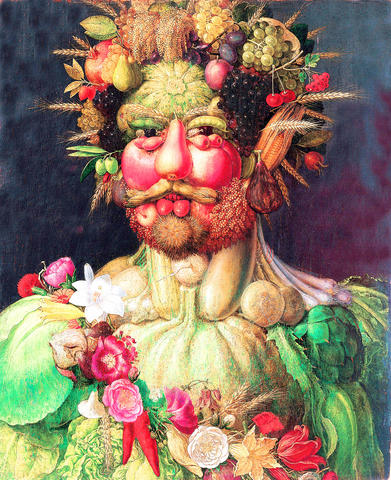
PHOTO: NY TIMES NEWS SERVICE
There is a temptation to find in the show's popularity a metaphor for the general mood here. France's hyperactive president, Nicolas Sarkozy, has embarked on a campaign of economic transition and tough love. He is pushing a new French globalism in lieu of the comfortable old welfare system that has guaranteed early retirement and many other benefits, along with high unemployment, especially among disenfranchised immigrants, to whom he has done conspicuously little to endear himself.
Arcimboldo's subject was the instability of life, its changeability in a widening world. His purpose was to inspire a fresh but not always entirely comforting sense of possibility and wonderment. Mercantile conquests by 16th-century European powers, France included, uncovered new continents, from which an ear of corn, exotic and rare, could serve not just as a visual pun for a human ear but also as a political symbol of faraway places, economies, peoples - of nature itself - brought to heel.
That said, I would hazard that the general horde of visitors, a good percentage of whom seem to be strapped into strollers and under 1m tall, don't dwell on metaphorical meanings. They wait in a long line that every day snakes out the front door of the museum into the Luxembourg Gardens, where parents dragoon reluctant children from the ancient carousel and pony rides out of the autumn sunshine toward the show, girded by the assuring sight of happy families exiting it.
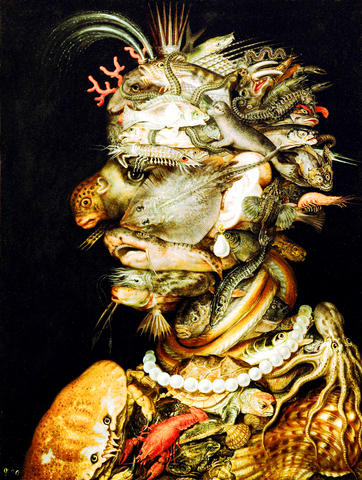
PHOTO: NY TIMES NEWS SERVICE
Mr. Fruit Face, as a friend of mine disdainfully calls him, has always been a guaranteed hit with the Transformers-age crowd. But his art is more serious and self-important than that. You can imagine him to have been the sort of initially jocular, learned dinner party companion whose arrogance makes itself known by the salad course. That he inspired thousands of appalling 20th-century Surrealists, apparently shocked at the genius of conceiving a gherkin to replace a nose, or a rose a cheek, isn't his fault.
Born in Milan in 1536, the son of a local artist, he started out painting conventional, darkling portraits. They're brittle but deft. He paid obeisance to Leonardo da Vinci via intermediaries like Bernardino Luini, who is said to have been a family friend. Commissions for stained glass and tapestries, permitting minor flights of peculiar fancy, eventually landed him in the employ of Maximilian II, in Vienna, then of Maximilian's cultivated son, Rudolf II.
There, he finally cooked up his famous faces. They satisfied a taste for exoticism. This was the era of high humanist curiosity. Newly rediscovered ancient texts like Pliny's Natural History circulated among scholars and artists; in the show, Archimbold's watercolors of animals and fish, exacting models he adapted for parts of faces, show him to be firmly grounded in science and real observation. Global exploration and advances in fields like optics and engineering stirred Rudolf, like other enlightened patrons, to wish to possess whatever was the rarest, the finest, the strangest, the most inexplicable art and artifacts. From such cabinets of curiosities - attempts to catalog and rationalize the irrational - evolved, one day, the modern museum. This was Arcimboldo's milieu and motivation.
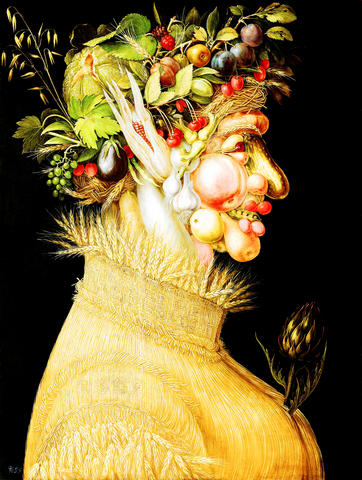
PHOTO: NY TIMES NEWS SERVICE
Usefully, the show includes more than a few works by sculptors and decorators who also catered to a fixation on the marvelous. Coconuts, conch shells, ostrich eggs and coral, gathered from the distant corners of the earth, become goblets, bowls and hilts for swords, three-dimensional versions of his painted faces. They're about art's roots in mysticism and magic. Painting itself is a sleight-of-hand trick, after all: colored dirt becomes an illusion.
Along which lines Arcimboldo clearly picked up pointers from Bosch and no doubt from Persian miniaturists. A gorgeous show of classic Iranian art happens to have just opened at the Louvre, and it includes several astonishing paintings from Arcimboldo's time: fantastical landscapes populated by wild creatures. Stare at the mountain scenes, and faces can begin to suggest themselves in the salt-taffy rock formations and trees.
All artists have their niches, and this commonplace slip of the mind became for Arcimboldo a virtual cottage industry. A bust of a bearded librarian, with a tin-man face made of books, and bookmarks for fingers, is a clever feat of virtuosity, like the reversible pictures he painted: right side up, they're still lifes; upside down, portraits.
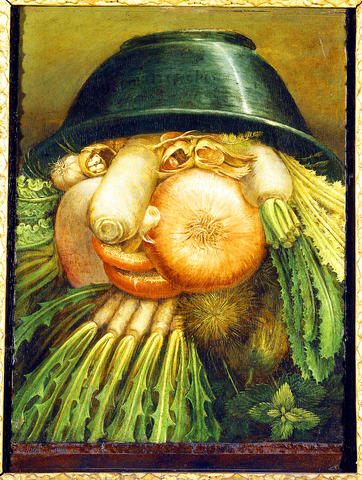
PHOTO: NY TIMES NEWS SERVICE
More interestingly, he also painted a three-quarter view of an old man, who, grossly desiccated, is memorably perverse by being somehow still dignified, almost courtly, in his dotage with branch stumps for stubble. Or there is the portrait of a German jurist, the humanist Johann Ulrich Zasius, with a plucked chicken for a head, a fish's mouth and a fish-tail chin. It's scary in ways that can almost remind you of Velazquez's portrait of Pope Innocent X, troubling the mind like a half-remembered nightmare.
So too are a quartet of stiff, plain-spoken little portraits of the family of Pedro Gonzalez. Their distinction was to grow hair all over their faces like the Wolf Man, an accident of nature akin to the Virgin Mary's portrait appearing in a grilled-cheese sandwich.
The universe concocts such marvels, which man emulates through art and industry in hopes to best it. That was Arcimboldo's bottom-line goal. His ambition, so frank and intellectual, gives to his prankish, often grotesque work its stylish hauteur.
Come to think of it, no wonder the French love him.

In late October of 1873 the government of Japan decided against sending a military expedition to Korea to force that nation to open trade relations. Across the government supporters of the expedition resigned immediately. The spectacle of revolt by disaffected samurai began to loom over Japanese politics. In January of 1874 disaffected samurai attacked a senior minister in Tokyo. A month later, a group of pro-Korea expedition and anti-foreign elements from Saga prefecture in Kyushu revolted, driven in part by high food prices stemming from poor harvests. Their leader, according to Edward Drea’s classic Japan’s Imperial Army, was a samurai

The following three paragraphs are just some of what the local Chinese-language press is reporting on breathlessly and following every twist and turn with the eagerness of a soap opera fan. For many English-language readers, it probably comes across as incomprehensibly opaque, so bear with me briefly dear reader: To the surprise of many, former pop singer and Democratic Progressive Party (DPP) ex-lawmaker Yu Tien (余天) of the Taiwan Normal Country Promotion Association (TNCPA) at the last minute dropped out of the running for committee chair of the DPP’s New Taipei City chapter, paving the way for DPP legislator Su
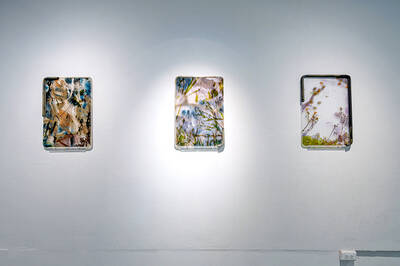
Located down a sideroad in old Wanhua District (萬華區), Waley Art (水谷藝術) has an established reputation for curating some of the more provocative indie art exhibitions in Taipei. And this month is no exception. Beyond the innocuous facade of a shophouse, the full three stories of the gallery space (including the basement) have been taken over by photographs, installation videos and abstract images courtesy of two creatives who hail from the opposite ends of the earth, Taiwan’s Hsu Yi-ting (許懿婷) and Germany’s Benjamin Janzen. “In 2019, I had an art residency in Europe,” Hsu says. “I met Benjamin in the lobby
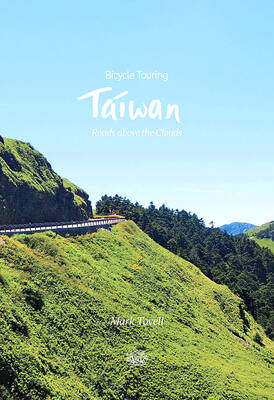
It’s hard to know where to begin with Mark Tovell’s Taiwan: Roads Above the Clouds. Having published a travelogue myself, as well as having contributed to several guidebooks, at first glance Tovell’s book appears to inhabit a middle ground — the kind of hard-to-sell nowheresville publishers detest. Leaf through the pages and you’ll find them suffuse with the purple prose best associated with travel literature: “When the sun is low on a warm, clear morning, and with the heat already rising, we stand at the riverside bike path leading south from Sanxia’s old cobble streets.” Hardly the stuff of your


 RSS
RSS