


It's been almost three decades since Philip Roth published The Ghost Writer, the first of his many novels chronicling the adventures of his best-known alter ego, Nathan Zuckerman. In that book Nathan was a starry-eyed young writer, eager to worship at the altar of high art and convinced that he had found a role model in the reclusive writer Lonoff, who led a quiet existence in the Berkshires, Massachusetts, far from the distractions of the city and far from the literary hubbub.
"Purity. Serenity. Simplicity. Seclusion," young Nathan thinks. "All one's concentration and flamboyance and originality reserved for the grueling, exalted, transcendent calling. I looked around and I thought, 'This is how I will live.'"
In subsequent Zuckerman novels, we learned that Nathan went on to achieve a very un-Lonoff-like fame with a scandalous best seller (not unlike Roth's own Portnoy's Complaint) that cut him off from his family and his past, and forced him to grapple with the unreckoned consequences of his art. We also learned that after a series of tumultuous, passive-aggressive relationships with various women and an assortment of medical and psychological woes, Nathan had finally come to replicate Lonoff's reclusive existence. For over a decade now, he has lived alone in a small house on a dirt road in the Berkshires, seeing few people and hearing little news. His days are spent turning sentences around; his nights are spent reading the great masterworks of literature he discovered as a student many decades ago.
"I don't want a story any longer," Nathan declared in Roth's 1998 novel, I Married a Communist. "I've had my story."
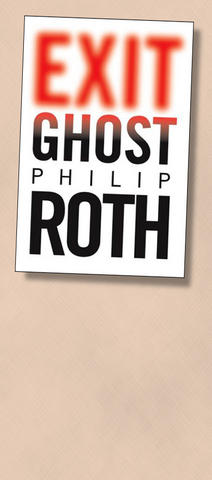
Now, in Roth's elegiac new novel, Exit Ghost - a kind of valedictory bookend to The Ghost Writer - Nathan returns to New York to visit a doctor, and finds himself being tempted, against his better judgment, back into the maelstrom of life. He agrees to swap homes for a year with two young writers, Jamie and her husband, Billy, who live in a small Upper West Side apartment. And he finds himself suddenly smitten with Jamie and hoping, against all odds, that this vibrant, 30-year-old, happily married woman will leave her husband for him - a famously self-absorbed 71-year-old writer, who, after prostate surgery, is both impotent and incontinent.
He also re-encounters Amy Bellette, Lonoff's former mistress, only to discover that the beautiful young woman he glimpsed in The Ghost Writer is now an invalid recovering from brain surgery.
From these bare bones of a plot, Roth has created a melancholy, if occasionally funny, meditation on aging, mortality, loneliness and the losses that come with the passage of time - very much the same themes he examined in his sketchy 2006 novel, Everyman, and his equally slight 2001 novel, The Dying Animal.
Compared with Roth's big postwar trilogy (American Pastoral, I Married a Communist and The Human Stain), which unfolded into a bold chronicle of American innocence and disillusionment, this volume is definitely a modest undertaking, but it has a sense of heartfelt emotion lacking in Everyman and Dying Animal, and for fans of the Zuckerman books, it provides a poignant coda to Nathan's story, putting a punctuation point to his journey from youthful idealism and passion through midlife confusion and angst toward elderly renunciation.
Although Nathan thinks he's embraced the ascetic life - "by paring and paring and paring away," he says, "I found in my solitude a species of freedom that was to my liking much of the time" - he's been living in a monkish bubble that's cut him off from ordinary human commerce and connection. He often goes days at a time without speaking to anyone, save his housekeeper or caretaker. He doesn't watch movies or television, doesn't own a cell phone, a VCR, a DVD player or a computer. He continues "to live in the Age of the Typewriter," claiming he doesn't know what the World Wide Web is and no longer bothers to vote.
"I had banished my country," he says, "been myself banished from erotic contact with women, and was lost through battle fatigue to the world of love."
Attracted to Jamie and shocked at what has happened to Amy Bellette in the years since he last saw her, Nathan finds himself grappling with feelings he'd thought he'd stifled many years ago and experiencing "the bitter helplessness of a taunted old man dying to be whole again." The two women's stories converge in the person of Richard Kliman, Jamie's former boyfriend, who now happens to be working on a biography of E.I. Lonoff that Amy wants to prevent.
Kliman is another one of those annoying and importunate characters - like Alvin Pepler in Zuckerman Unbound and Moishe Pipik in Operation Shylock - who pester Roth's heroes, and Nathan regards him as everything he detests: an unworthy rival for Jamie's affections and an ambitious literary parasite out to topple Lonoff from his pedestal (by revealing an incestuous affair this great writer purportedly had when he was young).
Kliman also represents youth to Nathan's decrepitude: While Kliman is one of the "not-yets" with "no idea how quickly things turn out another way," Nathan belongs to the group of "no-longers," "losing faculties, losing control, shamefully dispossessed from themselves, marked by deprivation and experiencing the organic rebellion staged by the body against the elderly."
It's unclear just how much of Kliman's agenda is imagined by Nathan, who after all once endowed Amy Bellette with the legendary biography of Anne Frank, and who's begun turning all his conversations with Jamie into an imaginary dialogue between an imaginary "He" and "She" - a dialogue that "was an aid to nothing, alleviated nothing, achieved nothing" and yet "seemed terribly necessary to write."
This, of course, is Nathan's habit - continually to complicate his life on paper, while continually complaining about readers who would confuse fact and fiction, life and art.
As usual, Nathan, like his creator, anticipates the reader's question: "But isn't one's pain quotient shocking enough without fictional amplification, without giving things an intensity that is ephemeral in life and sometimes even unseen?"
His answer: "Not for some. For some very, very few that amplification, evolving uncertainly out of nothing, constitutes their only assurance, and the unlived, the surmise, fully drawn in print on paper, is the life whose meaning comes to matter most."

In late October of 1873 the government of Japan decided against sending a military expedition to Korea to force that nation to open trade relations. Across the government supporters of the expedition resigned immediately. The spectacle of revolt by disaffected samurai began to loom over Japanese politics. In January of 1874 disaffected samurai attacked a senior minister in Tokyo. A month later, a group of pro-Korea expedition and anti-foreign elements from Saga prefecture in Kyushu revolted, driven in part by high food prices stemming from poor harvests. Their leader, according to Edward Drea’s classic Japan’s Imperial Army, was a samurai

Located down a sideroad in old Wanhua District (萬華區), Waley Art (水谷藝術) has an established reputation for curating some of the more provocative indie art exhibitions in Taipei. And this month is no exception. Beyond the innocuous facade of a shophouse, the full three stories of the gallery space (including the basement) have been taken over by photographs, installation videos and abstract images courtesy of two creatives who hail from the opposite ends of the earth, Taiwan’s Hsu Yi-ting (許懿婷) and Germany’s Benjamin Janzen. “In 2019, I had an art residency in Europe,” Hsu says. “I met Benjamin in the lobby
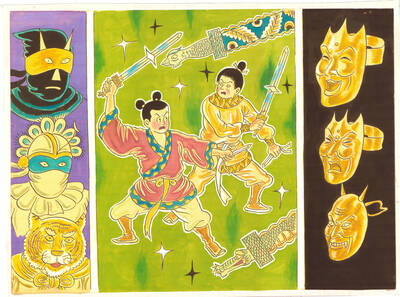
April 22 to April 28 The true identity of the mastermind behind the Demon Gang (魔鬼黨) was undoubtedly on the minds of countless schoolchildren in late 1958. In the days leading up to the big reveal, more than 10,000 guesses were sent to Ta Hwa Publishing Co (大華文化社) for a chance to win prizes. The smash success of the comic series Great Battle Against the Demon Gang (大戰魔鬼黨) came as a surprise to author Yeh Hung-chia (葉宏甲), who had long given up on his dream after being jailed for 10 months in 1947 over political cartoons. Protagonist

Peter Brighton was amazed when he found the giant jackfruit. He had been watching it grow on his farm in far north Queensland, and when it came time to pick it from the tree, it was so heavy it needed two people to do the job. “I was surprised when we cut it off and felt how heavy it was,” he says. “I grabbed it and my wife cut it — couldn’t do it by myself, it took two of us.” Weighing in at 45 kilograms, it is the heaviest jackfruit that Brighton has ever grown on his tropical fruit farm, located


 RSS
RSS