


Oh yes, he's dignified. Morgan Freeman seems long, slender, impossibly serpentine - and anything but 70 - as he uncurls himself from the sofa where he's giving interviews. Dressed in elegant tailored slacks and matching black shirt, he rises to his full height, which is considerable, and greets me warmly with a strong handshake and a "How ya doin'?" Even the most banal conversational gambit sounds like mood music when purred in that warm and smoky baritone.
I feel as if I'm meeting the Pope. The mind races for a moment or two. Morgan Freeman! God! President Deep Impact! John Milton! Clint's Mate! Called his Oscar "a doorstop"! But as Freeman invites me to sit, patting the sofa next to him with that down-home courtliness redolent of the deep south, the mist fades and he's a terrestrial being again.
The face is in close-up now, as it so often is in his movies, though in person Freeman seems much younger. Through films as diverse as The Shawshank Redemption, Glory, Amistad and Seven, the world's great cameramen have traversed this subtly shifting, always compelling facial landscape. Viewers of Freeman's work may feel they know every last mole and freckle around his watery, dolorous eyes. The camera and the microphone like to get in close with Freeman, to savor that voice and ponder that face, which can bear close-ups of merciless duration. Intimacy is one of his greatest strengths, central to the trustworthiness, authority and dignity that we often associate with his name. And it works pretty well for interviews, too.
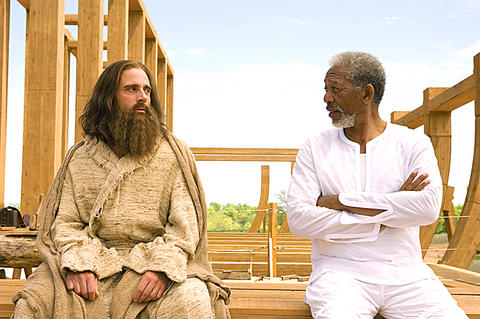
Freeman wants to discuss Feast of Love, an ensemble drama directed by Robert Benton about the impact of love, the loss of love, divorce, adultery and grief on a group of interconnected characters revolving around Freeman's college professor. At first, the structure feels a little unwieldy - eight people falling in and out of love with one another with a regularity and rhythm that suggests a highly intricate minuet of changing partners and positions - but the result is surprisingly satisfying and emotionally affecting.
There were ladies sniffling by the elevator after the screening, I tell him. A couple of fellas, too. "Oh, yeah," he smiles, evidently pleased to hear it. "It works its magic on you in the end, doesn't it?"
Freeman was lured by the chance to work with Greg Kinnear, who has a history of playing interesting weak men but makes each one compellingly different and who here seems doomed haplessly to alienate or lose every woman who matters to him.
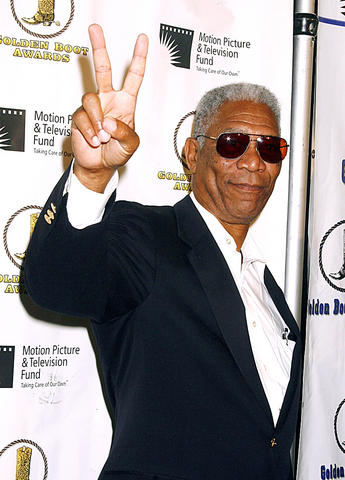
"The thing about Greg is that, yes, he gives great 'wimp,' but he always brings his own intelligence to each part. His husband and father in Little Miss Sunshine has one or two things in common with Bradley in Feast of Love, but the performances he gives are all very different, very subtly different."
He also liked the idea of playing half of an enduring marriage, something he says isn't often seen on screen, and even then rarely done right. He's always been an admirer of his onscreen wife in Feast of Love, Jane Alexander, whom he remembers from back in 1970, when she played the white wife of 1920s black boxer Jack Johnson in The Great White Hope. "Matter of fact, the role she played that really sticks in my mind is an old TV movie she made, when she played Calamity Jane, and not in a Betty Hutton kind of way either - but rough, masculine, a lot like the way that character was done in Deadwood."
He laughs suddenly at his own mention of the proudly foul-mouthed HBO western drama. His laughter is surprisingly boyish and light, and he curls up like a cat. For a moment he's a million miles from Robert Benson's assessment of him - "You cannot act moral fiber, or a certain kind of stature - you either have it or you don't. He truly has that quality."
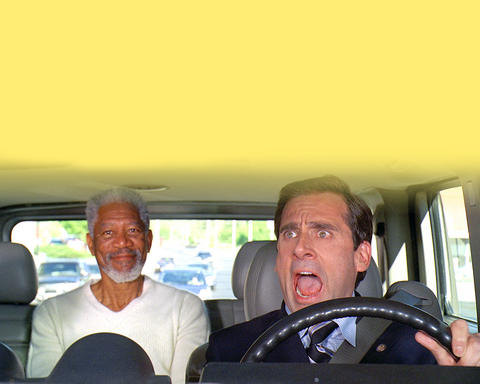
PHOTOS: AGENCIES
"I do often seem to be drawn to witness characters," Freeman says of Harry, who watches the parade pass by before him. "I guess they always have the last say, as it were. But this is completely different from any other film I've done. The whole thing is about love, and as Harry, I'm right in the middle of it all."
Freeman was famously a late bloomer, making his first major impact in 1987, when he was almost 50, playing a vicious, manipulative pimp opposite Christopher Reeve in Street Smart, a role that netted him a supporting actor Oscar nomination. At the same time, he was appearing off-Broadway in Driving Miss Daisy, and getting rave reviews.
When the play was filmed two years later, he was nominated once again, this time for best actor, and his career as a ready-made, out-of-nowhere middle-aged character player was sealed. He hasn't looked back since, despite taking, as he says, "a lot of shit" for playing a loyal black servant in the days of Jim Crow. "It never was shit that I acknowledged. From people who had certain expectations and this attitude about Uncle Tom and all that, which is a reaction you expect from people who have no idea what they're talking about." (He doesn't mention Spike Lee, though Lee, then a young firebrand with one movie under his belt, scored a lot of points by attacking Driving Miss Daisy.)
The son of a barber and a cleaner, Freeman was born in Memphis and, besides stints in Chicago and Gary, Indiana, he mainly grew up south of Memphis, in the heart of old plantation country around Greenwood, Mississippi, an area near where Muddy Waters hailed from, and which sent most of its population north along Highway 51 as industrialized cotton-harvesting took hold.
"I grew up in this little 2,600-soul town in north-east Mississippi and there are a lot of things about the south, however bad it undoubtedly was, and as much as you can say that's negative about it, that I remember quite fondly. I find myself more fortunate having been raised there than in say, Chicago. The south side of Chicago" - the huge ghetto where he later lived for a while - "was like a bottleneck causing this utter negativity of the spirit. You had to belong to some sort of street gang, if only for self-preservation because you had to run that gamut of gangs and ethnic neighborhoods all the way to school, block by block. And then all the way back. But if you had no money, the south was a much better place to be, and I was very poor growing up, really poor.
"Yeah, well, that world is truly gone now." He pauses, grips the bridge of his nose with thumb and forefinger, and mutters, "Oh, wait a minute, Jesus Christ, how could I say that?" He grimaces, acknowledging that some things will always seem ineradicable down south.
He says he knew in his bones that he was going to act, finding his initial inspiration in the Saturday matinee serials starring the singing cowboys he loved. He won a statewide drama contest at 12, and did a radio play in Nashville when he was in high school. Was he a born performer? "Yes, it just seemed, it always seemed, the most natural thing in the world. I was born for it, somehow. I know I was, and I knew early on. At the movies when I was a kid, I always was looking at the screen and thinking, 'Oh, I can do that.'"
Surprisingly, he turned down acting scholarships when he graduated from high school, and in 1954 joined the air force, an institution that had only recently been desegregated. "I had a partial scholarship to two places, but I had a great need to get out of where I was and see more of the world, which outweighed everything else for me then. I was very much in transition."
After five years in the service, he spent the 1960s trying to learn his trade, doing stints with acting and dance troupes in Los Angeles and San Francisco before settling in New York, working on stage and snagging the occasional small movie part. Of the blaxploitation boom that drew black actors to Hollywood in droves in the early 1970s, he says: "For me there was nothing attractive or interesting or rewarding about blaxploitation, so I stayed in New York." By the mid-70s, he was an established stage actor, drawing good notices in The Taming of the Shrew and Coriolanus, until he retired from the stage when his movie career took off.
After Street Smart and Driving Miss Daisy, Freeman found himself heavily in demand before settling into a sort of "Bad-Back Pack" of older actors who are never out of work, many of whom have been his co-stars: Gene Hackman (his Unforgiven nemesis), Jack Nicholson (soon to be seen with Freeman in The Bucket Club, about two old farts who escape the terminal ward and do everything they never had the guts to do before they kick the titular pail), Clint Eastwood (who may soon direct Freeman for the third time, as Nelson Mandela) and Anthony Hopkins (a fellow adherent of the "just act, dear boy" school of performance). Though he probably works a little too often for his own good, one can hardly blame him for trying to make up for his long early career in the wilderness. Plus, he gets all the plum roles anyway.
You've played God and the US president, I tell him. Do you feel guilty about taking food from the mouth of Sean Connery? "Oh, no," he laughs, "Up here it's every man for himself! But yes, I played the president in Deep Impact. You feel like the press accepts without question, but one interviewer asked me, 'What's it like to play a black president?' And I said, what on earth do you mean - it's like playing the president! I think that's the difference between me and a lot of other actors. I just don't think so much in those terms."

Last week Joseph Nye, the well-known China scholar, wrote on the Australian Strategic Policy Institute’s website about how war over Taiwan might be averted. He noted that years ago he was on a team that met with then-president Chen Shui-bian (陳水扁), “whose previous ‘unofficial’ visit to the US had caused a crisis in which China fired missiles into the sea and the US deployed carriers off the coast of Taiwan.” Yes, that’s right, mighty Chen caused that crisis all by himself. Neither the US nor the People’s Republic of China (PRC) exercised any agency. Nye then nostalgically invoked the comical specter
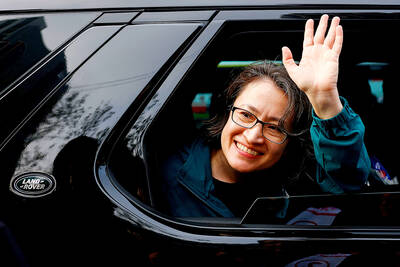
Relations between Taiwan and the Czech Republic have flourished in recent years. However, not everyone is pleased about the growing friendship between the two countries. Last month, an incident involving a Chinese diplomat tailing the car of vice president-elect Hsiao Bi-khim (蕭美琴) in Prague, drew public attention to the People’s Republic of China’s (PRC) operations to undermine Taiwan overseas. The trip was not Hsiao’s first visit to the Central European country. It was meant to be low-key, a chance to meet with local academics and politicians, until her police escort noticed a car was tailing her through the Czech capital. The
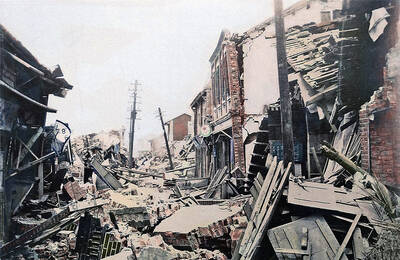
April 15 to April 21 Yang Kui (楊逵) was horrified as he drove past trucks, oxcarts and trolleys loaded with coffins on his way to Tuntzechiao (屯子腳), which he heard had been completely destroyed. The friend he came to check on was safe, but most residents were suffering in the town hit the hardest by the 7.1-magnitude Hsinchu-Taichung Earthquake on April 21, 1935. It remains the deadliest in Taiwan’s recorded history, claiming around 3,300 lives and injuring nearly 12,000. The disaster completely flattened roughly 18,000 houses and damaged countless more. The social activist and

Over the course of former President Ma Ying-jeou’s (馬英九) 11-day trip to China that included a meeting with Chinese Communist Party (CCP) leader Xi Jinping (習近平) a surprising number of people commented that the former president was now “irrelevant.” Upon reflection, it became apparent that these comments were coming from pro-Taiwan, pan-green supporters and they were expressing what they hoped was the case, rather than the reality. Ma’s ideology is so pro-China (read: deep blue) and controversial that many in his own Chinese Nationalist Party (KMT) hope he retires quickly, or at least refrains from speaking on some subjects. Regardless


 RSS
RSS