


The ocean crashed hypnotically as the Venus of Hana yoga gently gave her commands. "Let the sun rise over the crater," she said, her arm arching into an ethereal halo over her head. She read a poem by Mary Oliver, sang awhile and instructed us to extend our buttocks toward Hana. We closed our eyes, dimly aware of the wind rustling through banana leaves.
Then our yogi, Erin Lindbergh, summed up how it feels to spend a slow Sunday morning on the edge of the earth in a tropical nirvana where all of nature seems to be on Viagra. "There is a bowl of flowers in your heart," she said.
Nearly 40 years ago, her grandfather - Charles Lindbergh - became one of a multitude of seekers to be smitten by Hana, on the east coast of Maui. He is buried in a swamp mahogany coffin at the Hoomau Congregational Church in Kipahulu, not far from his granddaughter's yoga studio, his now-mossy grave rimmed by beach rock. Like the manic hordes who form a human chain in rented Mustangs and PT Cruisers on the Hana Highway, fleeing chain-hotel sterility on the "other side" of Maui, the legendary pilgrim of the skies was restlessly searching for serenity, a sacred sense of apartness.
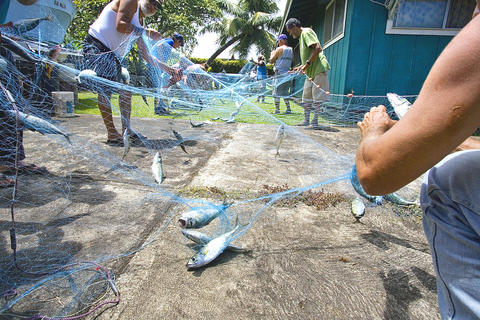
PHOTO: NY TIMES NEWS SERVICE
To his granddaughter, who recently moved from Montana, and bears an uncanny resemblance to her grandmother Anne Lindbergh, this remote fleck of paradise some 84km, 617 hairpin curves and 56 one-lane bridges away from the nearest city possesses mana, "a life energy," an unseen spiritual force.
"Hana appeals to the calmer side of one's being," Sunni Kaikala Hueu, a Hana native, has written. "Some say that Hana is almost medicinal in nature - a quiet vibration that is felt."
The vibes can be profound, all right. Where else but in Hana - its fabled highway the approximate width of a suburban driveway - is it possible to encounter traffic jams beside hidden waterfalls as tourists pose for "Coming of Age in Samoa" shots with cellphones? Where perma-culturally inclined off-the gridders live in New Age treehouses and make bike-powered smoothies, while across the street in a community kitchen, a tiny 80-something kapuna in pink pedal-pushers peels boiled taro the old-fashioned way: with an opihi, or limpet, shell.
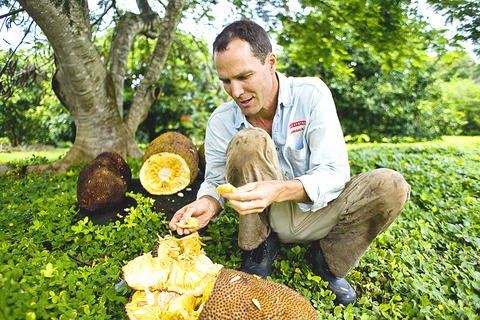
PHOTO: NY TIMES NEWS SERVICE
In these jungled thickets, hot enough to make lipstick melt, the escapist Garden of Eden fantasies of to-do haole, as rich Caucasians are called, converge and occasionally collide with native truths. The seductive mix of aloha and pristine beauty - the happy product of Hana's geographic isolation - has long drawn moneyed sophisticates, from Samuel Pryor, a Pan Am vice president, who shares his eternal rest with his crony Lindbergh as well as his pet gibbons, whom he dressed as children, to more recent emigres like Woody Harrelson, Kris Kristofferson and George Harrison. Most recently there is Oprah the Divine, who has bought some 40 hectares of Hana coastline, including a venerated cinder cone said to contain the bones of the volcano goddess Pele.
For some 750,000 visitors a year, Hana is a way station en route to the Seven Sacred Pools - a series of pools and waterfalls of Tarzan-like perfection that, thanks to sheer numbers, have sadly become the Jersey Shore of Hana. The day-trippers may avoid Hana Highway robbery (US$16-a-kilogram coffee), but on an island more commonly associated with strip malls, golf and swimming pools with fake shipwrecks for the kiddies, they may also miss Hana's essence: a fragile oasis of Hawaiian culture not unlike trees that miraculously survive the onslaught of burning lava.
Down the road from the Hotel Hana-Maui, a US$475-plus-a-night watering hole stretching languorously to the sea, a man named Blondie, who was anything but, was sitting in a thatched hut scanning the ocean for nervous ripples. He is a kilo ia, an ace fish spotter. The hut is the akule hale, the fisherman's meeting house, a hangout with a pebbled dirt floor and a calendar mounted with a clothespin. It is a lair for men who have gone holo holo (a waggish term for fishing).
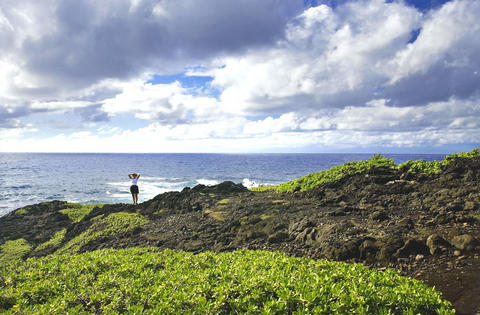
PHOTO: NY TIMES NEWS SERVICE
They were awaiting the arrival of scad mackerel, signaling the start of the modern hukilau, an enterprise involving cellphone communiques, Polaroid sunglasses and power and paddle boats scaring fish into nets. When the akule come in, all of Hana partakes.
The fish are but an excuse to "talk story," fortified this day by numerous pre-breakfast beers and fish sizzling in a huge skillet. Burt Freeland, the local undertaker, spoke of a phone call he had just received from the police about an address: "They asked the auntie for her house number and she said, 'I don't know.' She never knew she had one."
Not knowing one's own address struck me as very Hana. Stay awhile and the local intelligence comes fast and furious: The ocean is "our icebox." The taro plant is a divine ancestor. Never turn your back on the ocean. Flash floods can kill even on sunny days.
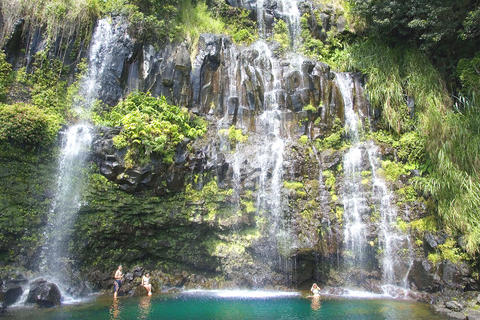
PHOTO: NY TIMES NEWS SERVICE
"A jeep full of haole washed down the mountain on a solid wall of water and floated 5km downstream," Freeland said. "If clouds are on the mountain, don't stay in the ravine."
Those who live there know that what Hana giveth, Hana can take away.
"Hana is not for the faint of heart," Arabella Ark, a voluble ex-Californian ceramicist and my bed-and-breakfast proprietor, would explain later. "It either absorbs you or spits you out."
I had pulled into Ark's driveway on a late May evening, dodging myna birds, the pigeons of the Hana Highway. All around was ripeness. The house, once the home of the doctor who treated Lindbergh, effervesced with Tahitian gardenias and ti leaves with magenta berries resembling 1940s costume jewelry. It felt as if I were entering a corsage.
My first day, I met an heiress who owns a waterfall and lives in a Samoan-style oceanfront villa. We zoomed around in a Kawasaki off-road vehicle, braking by her orchid greenhouse. In her living room, chickens improbably skittered around Sam Maloof furniture (one laid an egg).
She spoke eloquently of the coast's bloody history, of centuries-old battles between Big Island and Maui chiefs for control of its natural riches. "Hana is a vortex," she explained, before jetting off to New York for an art opening.
Indeed, history casts a long shadow in Hana. It was there, according to legend, that the demi-god Maui fished up the Hawaiian islands from the ocean with a magic fishhook, lifting the heavens high above the earth so that humans could walk upright.
At a school assembly held under a shower tree, first graders with yellow hibiscus behind their ears sang of the aina, the land, and a fifth-grader with silken hair danced the hula in a white dress. Native families like Fawn Kukanakala-Helekaahi-Burns', one of the parents there, still make a pilgrimage on foot to Haleakala crater when a baby is born to bury the piko, or umbilical cord, beneath a life-sustaining rock or tree. Land is kin: the native language does not have a word for private property, but dozens for rain.
It was around Day 1.5 that I began to develop the living-in-Hana fantasy. At dawn, I opened the louvered glass shutters of Ark's guest cottage, her Carmen Miranda foliage redolent from evening rain. From the lawn, the Big Island rose mirage-like in the distance, the ocean the color of a pearl.
I jogged along the empty Hana Highway, dodging fragrant, fermenting mangoes that would thud Chicken Little-like in my path. There were ancient rock walls, mossy one-lane bridges with construction dates chiseled in old calligraphy. One day, I saw a street sweeper clean up what passes for garbage - breadfruit leaves.
Erin Lindbergh has come to understand her grandfather's connection to this place, though she was only 12 when he died in 1974.
"People here are so present," she said yogically. "There is no artifice. So they allow you to be who you are."
She shared this wisdom as we bushwhacked through cane grass in the jungle, the serrated edges like razors on my sunburned legs. We were climbing to a spring-fed pool and waterfall high in the mountains, accompanied by her dog and my husband, Roger, who had flown in briefly for our 20th wedding anniversary. The air was dense with humidity; soon, it began to rain. She was a sweatless, smudgeless still life in white linen. Thorns only added to her luster.
At last the enchanted pool loomed, a vision by Henri Rousseau. She disrobed, plunging in taut down-dog near-nothingness into the water, more perfect even than linen. Roger stood transfixed. I began channeling Nora Ephron.
People come to Hana to reinvent themselves. Anne Lindbergh understood this well: she christened her home Argonauta, a reference to a mother who leaves her shell to start a new life.
Ark moved to Hawaii 35 years ago with her first husband after living in Paris. Her neighbor on Oahu was Marvin Nogelmeier, "a hippie jeweler from Minnesota." He is now Puakea Nogelmeier, a celebrated authority on Hawaiian language and culture.

Last week Joseph Nye, the well-known China scholar, wrote on the Australian Strategic Policy Institute’s website about how war over Taiwan might be averted. He noted that years ago he was on a team that met with then-president Chen Shui-bian (陳水扁), “whose previous ‘unofficial’ visit to the US had caused a crisis in which China fired missiles into the sea and the US deployed carriers off the coast of Taiwan.” Yes, that’s right, mighty Chen caused that crisis all by himself. Neither the US nor the People’s Republic of China (PRC) exercised any agency. Nye then nostalgically invoked the comical specter
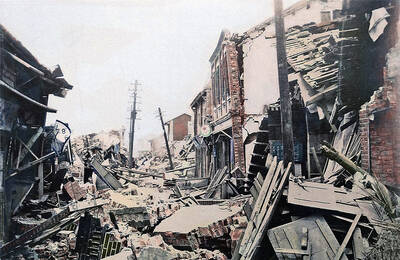
April 15 to April 21 Yang Kui (楊逵) was horrified as he drove past trucks, oxcarts and trolleys loaded with coffins on his way to Tuntzechiao (屯子腳), which he heard had been completely destroyed. The friend he came to check on was safe, but most residents were suffering in the town hit the hardest by the 7.1-magnitude Hsinchu-Taichung Earthquake on April 21, 1935. It remains the deadliest in Taiwan’s recorded history, claiming around 3,300 lives and injuring nearly 12,000. The disaster completely flattened roughly 18,000 houses and damaged countless more. The social activist and

Over the course of former President Ma Ying-jeou’s (馬英九) 11-day trip to China that included a meeting with Chinese Communist Party (CCP) leader Xi Jinping (習近平) a surprising number of people commented that the former president was now “irrelevant.” Upon reflection, it became apparent that these comments were coming from pro-Taiwan, pan-green supporters and they were expressing what they hoped was the case, rather than the reality. Ma’s ideology is so pro-China (read: deep blue) and controversial that many in his own Chinese Nationalist Party (KMT) hope he retires quickly, or at least refrains from speaking on some subjects. Regardless

Approaching her mid-30s, Xiong Yidan reckons that most of her friends are on to their second or even third babies. But Xiong has more than a dozen. There is Lucky, the street dog from Bangkok who jumped into a taxi with her and never left. There is Sophie and Ben, sibling geese, who honk from morning to night. Boop and Pan, both goats, are romantically involved. Dumpling the hedgehog enjoys a belly rub from time to time. The list goes on. Xiong nurtures her brood from her 8,000 square meter farm in Chiang Dao, a mountainous district in northern Thailand’s


 RSS
RSS