


To appreciate the silken agility with which Ann Patchett constructs her fiction, consider the way the opening sequence in her new novel, Run, invokes the Virgin Mary. On the book's first page Patchett reveals that one of her story's central characters, Bernadette Doyle, died two weeks earlier. Now Bernadette's sisters have arrived to grapple with a family tradition.
A statue of the Virgin, adorned in blue robe and halo, portable enough to be placed on a bedroom dresser, has been passed down from generation to generation in this family. It has an unusual history. The Italian sculptor who created it used the delicate beauty of Bernadette's great-grandmother as part of his inspiration. Through the generations there has been an enduring resemblance between the iconic, red-haired image and the family's real women.
Tradition dictates that the statue be handed down to a worthy relative. But Bernadette spoiled the pattern. She had no daughters, only sons. The oldest, Sullivan, has the statue's hair color but none of its virtue, as he is the family ne'er-do-well. The younger two boys look even less like the statue, because they are black. But Bernard Doyle, Bernadette's husband, overrules his sisters-in-law by insisting that his younger sons are entitled to the precious family artifact, appearances notwithstanding.

One thing that makes this political maneuvering so intriguing is that it is political. (Bernard Doyle is a former mayor of Boston, well-schooled in the art of bending others to his will.) Another is the lovely ease with which Patchett shifts her characters through time.
In the first few pages of Run, without apparent effort, she glides through time. She glimpses Bernadette as a bride, telling her husband the history of the statue, and then Bernadette as a mother who eagerly adopts two more sons when Sullivan is 12. A visit to the pediatrician, who notices a lump on Bernadette's neck, swirls the chapter back to its starting point. She is gone, survived by one holy statue and a household full of men, as united by nurture as they are different in nature.
No stranger could glance at the Doyles and figure out what they have to do with one another. This author specializes in delving beneath the surface of such incongruity. As she did in the beautiful Bel Canto, Patchett once again thrives on juxtaposing wildly different characters and creating volatile chemistry among them. (Nothing so exotic is liable to happen in the workaday fiction of Ann Packer, with whom Ann Patchett should not be confused.) At the same time she creates an entirely credible set of dynamics for the Doyle family.
Then, long after Bernadette's death, the Doyle men are quite literally shaken by a new arrival. In the midst of a Massachusetts snowstorm, a Chevy Tahoe plows into Tip, the more scholarly and cold-blooded of the adopted brothers. He might have been killed without the intervention of a black woman, an apparent stranger named Tennessee Moser, who shoves him out of harm's way and is then badly hurt herself.
The woman is hospitalized, and that leaves her 11-year-old daughter, Kenya, with nowhere to go. When the Doyles take charge of the girl, they begin to suspect that Kenya was secretly part of their family all along.
In place of the shock and sibling rivalries that might be expected in such a story, Patchett provides room for contemplation. She dispenses with her material's least interesting prospects by making the Doyles deeply devoted to one another in ways that make racial divisions meaningless, and by making Kenya, Tip and Tip's genetic brother, Teddy, exemplary and accomplished people. Although Bernard Doyle was accused of political opportunism at the time he adopted Tip and Teddy, he has proven to be the most devoted of fathers, despite the usual pangs of fatherly frustration.
As their names indicate, Tip and Teddy were raised to be Massachusetts politicians and fulfill their father's dreams. But Tip is an aloof Harvard ichthyologist, "the kind of kid who could hang from your neck and still maintain a critical distance," and he is impatient with the family ambitions. Teddy contemplates becoming a priest like his 88-year-old Uncle Sullivan, who is said to be a miraculous healer.
The other Sullivan, Tip and Teddy's older brother, is the son who destroyed his father's career. He has spent years lying low in Africa but reappears suddenly on the night of the accident to somehow, uncannily, become the Doyle who understands Kenya and her mother best.
Run, with a title that suggests many things (including Kenya's athletic prowess and Doyle's political drive), and with a watery looking cover that reflects the whole book's aura of a human aquarium, becomes an elegant melange of family ties. Patchett gives her readers much to contemplate when genetics, privilege, opportunity and nurture come into play. And to her credit she is neither vague nor reductive about any of these things; she creates a genuinely rich landscape of human possibility. If she does not wildly exploit the drama of colliding fates on a snowy night and subsequent life-or-death medical crisis, there are plenty of other writers who tell such stories.
Run is muted only insofar as its characters are all so accomplished, their natures so decent and their barbs so civilized. It's as if the story's racial nuances, which are rendered almost nonexistent, are still present enough to preclude any rough edges.
Patchett showed no such restraint in Bel Canto, a more astonishing book and a less inhibited one. But Run still shimmers with its author's rarefied eloquence, and with the deep resonance of her insights. When Kenya arrives at the Doyle home, a place she has looked at with longing all her life, and is given one of the boys' white T-shirts to sleep in, Patchett invokes the image of a ship's sail. That's an exquisitely simple image of how much Kenya's life has changed overnight.

Last week Joseph Nye, the well-known China scholar, wrote on the Australian Strategic Policy Institute’s website about how war over Taiwan might be averted. He noted that years ago he was on a team that met with then-president Chen Shui-bian (陳水扁), “whose previous ‘unofficial’ visit to the US had caused a crisis in which China fired missiles into the sea and the US deployed carriers off the coast of Taiwan.” Yes, that’s right, mighty Chen caused that crisis all by himself. Neither the US nor the People’s Republic of China (PRC) exercised any agency. Nye then nostalgically invoked the comical specter
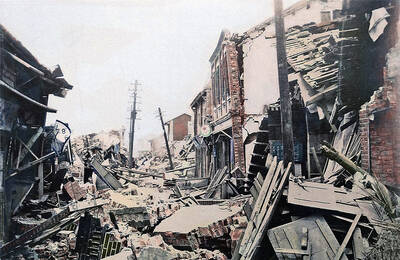
April 15 to April 21 Yang Kui (楊逵) was horrified as he drove past trucks, oxcarts and trolleys loaded with coffins on his way to Tuntzechiao (屯子腳), which he heard had been completely destroyed. The friend he came to check on was safe, but most residents were suffering in the town hit the hardest by the 7.1-magnitude Hsinchu-Taichung Earthquake on April 21, 1935. It remains the deadliest in Taiwan’s recorded history, claiming around 3,300 lives and injuring nearly 12,000. The disaster completely flattened roughly 18,000 houses and damaged countless more. The social activist and

Over the course of former President Ma Ying-jeou’s (馬英九) 11-day trip to China that included a meeting with Chinese Communist Party (CCP) leader Xi Jinping (習近平) a surprising number of people commented that the former president was now “irrelevant.” Upon reflection, it became apparent that these comments were coming from pro-Taiwan, pan-green supporters and they were expressing what they hoped was the case, rather than the reality. Ma’s ideology is so pro-China (read: deep blue) and controversial that many in his own Chinese Nationalist Party (KMT) hope he retires quickly, or at least refrains from speaking on some subjects. Regardless

Approaching her mid-30s, Xiong Yidan reckons that most of her friends are on to their second or even third babies. But Xiong has more than a dozen. There is Lucky, the street dog from Bangkok who jumped into a taxi with her and never left. There is Sophie and Ben, sibling geese, who honk from morning to night. Boop and Pan, both goats, are romantically involved. Dumpling the hedgehog enjoys a belly rub from time to time. The list goes on. Xiong nurtures her brood from her 8,000 square meter farm in Chiang Dao, a mountainous district in northern Thailand’s


 RSS
RSS