


A small town in Somerset, England, Glastonbury is a mythical site wrapped in mythologies and legends of Joseph of Arimathea, the Holy Grail, King Arthur and the birth of Christianity in the British Isles. In 1970, a local farmer named Michael Eavis started a small hippie gathering and a different kind of pilgrimage was formed, taking die-hard music fans and hedonists to what is now one of the world's largest and best-known music festivals. It takes place one weekend of June nearly every year.
In 2002, Julien Temple (director of the Sex Pistol Documentaries, The Great Rock 'n' Roll Swindle and The Filth and the Fury) began working on Glastonbury by issuing a plea for amateur videos taken by punters at the festivals. Nine hundred-odd hours of footage poured in: a mind-boggling range of material spanning four decades. It was whittled down to a 128-minute long documentary chronicling the inspiring and sometimes turbulent history of the Glastonbury Festival.
A mosaic combining bits and pieces of home movies and video shots, BBC coverage of legendary performances and newer footage shot by Temple's crew from 2002 to 2005, the epic film offers plenty of iconic performances featuring the likes of Bjork, David Bowie, Nick Cave and the Bad Seeds , the EMO Orchestra, Coldplay, Morrissey, Babyshambles, Levellers, Radiohead, Faithless, the Chemical Brothers, Orbital, Pulp, Primal Scream and Velvet Underground to name just a few. Yet the film's true stars are the ordinary festival-goers: travelers, revelers, entertainers and intoxicated lads and lasses who constitute the authentic Glastonbury experience.

PHOTO: COURTESY OF TA LAI FILM
In this movie, one can watch the Mutoid Waste Company recreate Stonehenge with cars, naked hippies frolicking in the grass, children shambling around in a maze of yurts and the toilets no one dares to come near. A fire-juggler sets himself on fire. An old-time hippie spouts wise words and a confused man asks, "Is that music out there or in my head?" The amateur footage captures the chaos, euphoria and the real essence of the massive event. The film's apparent haphazardness suits the fantastic chaos of the festival well by presenting a continuum of experiences that have occurred at the muddy Worthy Farm.
Eavis himself is featured prominently in the film. There is footage of him from the very first event, his battles against the local council, his commentary on the turbulent days of the 1980s when travelers took refuge at the festival and his view on the growing commercialization of the festival. The festival's liberal political heritage is also derived from the flower power era.
Disparate images of the festival further reveal the uneasy relationship between Eavis and the peace convoy, the traveling army of bus-dwelling, authority-defying hippie-punks whose settlement at the site of the festival led to violence and rioting in 1990. The presence of police patrols and the sound of gunshots lay bare the uncomfortable side of the festival that has evolved to become the present-day event attended by 150,000 people.

PHOTO: COURTESY OF TA LAI FILM
Monolithic security fences are erected, cash machines are installed and happy consumers quaff down bottles of vodka in the Smirnoff bar. The film makes an honest portrait of the festival changing with time, becoming part of the nation's culture and history in the making. And the best part is, it's a wonderfully done piece that takes the audience straight to the festival, no matter where they are or whether they have ever been to it.
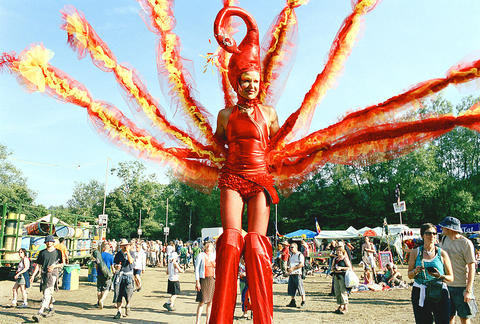
PHOTO: COURTESY OF TA LAI FILM

In late October of 1873 the government of Japan decided against sending a military expedition to Korea to force that nation to open trade relations. Across the government supporters of the expedition resigned immediately. The spectacle of revolt by disaffected samurai began to loom over Japanese politics. In January of 1874 disaffected samurai attacked a senior minister in Tokyo. A month later, a group of pro-Korea expedition and anti-foreign elements from Saga prefecture in Kyushu revolted, driven in part by high food prices stemming from poor harvests. Their leader, according to Edward Drea’s classic Japan’s Imperial Army, was a samurai

Located down a sideroad in old Wanhua District (萬華區), Waley Art (水谷藝術) has an established reputation for curating some of the more provocative indie art exhibitions in Taipei. And this month is no exception. Beyond the innocuous facade of a shophouse, the full three stories of the gallery space (including the basement) have been taken over by photographs, installation videos and abstract images courtesy of two creatives who hail from the opposite ends of the earth, Taiwan’s Hsu Yi-ting (許懿婷) and Germany’s Benjamin Janzen. “In 2019, I had an art residency in Europe,” Hsu says. “I met Benjamin in the lobby
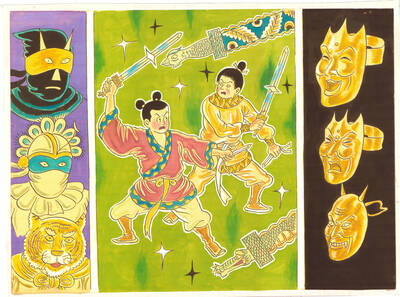
April 22 to April 28 The true identity of the mastermind behind the Demon Gang (魔鬼黨) was undoubtedly on the minds of countless schoolchildren in late 1958. In the days leading up to the big reveal, more than 10,000 guesses were sent to Ta Hwa Publishing Co (大華文化社) for a chance to win prizes. The smash success of the comic series Great Battle Against the Demon Gang (大戰魔鬼黨) came as a surprise to author Yeh Hung-chia (葉宏甲), who had long given up on his dream after being jailed for 10 months in 1947 over political cartoons. Protagonist

A fossil jawbone found by a British girl and her father on a beach in Somerset, England belongs to a gigantic marine reptile dating to 202 million years ago that appears to have been among the largest animals ever on Earth. Researchers said on Wednesday the bone, called a surangular, was from a type of ocean-going reptile called an ichthyosaur. Based on its dimensions compared to the same bone in closely related ichthyosaurs, the researchers estimated that the Triassic Period creature, which they named Ichthyotitan severnensis, was between 22-26 meters long. That would make it perhaps the largest-known marine reptile and would


 RSS
RSS