


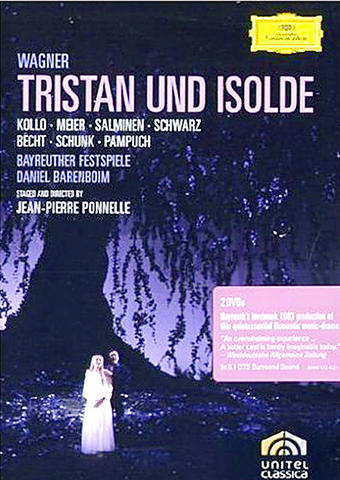
Wagner's Tristan und Isolde has long lacked a first-class DVD version. The Metropolitan Opera's offering with Ben Heppner and Jane Eaglen and an abstract staging by Dieter Dorn [reviewed Taipei Times Feb. 1, 2004] pleased few, and the old 1973 set with John Vickers and Birgit Nilsson apparently has poor image and sound quality. The strongest rendering up to now was probably from the National Theater Munich, with Waltraud Meier as Isolde and directed (in highly original fashion) by Peter Konwitschny. But a famous Bayreuth version directed by Jean-Pierre Ponnelle dating from 1983 has just appeared on DVD from Deutsche Grammophon. So, how do these two seeming front-runners compare?
Ponnelle's Tristan opens wonderfully with a gray sea covered by drifting mist, and this continues for most of the Prelude. This focuses the imagination on the mythic nature of the subject matter and stills distracting thoughts in preparation for the long haul ahead. But it's Act Three that's most impressive, with Tristan, Kurwenal and the Shepherd looking like World War I soldiers stranded, unshaven and delirious, in no man's land. The last half hour is treated as a fantasy in the mind of the fevered hero. This, in other words, is a largely traditional Tristan, but with dream-like elements added.
Rene Kollo makes a predictably fine Tristan, and Matti Salminen is, as you'd expect, overwhelming as King Marke. Hermann Becht and Hanna Schwarz are excellent as Kurwenal and Brangane respectively. Johanna Meier (Isolde), someone who never managed to become internationally famous, is persuasive enough, though the Liebestod proves beyond her. Daniel Barenboim conducts the Bayreuth Festival Orchestra with appropriate intensity.
The Munich Tristan is very different. In the first act, in place of gloom and foreboding we have light. It's set on board a luxury liner, complete with sun-chairs and cocktails, and the chorus of sailors looks mockingly in on the drugged lovers through a porthole. Act Two is more conventional - until, that is, Tristan lugs on a cheap yellow sofa for the couple to sit and sing on (they're supposed to be in the middle of a forest). Act Three starts with Tristan watching a slide-show, followed by some really zany stage inventions when Marke and Brangane arrive.
I don't usually like these tradition-challenging productions, but this one proved an exception. I put this down to the enormous persuasiveness of Waltraud Meier as an erotic, indeed sex-crazed, Isolde. The reason this works is that she's one of the world's most effective dramatic sopranos as well. Jon Frederick West is a highly masculine Tristan - not in her league vocally, perhaps, but powerful enough through headphones on a DVD. Kurt Moll is very moving as Marke, and Marjana Lipovsek is also strong as Brangane. Zubin Mehta conducts the Bayerische Staatsorchester with notable discernment, and the sound quality is very fine, with orchestral detail easily heard throughout.
The choice, then, depends on your priorities. On balance I'd opt for the Ponnelle/ Barenboim version, though the Isolde on the Konwitschny/ Mehta DVD is undoubtedly superior, and I'd like to have their Act One to watch when I felt in need of some visual stimulation.

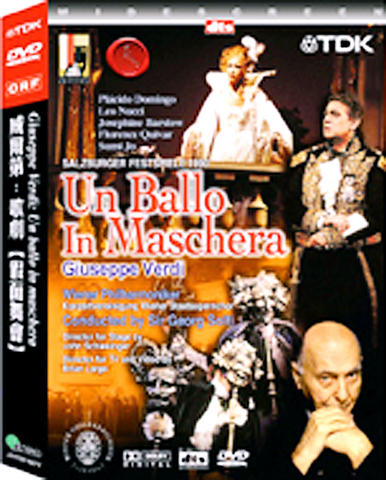
T aiwan's Jingo has come up trumps with an absolutely superb rendering of Verdi's Un Ballo in Maschera (A Masked Ball) in a vivid production from the 1990 Salzburg Festival by UK film director John Schlesinger (Midnight Cowboy). It stars Placido Domingo, Leo Nucci, Josephine Barstow and Florence Quivar, with the South Korean soprano Sumi Jo as Oscar. Schlesinger created the production the previous year under Karajan, but following Karajan's death Gorg Solti took over for its first revival, seen here. (Commenting on the premier, Schlesinger remarked that the festival audience could barely raise their hands to applaud for the weight of the jewelry).
On this DVD, Solti urges the Vienna Philharmonic into a searing account of Verdi's dramatic score, and I've rarely heard instrumental color as richly reproduced. Verdi's natural grandeur is matched by the grandeur of the sets and costumes, and with the work's original Swedish setting restored, this Ballo is magnificent on all fronts.
All the soloists were then at their peak, including Josephine Barstow, whose powerful acting matches her devastating singing. The central scenes, from the arrival of Amelia in the graveyard to the drawing of lots as to who should kill Gustavo, are incomparably fine, with passionate commitment all round. Domingo manages Gustavo's death (from two ear-splitting pistol shots) superbly, and it's also wonderfully filmed. Opera doesn't come much more impressive than this.
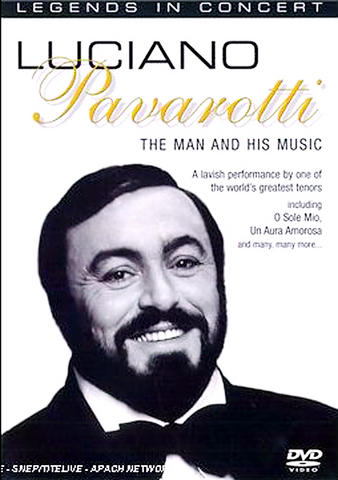
F ollowing the death of Pavarotti, Well Go USA in Taiwan is promoting a DVD of a concert he gave at the Grand Teatro del Liceo in Barcelona in 1988. The program is nearly identical to the one he performed the same year at New York's Metropolitan Opera, with James Levine at the keyboard [Decca DVD 074 307-1 2HD].
Well Go's DVD contains an interview with Pavarotti and it's impressive to hear him speaking in fluent Spanish. But it isn't only affection for Levine that makes me prefer the New York concert to this one. The former has far and away the more inspirational feel, and Levine's self-effacing piano playing is nothing less than exquisite.
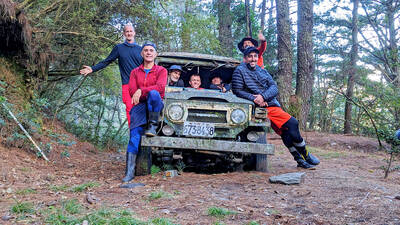
The year was 1991. A Toyota Land Cruiser set out on a 67km journey up the Junda Forest Road (郡大林道) toward an old loggers’ camp, at which point the hikers inside would get out and begin their ascent of Jade Mountain (玉山). Little did they know, they would be the last group of hikers to ever enjoy this shortcut into the mountains. An approaching typhoon soon wiped out the road behind them, trapping the vehicle on the mountain and forever changing the approach to Jade Mountain. THE CONTEMPORARY ROUTE Nowadays, the approach to Jade Mountain from the north side takes an

Last week Joseph Nye, the well-known China scholar, wrote on the Australian Strategic Policy Institute’s website about how war over Taiwan might be averted. He noted that years ago he was on a team that met with then-president Chen Shui-bian (陳水扁), “whose previous ‘unofficial’ visit to the US had caused a crisis in which China fired missiles into the sea and the US deployed carriers off the coast of Taiwan.” Yes, that’s right, mighty Chen caused that crisis all by himself. Neither the US nor the People’s Republic of China (PRC) exercised any agency. Nye then nostalgically invoked the comical specter

Relations between Taiwan and the Czech Republic have flourished in recent years. However, not everyone is pleased about the growing friendship between the two countries. Last month, an incident involving a Chinese diplomat tailing the car of vice president-elect Hsiao Bi-khim (蕭美琴) in Prague, drew public attention to the People’s Republic of China’s (PRC) operations to undermine Taiwan overseas. The trip was not Hsiao’s first visit to the Central European country. It was meant to be low-key, a chance to meet with local academics and politicians, until her police escort noticed a car was tailing her through the Czech capital. The
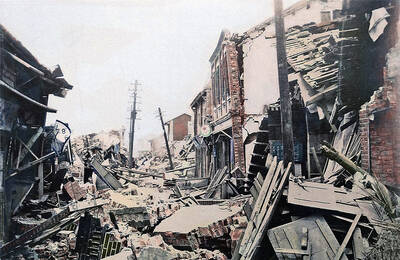
April 15 to April 21 Yang Kui (楊逵) was horrified as he drove past trucks, oxcarts and trolleys loaded with coffins on his way to Tuntzechiao (屯子腳), which he heard had been completely destroyed. The friend he came to check on was safe, but most residents were suffering in the town hit the hardest by the 7.1-magnitude Hsinchu-Taichung Earthquake on April 21, 1935. It remains the deadliest in Taiwan’s recorded history, claiming around 3,300 lives and injuring nearly 12,000. The disaster completely flattened roughly 18,000 houses and damaged countless more. The social activist and


 RSS
RSS