


The signs say "School Is Open, Drive Safely." Of course, one should always drive safely, school or no school, and not only "when children are present," as speed limit signs near schools often state. If only these signs reflected what health and safety experts hope will become a major change in how children get to and from school and after-school activities.
Forty years ago, half of all students walked or bicycled to school. Today, fewer than 15 percent travel on their own steam. One-quarter take buses, and about 60 percent are transported in private automobiles, usually driven by a parent or, sometimes, a teenager.
The change was primarily motivated by parents' safety concerns - a desire to protect their children from traffic hazards and predators. But it has had several unfortunate consequences. Children's lives have become far more sedentary. They are fatter than ever and at greater risk of developing hypertension, diabetes and heart disease at young ages.
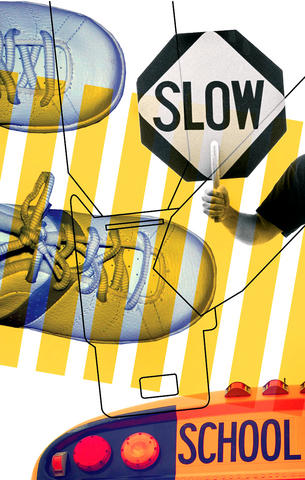
ILLUSTRATION: NY TIMES NEWS SERVICE
The sedentary life also affects their behavior and the ability to learn. Studies have shown that children who engage in moderate to vigorous physical activity show improvement in concentration, memory, learning, creativity and problem solving, as well as mood, for up to two hours after exercise.
With more children being driven to school, traffic congestion has mushroomed. That has increased stress to drivers and risks to pedestrians and cyclists, as well as air pollution, especially in and around schools. Parents who drive their children to school make up about a quarter of morning commuters. More traffic also means more vehicular accidents, endangering the lives of children and the adults who drive them. It has become a vicious cycle that must be broken, and soon.
Safely moving children to and from school and after-school activities is a matter of great concern, not only to parents, but also to the American Academy of Pediatrics, which in July issued a policy statement on school transportation safety.
SCHOOL BUSES VS. CARS
The academy's statistics on injuries and fatalities suggest that being driven to school in a passenger vehicle is by far the most dangerous way to get there, and riding in a school bus is the safest. Seventy-five percent of the fatalities and 84 percent of the injuries occur in passenger vehicles, but just 2 percent of student deaths and 4 percent of injuries result from travel by school bus.
The numbers might not tell a complete story. The academy's Committee on Injury, Violence and Poison Prevention and the Council on School Health pointed out that "school bus crash data are incomplete, and that injuries cannot be reliably estimated.
"The first emergency-department-based study of non-fatal school-bus-related injuries found that the number of injuries, 17,000 annually to children 0 to 19 years of age, greatly exceeded previously published estimates."
When the Minneapolis highway bridge collapsed this summer and a school bus filled with children plunged toward the Mississippi River, witnesses described children "flying" around in the bus. There are just two ways that could have occurred. Either the bus was not equipped with safety restraints or the children, all of whom escaped safely, were not buckled in.
Before child-restraint systems and safety belts came along, large school buses relied on "compartmentalization" to protect their occupants. This meant closely spaced seats with high energy-absorbing backs, which we now know to be inadequate, especially in rollovers and side impacts with other large vehicles. As of this summer, Florida, Louisiana, New Jersey and New York, as well as many local school districts, had passed laws requiring seat belts in school buses. California requires them in newly made buses.
Children should be secured in age-appropriate restraints in all motor vehicles. On a school bus, someone other than the driver should be responsible for assuring this.
There are potential side benefits, too: better student behavior, a more consistent seat belt habit among children and fewer distractions for the driver.
The academy urged that all school buses built before 1977 be retired from use "because they are deficient in several significant safety standards." Old buses also spew undue emissions of pollution that children inhale, increasing respiratory symptoms and hospitalization for asthma.
Cities and communities throughout the country are trying to encourage more children to walk or bike to school. The only way this can occur is if children can travel there safely. That means more sidewalks and clearly marked bike lanes or paths separated from roadways, lower traffic speed on school routes, safer crosswalks, well-trained crossing guards at all corners near schools and adult supervision.
SAFER ROUTES
Also helpful are traffic-calming measures - changes in the design of streets and intersections to slow traffic automatically to acceptable speeds. In 2005, Congress allocated US$612 million over five years to help communities create such safer routes to school.
Seattle has reported a 77 percent to 91 percent reduction in traffic accidents after installing a citywide traffic-calming program that included 700 new residential traffic circles. Just last week, Governor Eliot Spitzer announced that New York would spend US$32 million in federal money on a Safe Routes to School initiative that includes transportation and public education projects across the state. More information on traffic calming is available from the Local Government Commission at www.lgc.org/clc.
Oct. 3 is the date of national Walk to School Day this year, promoted by the Partnership for a Walkable America (www.walktoschool-usa.org). Children who fail to learn how to walk safely face greater risks whenever they are pedestrians. They have to learn when it is safe to cross and how to judge the speed of oncoming traffic. They must be taught to look both ways for traffic, even on one-way streets. Vehicles do sometimes make mistakes, and bikes can come from any direction.
Parents, who are notoriously pressed for time to exercise, can benefit, too, if they walk or bike with their children to school. Just as parents have managed to organize car pools and play groups, they can organize groups of children who walk or cycle to school accompanied by a different adult each day or week. A walking version of the car pool, the Walking School Bus, has been successful in Canada and England. Parents share the responsibility of escorting children to and from school on foot or bike.
For guidance on setting up a Walking School Bus, a guidebook is available from the Centers for Disease Control and Prevention. Check the Web site, www.cdc.gov/nccdphp/dnpa/kidswalk.htm. No need to wait for Walk to School Day. Start today to promote better health and safety for all schoolchildren.

In late October of 1873 the government of Japan decided against sending a military expedition to Korea to force that nation to open trade relations. Across the government supporters of the expedition resigned immediately. The spectacle of revolt by disaffected samurai began to loom over Japanese politics. In January of 1874 disaffected samurai attacked a senior minister in Tokyo. A month later, a group of pro-Korea expedition and anti-foreign elements from Saga prefecture in Kyushu revolted, driven in part by high food prices stemming from poor harvests. Their leader, according to Edward Drea’s classic Japan’s Imperial Army, was a samurai

Approaching her mid-30s, Xiong Yidan reckons that most of her friends are on to their second or even third babies. But Xiong has more than a dozen. There is Lucky, the street dog from Bangkok who jumped into a taxi with her and never left. There is Sophie and Ben, sibling geese, who honk from morning to night. Boop and Pan, both goats, are romantically involved. Dumpling the hedgehog enjoys a belly rub from time to time. The list goes on. Xiong nurtures her brood from her 8,000 square meter farm in Chiang Dao, a mountainous district in northern Thailand’s

Located down a sideroad in old Wanhua District (萬華區), Waley Art (水谷藝術) has an established reputation for curating some of the more provocative indie art exhibitions in Taipei. And this month is no exception. Beyond the innocuous facade of a shophouse, the full three stories of the gallery space (including the basement) have been taken over by photographs, installation videos and abstract images courtesy of two creatives who hail from the opposite ends of the earth, Taiwan’s Hsu Yi-ting (許懿婷) and Germany’s Benjamin Janzen. “In 2019, I had an art residency in Europe,” Hsu says. “I met Benjamin in the lobby

April 22 to April 28 The true identity of the mastermind behind the Demon Gang (魔鬼黨) was undoubtedly on the minds of countless schoolchildren in late 1958. In the days leading up to the big reveal, more than 10,000 guesses were sent to Ta Hwa Publishing Co (大華文化社) for a chance to win prizes. The smash success of the comic series Great Battle Against the Demon Gang (大戰魔鬼黨) came as a surprise to author Yeh Hung-chia (葉宏甲), who had long given up on his dream after being jailed for 10 months in 1947 over political cartoons. Protagonist


 RSS
RSS