


It isn't memory that is the issue. It is commemoration. Memory, at least right now, is readily summoned. Commemoration is something else altogether.
The new exhibition at the New York Historical Society, for example, is not a commemoration. Here Is New York: Remembering Sept. 11, which opened yesterday, is exclusively about memory, which doesn't diminish its power. In two galleries 1,500 inkjet-printed photos taken six years ago during those apocalyptic days are mounted with simple stationery clips. They are reminders of hidden pressure points and buried sensations.
These images will jump-start the memories of any New Yorker who smelled the white dust, saw the drifting burned scraps of paper, who ran through the streets or watched in shock, who lost loved ones or still bears searing physical or mental scars.
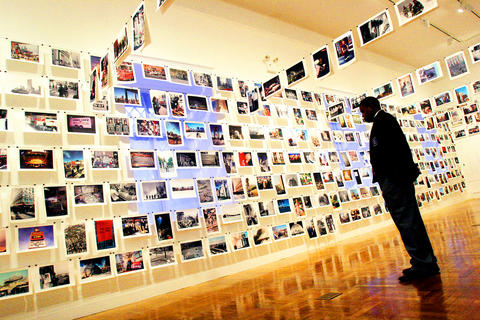
PHOTO: NY TIMES NEWS SERVICE
You have to turn your head and strain deliberately, to take in all these images: They are mounted in seven rows on each wall and hung on four cables strung across each gallery. They are not organized by theme, chronology or photographer. Their impact is almost a form of bombardment, a staccato accumulation of sensation, quantity as much as intensity, making a mark.
The photos, without credits, titles or dates, from 790 contributors, range from the amateur to the professional, from the clearly posed composition to the frenzied snap of a moment in which hysteria had to be kept at bay. This was probably the most photographed series of days in history. Was there anyone with a camera who did not try to capture some moment, staring in disbelief, anger or sorrow?
So the images now gather into familiar categories: the stark moonscape of melted aluminum, twisted steel and clouds of dust; the coating of white debris on cars and fleeing human figures; the impromptu shrines of flowers, candles and signs; the posters seeking the missing; the testimonials to firefighters and the police; the faces scarred by shock and tears; and later the uniformed memorial salutes.
These images, last seen in New York in 2002, were first collected in an almost impromptu exhibition in the days following Sept. 11 at 116 Prince St in SoHo, where Michael Shulan, Charles Traub, Gilles Peress and Alice Rose George began to display photos from the event, soliciting contributions from visitors and calling the show Here Is New York, a Democracy of Photographs. (Information about that exhibition is archived at www.hereisnewyork.org)
It was attended by tens of thousands before traveling to other countries. At the time, prints were sold to raise money for the Children's Aid Society Sept. 11 Fund. The creators of the exhibition later donated their originals and other materials to the Historical Society. A book of photos from that show has been published; it is also displayed here.
As mounted on loose sheets, without order or labels or identification, these photographs mirror the impact of immediate experience. But their effect is matched here by a selection of the 500 or so videos that the Here Is New York organizers also made - recollections of survivors, observers, rescuers - shown at the society in a video loop.
The strength of the current exhibition lies in the power of these memories and in the photographic flashes of time in which the unthinkable remains frozen.
Seeing a landing-gear fragment from one of the planes, or a rusted fragment of a Trade Center I-beam, or even a crushed and broken desk clock, with its hands stopped at 9:04 that morning - these are objects that have to be identified and interpreted to take on significance. They are displayed here because they are relics of an event, offering a direct link to the past; but we have to keep that connection in mind, and think again of everything else involved, to give them much emotional significance.
This is one of the limits of mere memory; it remains as sensation or fades as sensation. But this is what commemoration is supposed to transcend. Commemoration provides interpretation; it offers a public meaning that survives the event. It surpasses private experience and continues to provide significance even when memory is long gone. Commemoration is not a matter of healing or feeling; it is a matter of meaning.
The problem is that no other event I can think of has proved so resistant to public commemoration. The record has been dismal. Ground zero itself is still contested ground wrestled over by competing interest groups. There has also been wrangling about a planned memorial in Liberty State Park in New Jersey.
And in Shanksville, Pennsylvania, plans for a US$58 million memorial for the victims of United Flight 93 have focused not on the heroic acts of those who confronted the hijackers but on the creation of a sacral "healing landscape." The public realm has been swallowed up in the private and meditative, as if nothing but memory mattered; commemoration becomes a form of therapy.
But therapy is beside the point. The events of Sept. 11 did not arise out of natural disasters. Sept. 11 was an attack. That is why it merits public commemoration, not a pastoral meditation space.
As the photos at the Historical Society demonstrate, seeing Sept. 11 as an unjustified attack has always caused discomfort; it would require confrontation and combat. The preference for many, within hours of the "tragedy," was self-blame. A few of the photos, of course, show the kinds of reactions that have always followed acts of murder: "No mercy. Let's go to war!" proclaims one T-shirt.
But anxious protests are far more plentiful. "Peace is the answer. No fascist war," reads one poster.
"Don't turn tragedy into war" is yet another moral highlighted in one of the photos, which is strange, since we have ended up with both. In describing Sept. 11, the word tragedy has been used again and again. But tragedy implies a drama in which flawed beings are slowly drawn into their awful fate, the consequence of their all-too-human failings. Many apparently still see Sept. 11 in that light.
But an attack is something else, as later events and accumulated evidence have shown. And a reluctance to see it this way, along with the continuing problems of how Islamist terror is to be countered, is one reason why six years later we are left with many memories but no real commemoration.

In late October of 1873 the government of Japan decided against sending a military expedition to Korea to force that nation to open trade relations. Across the government supporters of the expedition resigned immediately. The spectacle of revolt by disaffected samurai began to loom over Japanese politics. In January of 1874 disaffected samurai attacked a senior minister in Tokyo. A month later, a group of pro-Korea expedition and anti-foreign elements from Saga prefecture in Kyushu revolted, driven in part by high food prices stemming from poor harvests. Their leader, according to Edward Drea’s classic Japan’s Imperial Army, was a samurai
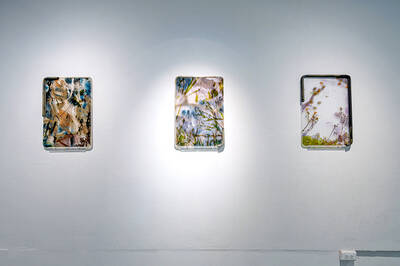
Located down a sideroad in old Wanhua District (萬華區), Waley Art (水谷藝術) has an established reputation for curating some of the more provocative indie art exhibitions in Taipei. And this month is no exception. Beyond the innocuous facade of a shophouse, the full three stories of the gallery space (including the basement) have been taken over by photographs, installation videos and abstract images courtesy of two creatives who hail from the opposite ends of the earth, Taiwan’s Hsu Yi-ting (許懿婷) and Germany’s Benjamin Janzen. “In 2019, I had an art residency in Europe,” Hsu says. “I met Benjamin in the lobby
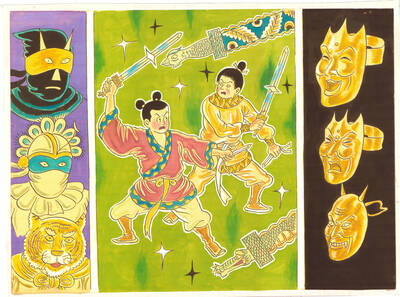
April 22 to April 28 The true identity of the mastermind behind the Demon Gang (魔鬼黨) was undoubtedly on the minds of countless schoolchildren in late 1958. In the days leading up to the big reveal, more than 10,000 guesses were sent to Ta Hwa Publishing Co (大華文化社) for a chance to win prizes. The smash success of the comic series Great Battle Against the Demon Gang (大戰魔鬼黨) came as a surprise to author Yeh Hung-chia (葉宏甲), who had long given up on his dream after being jailed for 10 months in 1947 over political cartoons. Protagonist

The following three paragraphs are just some of what the local Chinese-language press is reporting on breathlessly and following every twist and turn with the eagerness of a soap opera fan. For many English-language readers, it probably comes across as incomprehensibly opaque, so bear with me briefly dear reader: To the surprise of many, former pop singer and Democratic Progressive Party (DPP) ex-lawmaker Yu Tien (余天) of the Taiwan Normal Country Promotion Association (TNCPA) at the last minute dropped out of the running for committee chair of the DPP’s New Taipei City chapter, paving the way for DPP legislator Su


 RSS
RSS