


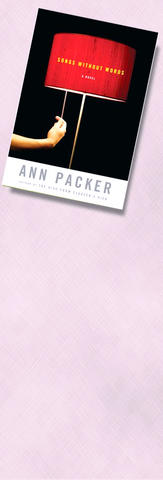
The two close female friends in Ann Packer's ladylike, man-proof new novel spend 300-odd pages exploring the nuances of their lifelong bond. If this sounds like an interesting story, bear in mind that any synopsis will make this book appear better than its full, sprawling version turns out to be. Synopses emphasize plots, themes and dramatic tensions. They do not dawdle through descriptions of how cheese rolls can be "such a reliable pleasure," how raisin-bran cookies have a "branny, raisiny" nature or how the essence of soccer is "the blunt, running, back and forth of the game."
But Songs Without Words has time for a lot of bland, homey flourishes. And it relies upon them heavily to express how life is like a seesaw, that thing in playgrounds upon which children ride up or down. After the keenly observed realism she demonstrated in her much more penetrating Dive From Clausen's Pier, Packer this time treats pedestrian, domestic details about her characters strategically, as if they captured physical manifestations of interior currents. Strategically, this succeeds only in giving Songs Without Words a pedestrian spirit.
Meet Liz and Sarabeth, two women who live in the Bay Area and are as different as their names. Liz is down to earth and practical, while Sarabeth is creative and quirky. Sarabeth is also single and uneasy about her life in Berkeley, whereas Liz is firmly settled in suburban bliss. Liz and her husband, Brody, have the kind of marriage in which "maybe I'll just skip my pajamas tonight" might be a hot-blooded remark from either of them.
Liz and Brody also have two children, Lauren and Joe. Lauren is bursting with dangerous angst in ways that make her seem to have wandered in from an explosively timely Jodi Picoult novel, then stopped ticking. Lauren is showing signs of distress, including an embarrassing high school crush and anxiety about her grades. She goes to the kind of school where girls say things like: "Want some dry-roasted edamame? They're rich in isoflavones." Something is making Lauren feel inadequate in this environment.
But Liz is awfully busy. She thinks about crafts and yoga and Sarabeth and what's for dinner, not really noticing her daughter's situation. Sooner or later this kind of setup might lead the book into dark waters if it were actually going anywhere. But the main effect of Lauren's malaise is to provoke frissons of discord between Sarabeth and Liz.
In a novel that wishfully invokes Mrs. Dalloway, Anna Karenina, the paintings of Alex Katz and other touchstones of subtle bourgeois dissatisfaction, resentments between the two friends begin to emerge. As the prologue to Songs Without Words explains, Sarabeth grew up in Liz's family after her own mother's suicide. And the idea of motherhood taps into her deepest longings. She depends on Liz not only for sisterly intimacy but also for a kind of support that is not in the normal range of adult friendship.
Or is it? Packer's most intuitive point here is that mother-daughter dynamics and neediness linger throughout life, even among apparent peers, in ways that become sharper over time. At her most genuinely astute, Liz thinks about "how knowledge accumulated in layers rather than linearly, how you learned the same things over and over, but differently each time, more deeply."
This is also the best-case scenario for how Songs Without Words is meant to unfold. Perhaps it would work that way if less attention were paid to, say, the friends' thoughts about no-drain vacuum bags of tuna. In a fraught moment at the supermarket, Liz looks at the tuna packaging and remembers how nifty Sarabeth thinks it is. There is sadness here. The no-drain vacuum is as close as Liz can get to her friend after Lauren's troubles drive a wedge between them.
Liz's initial, also food-related sympathy for Sarabeth (she wishes she could "lift the misery off Sarabeth the way you could lift a mesh dome off a bowl of potato chips, straight up, without jostling the sides of the bowl") is the product of a lifetime. But it has remained unexamined until Liz is also forced to consider her friend's recklessness and Sarabeth's selfish side.
To illustrate these emotions, Packer makes Sarabeth someone who earns her living by poking into others' lives: she spruces up homes for real-estate viewings, working miracles with good-looking fruit and neutral towels. In this aspect of her work, Sarabeth is both an invasive presence and a hanger-on in clients' lives. In her sideline, which is dreaming up "larky" lampshades, she also shows a playful, larky side.
The book uses Liz's pet project, bench painting (loud, awkward plaid crossed with forced-larky flowers), as significant self-expression. And Packer actually communicates more through things that result from the friends' handiwork than those that come out of their mouths. These women dwell in an environment so cosseted that it drives Liz's husband to rhetorical questions ("Did a certain kind of ease pave the way for trouble?"). When trouble strikes their placid paradise, the book eschews cheap melodrama but never otherwise breaks out of its comfy bubble.
"Isn't life funny?" Liz asks laughingly, fairly early in the story. By the end of Songs Without Words, she has returned to a similar attitude, even if it now seems precarious and hard won.
"God, it was the most ordinary things that caused the greatest misery," Liz tells herself at some point on this journey. The honesty of that thought is hard to dispute.

In late October of 1873 the government of Japan decided against sending a military expedition to Korea to force that nation to open trade relations. Across the government supporters of the expedition resigned immediately. The spectacle of revolt by disaffected samurai began to loom over Japanese politics. In January of 1874 disaffected samurai attacked a senior minister in Tokyo. A month later, a group of pro-Korea expedition and anti-foreign elements from Saga prefecture in Kyushu revolted, driven in part by high food prices stemming from poor harvests. Their leader, according to Edward Drea’s classic Japan’s Imperial Army, was a samurai

Approaching her mid-30s, Xiong Yidan reckons that most of her friends are on to their second or even third babies. But Xiong has more than a dozen. There is Lucky, the street dog from Bangkok who jumped into a taxi with her and never left. There is Sophie and Ben, sibling geese, who honk from morning to night. Boop and Pan, both goats, are romantically involved. Dumpling the hedgehog enjoys a belly rub from time to time. The list goes on. Xiong nurtures her brood from her 8,000 square meter farm in Chiang Dao, a mountainous district in northern Thailand’s

Located down a sideroad in old Wanhua District (萬華區), Waley Art (水谷藝術) has an established reputation for curating some of the more provocative indie art exhibitions in Taipei. And this month is no exception. Beyond the innocuous facade of a shophouse, the full three stories of the gallery space (including the basement) have been taken over by photographs, installation videos and abstract images courtesy of two creatives who hail from the opposite ends of the earth, Taiwan’s Hsu Yi-ting (許懿婷) and Germany’s Benjamin Janzen. “In 2019, I had an art residency in Europe,” Hsu says. “I met Benjamin in the lobby
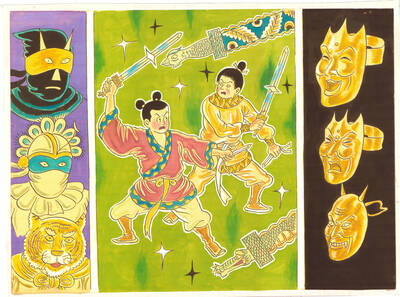
April 22 to April 28 The true identity of the mastermind behind the Demon Gang (魔鬼黨) was undoubtedly on the minds of countless schoolchildren in late 1958. In the days leading up to the big reveal, more than 10,000 guesses were sent to Ta Hwa Publishing Co (大華文化社) for a chance to win prizes. The smash success of the comic series Great Battle Against the Demon Gang (大戰魔鬼黨) came as a surprise to author Yeh Hung-chia (葉宏甲), who had long given up on his dream after being jailed for 10 months in 1947 over political cartoons. Protagonist


 RSS
RSS