


Two very different movies about the Iraq war are among the favorites for awards at this year's Venice Film Festival as it passes the halfway stage, and an unusually high number of male leads have stood out.
For pure shock value, Brian De Palma's Redacted wins hands down, stunning audiences with an uncompromising reconstruction of the real-life rape of a 14-year-old Iraqi girl and the murder of her and her family by US soldiers.
For those looking for a more nuanced take on the conflict, a hot topic in Hollywood today, Paul Haggis's In the Valley of Elah stands out, as does the performance of Tommy Lee Jones.
Paolo Mereghetti, film critic for Italy's Corriere della Sera newspaper, gave his highest marks so far to Redacted, calling it "well and truly a blow to the stomach."
But not everyone agreed. Jay Weissberg, critic for the US-based Variety industry magazine, said De Palma "hits you over the head with a sledge hammer."
He and Maria Giulia Minetti, who covers the festival for Italian daily La Stampa, preferred Haggis' picture.
"So far I think the hot favorite is In the Valley of Elah more than Redacted, because it combines the high quality of the director, the message about the Iraq War and a thriller-type story that the public will enjoy," Minetti said.
Jones' performance as a man whose son is murdered by fellow soldiers after returning from Iraq is seen as an early Oscar contender, and much discussed was the film's defining image of an American flag hanging upside down, a symbol of distress.
Critics said much would depend on whether the jury, led by Chinese director Zhang Yimou (張藝謀), would reward a political movie.
The competition includes films about Iraq, migrant labor in Britain, corruption in America, the Italian mafia and police brutality in Egypt.
"There isn't one film that everyone is saying 'This is the one' about,'" said Weissberg. "People are very divided."
In terms of the Golden Lion for best film, critics also rate Michael Clayton, starring George Clooney as a washed out corporate "fixer" and French drama Les Amours d'Astree et de Celadon, set in the time of the druids.
The Assassination of Jesse James by the Coward Robert Ford, featuring Brad Pitt, has won good reviews, and La Graine et le Mulet, Abdellatif Kechiche's story of an Arab family living in southern France, was also popular.
Vying for best actor alongside Jones is Casey Affleck as a creepy social misfit in The Assassination, Jude Law and Michael Caine won plaudits for Sleuth, and Tony Leung (梁朝偉) impressed in Lust, Caution (色,戒) by Ang Lee (李安).
Best actress favorite, with just over half the 22 main competition films having had their premiere, is Briton Kierston Wareing for her portrayal of an ambitious single mother who recruits migrant workers in Ken Loach's It's a Free World.
Keira Knightley won praise in Atonement, Joe Wright's adaptation of the acclaimed Ian McEwan novel, and Cate Blanchett could figure for her portrayal of singer Bob Dylan in Todd Haynes' unusual biopic I'm Not There.
Japanese director Takashi Miike presented his raucous take on the spaghetti western, Sukiyaki Western Django, late Wednesday at the festival.
Takashi offers his eastern version in the year that the festival offers a retrospective on the genre.
The title of Miike's film refers to the Sergio Corbucci 1966 cult classic Django, which starred Italian actor Franco Nero.
Miike's film is packed with references to the work of both Corbucci and Sergio Leone, who directed a trio of Clint Eastwood films that helped make spaghetti westerns an international phenomenon in the mid-1960s.
Classic lines (such as "Give it up, Yoichi. The strong and the brave gets the woman") are delivered un-selfconsciously, if haltingly, in broken English.
Cult director Quentin Tarantino, the only non-Japanese person in the film, plays a stranger in a poncho with the fastest draw in the East.
Spaghetti westerns were a uniquely European variation on the classic American western that emerged in the mid-1960s. Considered extremely violent at the time, they usually had Italian directors at the helm, with a European cast and often American stars.
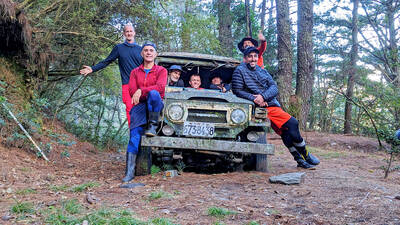
The year was 1991. A Toyota Land Cruiser set out on a 67km journey up the Junda Forest Road (郡大林道) toward an old loggers’ camp, at which point the hikers inside would get out and begin their ascent of Jade Mountain (玉山). Little did they know, they would be the last group of hikers to ever enjoy this shortcut into the mountains. An approaching typhoon soon wiped out the road behind them, trapping the vehicle on the mountain and forever changing the approach to Jade Mountain. THE CONTEMPORARY ROUTE Nowadays, the approach to Jade Mountain from the north side takes an

Last week Joseph Nye, the well-known China scholar, wrote on the Australian Strategic Policy Institute’s website about how war over Taiwan might be averted. He noted that years ago he was on a team that met with then-president Chen Shui-bian (陳水扁), “whose previous ‘unofficial’ visit to the US had caused a crisis in which China fired missiles into the sea and the US deployed carriers off the coast of Taiwan.” Yes, that’s right, mighty Chen caused that crisis all by himself. Neither the US nor the People’s Republic of China (PRC) exercised any agency. Nye then nostalgically invoked the comical specter

Relations between Taiwan and the Czech Republic have flourished in recent years. However, not everyone is pleased about the growing friendship between the two countries. Last month, an incident involving a Chinese diplomat tailing the car of vice president-elect Hsiao Bi-khim (蕭美琴) in Prague, drew public attention to the People’s Republic of China’s (PRC) operations to undermine Taiwan overseas. The trip was not Hsiao’s first visit to the Central European country. It was meant to be low-key, a chance to meet with local academics and politicians, until her police escort noticed a car was tailing her through the Czech capital. The
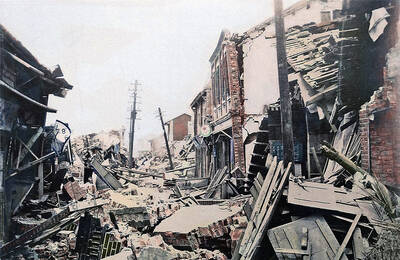
April 15 to April 21 Yang Kui (楊逵) was horrified as he drove past trucks, oxcarts and trolleys loaded with coffins on his way to Tuntzechiao (屯子腳), which he heard had been completely destroyed. The friend he came to check on was safe, but most residents were suffering in the town hit the hardest by the 7.1-magnitude Hsinchu-Taichung Earthquake on April 21, 1935. It remains the deadliest in Taiwan’s recorded history, claiming around 3,300 lives and injuring nearly 12,000. The disaster completely flattened roughly 18,000 houses and damaged countless more. The social activist and


 RSS
RSS