


The best-selling novels of 1957 included Peyton Place by Grace Metalious and On the Road by Jack Kerouac.
Both were cultural touchstones: Peyton Place as a precursor of the modern soap opera and On the Road as a clarion call for the Beat generation and, later, as an underground bible of the 1960s and 1970s. Today, Peyton Place is mostly regarded as a historical curiosity, but On the Road, celebrating the 50th anniversary of its publication, still has a vibrant life on college English course syllabuses and high school summer reading lists, and in young travelers' backpacks.
"It's a book that has aged well," said Martin Sorensen, floor manager at Kepler's Books and Magazines in Menlo Park, California. A "noticeable" number of copies are sold each year at the store, he said.

PHOTOS: NY TIMES NEWS SERVICE
The autobiographical, stream-of-consciousness On the Road follows Sal Paradise (a character based on Kerouac) and Dean Moriarty (based on Kerouac's friend Neal Cassady) as they ramble back and forth across the country, drinking, listening to jazz and having affairs.
Viking is releasing a 50th-anniversary edition today (the original came out Sept. 5, 1957) and is also publishing, for the first time in book form, the original version that Kerouac typed on a 37m-long scroll and a new analysis by John Leland, a reporter at the New York Times, titled Why Kerouac Matters: The Lessons of 'On the Road' (They're Not What You Think). The Library of America will include On the Road in a collection of Kerouac's "road novels" to be published next month. And the New York Public Library will pay homage in November with an exhibition of the original scroll and other materials from the Kerouac archives.
Although much of this will primarily appeal to Beat aficionados, On the Road continues to have a wider cultural significance, particularly for the young. Fueled in part by school assignments, it sells about 100,000 copies a year in various paperback editions, according to Viking. And while its era as a counterculture standard-bearer may have passed (it's hard to remain countercultural while being featured in Gap ads, as Kerouac was in the 1990s), it has far outlasted many other cult classics.
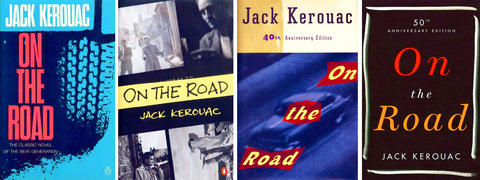
Michael Heslop, 30, says he first read On the Road as a senior in high school and rereads it every other year. In 2004, he opened Kafe Kerouac, a coffee shop, record store, bookstore and performance space in Columbus, Ohio. "I wanted to name it after an American writer I admired," Heslop said. "Jack Kerouac felt like the essence of the underground independent coffee shop more than a Hemingway or a Mark Twain." (He also offers an unlikely Kerouac drink, a hazelnut mint latte. "It's hard to name plain black coffee after somebody," Heslop said.)
In true beat fashion, Kafe Kerouac plays host to poetry readings and open mikes and draws a college crowd. Nina Hernandez, 23, an employee at the cafe, first read On the Road a year ago. "I like that he wasn't about the rules; he just stripped that away and wrote what he was thinking," she said.
But Hernandez, an industrial engineering student, also said she hadn't heard of Kerouac until she began working at the cafe. And, she noted, the book was not without its flaws: "Sometimes I found it a little wordy."
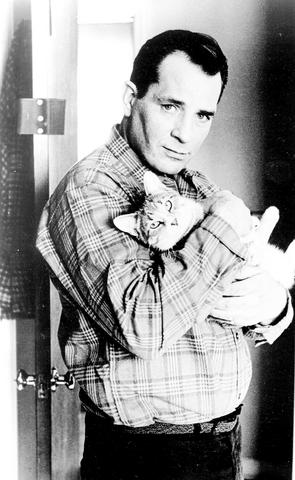
In the academy, On the Road gets a mixed reputation. "I don't think the book is taken seriously by most scholars and literary critics," said Bill Savage, a senior lecturer in the English department at Northwestern University, where he has been teaching On the Road for two decades.
Still, Savage said, his students connect with the book quite personally. "Undergraduates can really relate to it because they live in such a mediated world with the Internet, the cell phone and the iPod," he said. "There are so many ways in which you're not where you are, and Kerouac is about being where you are."
Some students, though, reject the book as dated. Ann Douglas, a Beat scholar who has been teaching it for more than 25 years at Columbia, acknowledges that students don't accept it as "gospel." They criticize it from all different angles, she said - finding it, for example, condescending toward Mexicans or women.
But Douglas says that her seminar on the Beats regularly has six times as many applicants as there are spaces, and that the novel still resonates strongly.
"Again and again, students do the best writing of their careers," she said. "It's a summons to put aside fear of what people will say or what your family expects and to find a voice that is really their own."
At City Lights Books, the San Francisco literary landmark, Lawrence Ferlinghetti, the Beat poet and publisher and co-founder of the store, mused on the continuing success of the book.
Ferlinghetti, 88, contrasted Kerouac's work with Thomas Wolfe's Look Homeward, Angel, which he said was "the kind of book that you read when you are 18 and it's just wonderful, but if you read it when you are 35 or 50 you are embarrassed by its over-romantic tone and its flowery exuberance." But having read On the Road when it first came out and he was in his 30s, and just last month, Ferlinghetti said, "It is really still 'with it,' you might say."
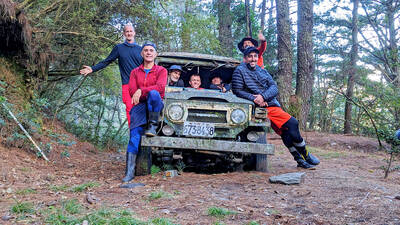
The year was 1991. A Toyota Land Cruiser set out on a 67km journey up the Junda Forest Road (郡大林道) toward an old loggers’ camp, at which point the hikers inside would get out and begin their ascent of Jade Mountain (玉山). Little did they know, they would be the last group of hikers to ever enjoy this shortcut into the mountains. An approaching typhoon soon wiped out the road behind them, trapping the vehicle on the mountain and forever changing the approach to Jade Mountain. THE CONTEMPORARY ROUTE Nowadays, the approach to Jade Mountain from the north side takes an

Last week Joseph Nye, the well-known China scholar, wrote on the Australian Strategic Policy Institute’s website about how war over Taiwan might be averted. He noted that years ago he was on a team that met with then-president Chen Shui-bian (陳水扁), “whose previous ‘unofficial’ visit to the US had caused a crisis in which China fired missiles into the sea and the US deployed carriers off the coast of Taiwan.” Yes, that’s right, mighty Chen caused that crisis all by himself. Neither the US nor the People’s Republic of China (PRC) exercised any agency. Nye then nostalgically invoked the comical specter
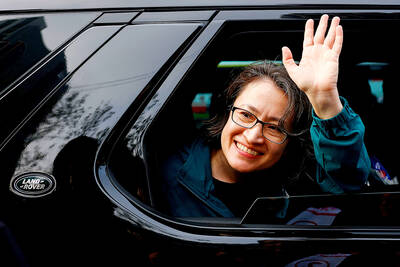
Relations between Taiwan and the Czech Republic have flourished in recent years. However, not everyone is pleased about the growing friendship between the two countries. Last month, an incident involving a Chinese diplomat tailing the car of vice president-elect Hsiao Bi-khim (蕭美琴) in Prague, drew public attention to the People’s Republic of China’s (PRC) operations to undermine Taiwan overseas. The trip was not Hsiao’s first visit to the Central European country. It was meant to be low-key, a chance to meet with local academics and politicians, until her police escort noticed a car was tailing her through the Czech capital. The
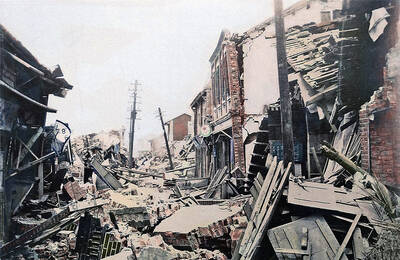
April 15 to April 21 Yang Kui (楊逵) was horrified as he drove past trucks, oxcarts and trolleys loaded with coffins on his way to Tuntzechiao (屯子腳), which he heard had been completely destroyed. The friend he came to check on was safe, but most residents were suffering in the town hit the hardest by the 7.1-magnitude Hsinchu-Taichung Earthquake on April 21, 1935. It remains the deadliest in Taiwan’s recorded history, claiming around 3,300 lives and injuring nearly 12,000. The disaster completely flattened roughly 18,000 houses and damaged countless more. The social activist and


 RSS
RSS