


David Peace first went to Japan 13 years ago, in his mid-twenties, to teach English as a foreign language, and stayed. You could argue that the prose of the novels he has written compulsively since - seven fat books published in the past eight years - has been heavily influenced by his original day job. Peace uses truncated subject, verb, object sentences in repetitive rhythms to establish the claustrophobia of extreme states of mind. Sometimes, his paragraphs read like a basic English primer: "I haggle. To eat. I barter. To work. I threaten. To eat. I bully. To work. I buy three eggs and some vegetables," he writes here, typically.
To quote small chunks of Peace's writing, though, is to miss most of its intensive craft and appeal. He experimented with his demotic rhythms in the loosely linked novels that explored the two dominant myths of his growing up in England in the 1970s and 1980s: the hunt for serial murderer Peter Sutcliffe "Yorkshire Ripper" and the miners' strike. His real breakthrough as a stylist, however, came in The Damned Utd, his last book, the wonderful fictional rendering of an interior monologue of UK football legend Brian Clough, a deeply paranoid and self-obsessive voice, full of contradiction and drama.
It seems a long way from Leeds United to postwar Tokyo, but a good deal of the internal tension of Clough's hypnotic stream of consciousness is replayed in a different context here. It is 1946 and Japan, disgraced and defeated by the Allies, is living in fear of a third wave of destruction: "Tokyo hot and dark, hidden and cowed; night and day, rumors of new weapons, fears of new bombs; first Hiroshima, then Nagasaki, next is Tokyo ... . " The Japanese nation is under siege both from the "victors" and from Formosans, Koreans and Chinese seeking retribution. The American occupying forces are conducting purges to root out war criminals. In the Tokyo Metropolitan Police Department, everyone has changed identity to avoid recrimination. The slogans on the Tokyo station walls, parroted by senior officers - "Now is not a time to forget our obligations, they are who we are" or "It is time to reveal the true essence of the nation" - are blood-stained and desperate.
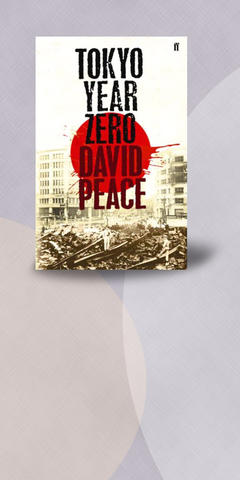
Even so, the Japanese are already trying to rebuild out of the wreckage of defeat and though the foundations are not promising - "rubble and ash ... piss and shit, cholera and typhus, disease and death, death and loss" - Tokyo's reconstruction is relentless. One of the percussive background noises to Peace's tale is that of jackhammers endlessly at work on the new city: "ton-ton-ton-ton-ton." All of the chaos is sharply detailed. I once interviewed Peace and he talked of his fictional method as one of obsessive factual research, total immersion in the news and culture of the time: "Everything that can be fact is fact. People say to me it is always raining in your books. But if it is raining on the day I say it was, then it certainly was raining on that day, I guarantee." In this case, the weather reports - Tokyo, 90 degrees, fine - only add to the oppression.
Tokyo Year Zero is told in the voice of Detective Minami of the Tokyo Metropolitan Police. Minami has been driven crazy by nothing being as it seems, by imperial Japan being occupied. Democracy is good. Democracy is bad. My mouth is dry. The aggressor is the victim. The victim is the aggressor. My stomach aches. The winners are the losers. The losers are the winners ... ." The day Japan accepts the imposed provisions of defeat is also the day that Detective Minami starts finding bodies of young geishas in Shiba Park strangled with their own shawls.
The case is a real one - it emerged, we discover, out of a newspaper article (Peace is a great fossicker in archives) with the headline "Sex maniac confesses to killing four young women" and the information that the accused, Kodaira Yoshio, "was executed at the Miyagi Prison in Sendai Prefecture on the fifth of October, 1949." Out of these facts, Peace weaves a thriller that is both a gory psychological whodunit and a meditation on the origins of modern Japan.
The result is something dark and bloody, the tone lying somewhere between Akira Kurosawa's Macbeth and the caricatures of the more violent manga cartoons. Peace has form here, from his stylized accounts of the Yorkshire Ripper murders, and he inches two steps forward, one step back in his circling prose, towards a very Japanese heart of darkness.
Minami's voice is trapped in a continuous insomniac present tense, dogged by italicized flashbacks to the cruelties of his war and his growing fears that his violent past is somehow linked to the murders that he investigates. The minds of Peace's characters always nag at particular stubborn images. In Minami's case, this is the half-remembered fragment of one highly charged night with his lover Yuki, which somehow is implicated in all of his growing guilt.
Most of the time, Peace's staccato prose is a perfect instrument for this interior hell. Such is his control of the recurring elements of his childlike sentences that he can even just about get away with constructions like this one:
"I see Senju Akira with his pistol-
Bang! Bang! Bang!
One, two, three, four-
Bang! Bang! Bang...
Dead Formosans-
Bang! Bang ...
Five, six-
Bang!'
It is no surprise that the book comes with a jacket quote from James Ellroy: Peace's style borrows much from the noir shorthand of the American, worrying at things, never letting his reader rest. As in Ellroy, the momentum depends on sudden fresh or shocking images being injected into the quick fire paranoia.
Minami returns obsessively to the lives of the geishas, whispering their come-ons from the shadows: "Asobu?" ("Will you play?") He observes their lives with typical spareness: "In the ballroom. There are a hundred Japanese girls. In Occidental gowns. Nothing underneath. Beneath red paper streamers that hang in the heat from the ceiling. They dance with each other to scratched and deafening records relayed through a battery of amplifiers. Back and forth across the floor in downtrodden heels and scruffy school plimsolls. They push each other. To the distorted American jazz. In the ballroom. Back and forth.
"Life among them is worth nothing. There are over one million urns containing the ashes of the war dead still unclaimed by their bereaved families." Everyone has lost a daughter. In this place, it should be possible to conceal even the most brutal of crimes, but the truth, Peace suggests, is insistent.
Tokyo Year Zero is the first of a trilogy of crime novels that promises to address the creation of modern Japan (Peace is nothing if not ambitious; he thinks in epic terms). The idea that it was built on horror committed and horror received seems a very fair place to begin. It will be interesting to see how he proceeds. The voice that comes so alive in 1946 might, you suspect, prove harder to sustain in less extreme moments.

In late October of 1873 the government of Japan decided against sending a military expedition to Korea to force that nation to open trade relations. Across the government supporters of the expedition resigned immediately. The spectacle of revolt by disaffected samurai began to loom over Japanese politics. In January of 1874 disaffected samurai attacked a senior minister in Tokyo. A month later, a group of pro-Korea expedition and anti-foreign elements from Saga prefecture in Kyushu revolted, driven in part by high food prices stemming from poor harvests. Their leader, according to Edward Drea’s classic Japan’s Imperial Army, was a samurai

The following three paragraphs are just some of what the local Chinese-language press is reporting on breathlessly and following every twist and turn with the eagerness of a soap opera fan. For many English-language readers, it probably comes across as incomprehensibly opaque, so bear with me briefly dear reader: To the surprise of many, former pop singer and Democratic Progressive Party (DPP) ex-lawmaker Yu Tien (余天) of the Taiwan Normal Country Promotion Association (TNCPA) at the last minute dropped out of the running for committee chair of the DPP’s New Taipei City chapter, paving the way for DPP legislator Su
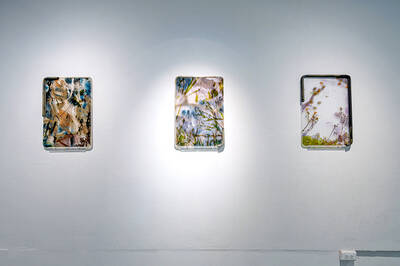
Located down a sideroad in old Wanhua District (萬華區), Waley Art (水谷藝術) has an established reputation for curating some of the more provocative indie art exhibitions in Taipei. And this month is no exception. Beyond the innocuous facade of a shophouse, the full three stories of the gallery space (including the basement) have been taken over by photographs, installation videos and abstract images courtesy of two creatives who hail from the opposite ends of the earth, Taiwan’s Hsu Yi-ting (許懿婷) and Germany’s Benjamin Janzen. “In 2019, I had an art residency in Europe,” Hsu says. “I met Benjamin in the lobby
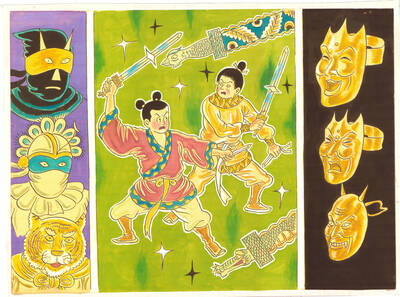
April 22 to April 28 The true identity of the mastermind behind the Demon Gang (魔鬼黨) was undoubtedly on the minds of countless schoolchildren in late 1958. In the days leading up to the big reveal, more than 10,000 guesses were sent to Ta Hwa Publishing Co (大華文化社) for a chance to win prizes. The smash success of the comic series Great Battle Against the Demon Gang (大戰魔鬼黨) came as a surprise to author Yeh Hung-chia (葉宏甲), who had long given up on his dream after being jailed for 10 months in 1947 over political cartoons. Protagonist


 RSS
RSS