


As Beijing bureau chief for The Times of London, Oliver August soon discovered something very newsworthy: that "the 'New China' known to readers had even more cliches than people." So August set out to find an unusual angle. During his seven-year stint in China, he became intrigued by the roller-coaster ride of a farmer-turned-billionaire gangster, a man variously regarded as Robin Hood, the Chinese Gatsby or an enemy of the state.
Inside the Red Mansion is a chronicle of August's steady if desultory pursuit.
Lai Changxing (賴昌星) is the outlaw. He wound up fleeing China for Vancouver, where he would prompt what August calls the longest hearing in Canadian legal history. And he based his building, sales, prostitution and smuggling empire in the boom town of Xiamen on China's southern coast. Though illiterate, Lai named his principal pleasure palace the Red Mansion after one of China's epic works of fiction.
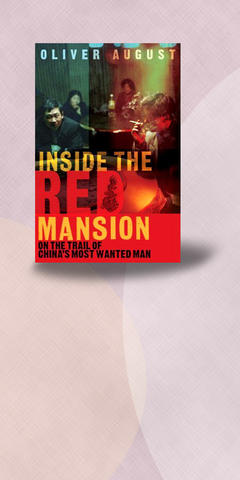
"For him to appropriate Dream of a Red Mansion was like changing the name of Colosimo's Cafe in Chicago - where Al Capone began his career - to Great Expectations, after Charles Dickens," August explains. Although the huge novel is sometimes known as Dream of the Red Chamber, it suited both Lai's and August's purposes to make its title sound as grandiose as possible. After all, August would make Lai and his lair the focus of a seven-year investigation.
As investigative journalists go, August sounds more fun-loving than dogged. He proudly describes having roller-skated his way through the Great Hall of the People in Beijing and being thrilled to have a security officer complain about him. ("This is too unserious.") And he undertook the search for Lai in a similar spirit of mischief.
While writing newspaper articles on the kinds of feature-story topics that run through the book (eg., how Xiamen Airlines conducted an onboard auction for airline merchandise and seats on future flights), he returned periodically to his roundabout hunt for Lai. Inside the Red Mansion winds up a colorfully digressive book capitalizing on the thought that understanding the new China is essential to understanding a criminal who could so successfully exploit it.
Early in the book, August encounters a men's room attendant eager to parlay that work into something, anything, that qualifies as a bigger business opportunity. Somebody else suggests combining a plastic surgery practice with a tailor shop to adjust patients' clothes. This seems to have been the enterprising spirit of Lai's gaudy rise to the top.
Although Lai is present through most of the book strictly as a reason to make others suddenly turn silent while being grilled by August, the economic atmosphere that proved so fertile for him is well evoked. From handing out a slew of bogus business cards as signs of status to playing golf by moonlight with multiple female caddies, Xiamen's rogue would-be entrepreneurs are nothing if not creative. The idea of night golf not only enhances the golf course's income but is said to protect farmers-turned-tycoons from the damaging sun.
In the circles that August wound up infiltrating, "Rich like Lai" was a toast, not a condemnation. The book describes how Lai's great success as a self-made man, who must have borrowed the Red Mansion conceit from a television miniseries since he could not read, has been imitated by many others.
At the anecdotal level August illustrates how China's sense of history has experienced a post-Mao re-emergence, how grandiose imperial decor is again in vogue, how thoroughly food imagery infiltrates every kind of Chinese conversation, and how certain old ideas (concubinage) have a glamour that their modern equivalents (prostitution) lack. The tycoon who survived the economic downturn of his city, Beihai, to become the world's biggest, most vulgar producer of foie gras is a typical figure to attract August's eye.
Inside the Red Mansion fares so well with peripheral stories that it must forestall the inevitable: an actual run-in with Lai. While in China, August never gets closer than glimpsing Lai's disappointing hometown and the grim pleasure palace of the title. Later he fares better in a Canadian courtroom during Lai's trial. (Lai ran afoul of Chinese authorities after attracting too much attention and wound up accused of smuggling and tax fraud on a grand scale. His flight to Canada created a diplomatic crisis and made him a focus of public scrutiny.)
So August has a wonderful anecdote about seeing Lai walk into court, size up the lawyers, decide he was underdressed for the occasion and simply walk out to change his clothes. He returned in a partial tuxedo. And "by the end of the hearing he was treating the security officers in the courtroom as part of his entourage rather than as captors." When it comes actually to interviewing Lai face to face, August's questions do not live up to the occasion. ("How did you get to know so many officials?")
In the process of telling Lai's story, August also conveys his own. He came to China from New York with a certain naivete about how freely he could move through the country. He began to notice signs of surveillance around him. "The temple park was a wonderful place for an afternoon outing, and all the more enjoyable if you could watch grown men crouch in the bushes," he observes.
And a year before Inside the Red Mansion was published, a handler from the Chinese Foreign Ministry told August that he had enjoyed the book. You needn't be a spy to agree.
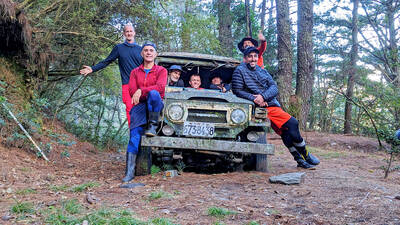
The year was 1991. A Toyota Land Cruiser set out on a 67km journey up the Junda Forest Road (郡大林道) toward an old loggers’ camp, at which point the hikers inside would get out and begin their ascent of Jade Mountain (玉山). Little did they know, they would be the last group of hikers to ever enjoy this shortcut into the mountains. An approaching typhoon soon wiped out the road behind them, trapping the vehicle on the mountain and forever changing the approach to Jade Mountain. THE CONTEMPORARY ROUTE Nowadays, the approach to Jade Mountain from the north side takes an

Last week Joseph Nye, the well-known China scholar, wrote on the Australian Strategic Policy Institute’s website about how war over Taiwan might be averted. He noted that years ago he was on a team that met with then-president Chen Shui-bian (陳水扁), “whose previous ‘unofficial’ visit to the US had caused a crisis in which China fired missiles into the sea and the US deployed carriers off the coast of Taiwan.” Yes, that’s right, mighty Chen caused that crisis all by himself. Neither the US nor the People’s Republic of China (PRC) exercised any agency. Nye then nostalgically invoked the comical specter

Relations between Taiwan and the Czech Republic have flourished in recent years. However, not everyone is pleased about the growing friendship between the two countries. Last month, an incident involving a Chinese diplomat tailing the car of vice president-elect Hsiao Bi-khim (蕭美琴) in Prague, drew public attention to the People’s Republic of China’s (PRC) operations to undermine Taiwan overseas. The trip was not Hsiao’s first visit to the Central European country. It was meant to be low-key, a chance to meet with local academics and politicians, until her police escort noticed a car was tailing her through the Czech capital. The
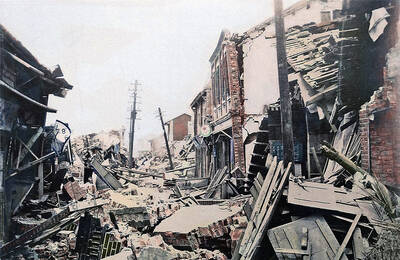
April 15 to April 21 Yang Kui (楊逵) was horrified as he drove past trucks, oxcarts and trolleys loaded with coffins on his way to Tuntzechiao (屯子腳), which he heard had been completely destroyed. The friend he came to check on was safe, but most residents were suffering in the town hit the hardest by the 7.1-magnitude Hsinchu-Taichung Earthquake on April 21, 1935. It remains the deadliest in Taiwan’s recorded history, claiming around 3,300 lives and injuring nearly 12,000. The disaster completely flattened roughly 18,000 houses and damaged countless more. The social activist and


 RSS
RSS