


Decades before it was given a name, Michelangelo Antonioni recognized the malady we now call attention deficit disorder. In his great 1960s films, L'Avventura, La Notte, Eclipse and Red Desert, but especially in L'Avventura, his masterpiece, it wasn't diagnosed as a chemical imbalance, but as a communicable social disease.
Spawned in a psychological petri dish in which idleness, boredom and dissatisfaction with the material rewards of life combined to create and spread a chronic, generalized, mild depression, it was an ailment peculiar to the upper middle class. What made audiences susceptible was the glamour that attached to it. As I watched the attractive aristocrats and climbers in his films mope through their empty lives, a part of me wanted to be just like those people: self-absorbed and miserable, perhaps, but also fashionable and sexy.
The ever-acute critic Pauline Kael recognized this contradiction in a famous essay, "Come-Dressed-as-the-Sick-Soul-of-Europe Parties," which aroused the ire of Antonioni devotees like me. More than four decades later, that contradiction remains unresolved in popular culture. Such is the power of film and television imagery that glamour and sex, no matter how tawdry or morally bankrupt, command our attention and whet our fantasies.
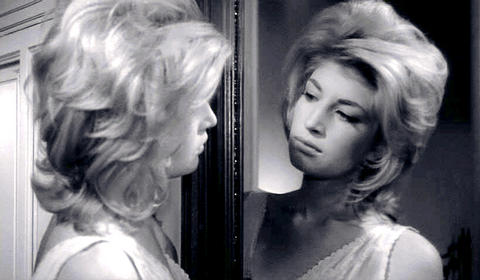
PHOTO: NY TIMES NEWS SERVICE
Antonioni was the movies' first diagnostician of what back then was called alienation, anomie, angst and decadence. If his films had their silly side (the image of Jeanne Moreau and Marcello Mastroianni, grappling fully clothed in a sand trap in La Notte), they were also prophetic. Their melancholy poetry transmuted an overriding mood of self-pity into something deeper and closer to tragedy.
Antonioni's death on Monday, so close to Ingmar Bergman's, should give us pause. Their deaths bring down the final curtain on the high-modernist era of filmmaking, when a handful of directors were artistic gods accorded the respect and latitude of great painters or authors. Among the European masters of the 1960s, only Jean-Luc Godard, that most modern of modernists, remains.
For all their differences of temperament, Bergman and Antonioni were staunch moralists. If Bergman, the Scandinavian, was stern and austere, Antonioni, the Italian, was a sensuous aesthete who, when it suited him, resorted to painting nature the way he wanted it to look on the screen.
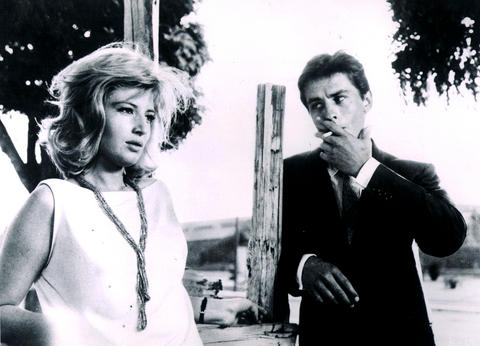
PHOTO: NY TIMES NEWS SERVICE
If both had bleak apprehensions of the decline and fall of Western civilization in an increasingly secularized age, Antonioni's vision was more urbane and cosmopolitan. The final bleak street-corner montage in Eclipse is downright apocalyptic. In that movie, the third part of the trilogy that included L'Avventura and La Notte, the world is consumed with stock-market fever. Greed trumps love. Sound familiar?
The meticulous compositions in Antonioni's films depict a shiny but flimsy new world displacing an older and more solid one. Classic stone architecture constructed to last for centuries is contrasted with bright, new high-rise skyscrapers without character. Nuns in black habits rub shoulders with avaricious starlets and shallow socialites. The affluent new generation senses its own susceptibility to corruption. Sandro, the faithless male protagonist of L'Avventura, is a once-serious architect who is bitterly aware that he has sold out his talent.
L'Avventura and Federico Fellini's more flamboyant film La Dolce Vita, to which it was continually compared, tugged the European art film toward fashion. Together they inaugurated a vogue among trendy Americans to punctuate their conversations with "Ciao" (often uttered in a petulant, pseudo-Italian accent) instead of "Goodbye."
As the 1960s wore on, Antonioni increasingly succumbed to the taint of fashion. His most successful film, "Blowup," set in swinging London among photographers and models, was clever but shallow. Yet the protagonist's search for an elusive photographic truth was prescient.
Antonioni's vogue ended abruptly in 1970 with the critical and commercial failure of Zabriskie Point. At the time, that movie, his first feature made in the US, was widely misunderstood by fans longing to identify with its young lovers, who dabble in revolutionary politics. When no revolution occurred at the end, the audience that had lined up to see it (I saw its first two New York screenings) left frustrated. In hindsight, its climactic fantasy of a house repeatedly exploding (to the strains of Pink Floyd) predicted the imminent failure of that so-called revolution. The notion that it was just a fantasy was a message nobody wanted to hear.
But Antonioni's fashionableness shouldn't distract us from his accomplishment. He was a visionary whose portrayal of the failure of Eros in a hyper-eroticized climate addressed the modern world and its discontents in a new, intensely poetic cinematic language. Here was depicted for the first time on screen a world in which attention deficit disorder, and the uneasy sense of impermanence that goes with it, were already epidemic.
The startling conceptual coup of L'Avventura was the story's unexplained disappearance of a young woman, Anna, from a desolate, rocky island where she and a yachting party have landed. Even before the group, which includes Sandro, leaves the island without finding Anna, Sandro puts the moves on her best friend, Claudia (Monica Vitti). She resists his advances, but succumbs once they have returned to the mainland.
As the police search for Anna, the members of the party become distracted. Even for Claudia, the movie's conscience and Antonioni's alter ego, the urgency of finding Anna recedes in the heat of her new relationship. The cycle of betrayal culminates with the final scene: Claudia and Sandro are staying in a hotel, and she awakens to find him gone.
Venturing downstairs, she finds him sprawled on a couch with a prostitute, an exhibitionist with whom they had crossed paths earlier, as the prostitute created a paparazzi frenzy in a village they were passing through. This character may be the movies' very first "celebutante." Today she is everywhere.

In late October of 1873 the government of Japan decided against sending a military expedition to Korea to force that nation to open trade relations. Across the government supporters of the expedition resigned immediately. The spectacle of revolt by disaffected samurai began to loom over Japanese politics. In January of 1874 disaffected samurai attacked a senior minister in Tokyo. A month later, a group of pro-Korea expedition and anti-foreign elements from Saga prefecture in Kyushu revolted, driven in part by high food prices stemming from poor harvests. Their leader, according to Edward Drea’s classic Japan’s Imperial Army, was a samurai

The following three paragraphs are just some of what the local Chinese-language press is reporting on breathlessly and following every twist and turn with the eagerness of a soap opera fan. For many English-language readers, it probably comes across as incomprehensibly opaque, so bear with me briefly dear reader: To the surprise of many, former pop singer and Democratic Progressive Party (DPP) ex-lawmaker Yu Tien (余天) of the Taiwan Normal Country Promotion Association (TNCPA) at the last minute dropped out of the running for committee chair of the DPP’s New Taipei City chapter, paving the way for DPP legislator Su
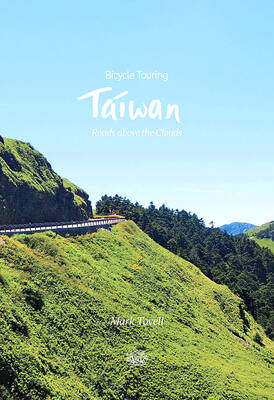
It’s hard to know where to begin with Mark Tovell’s Taiwan: Roads Above the Clouds. Having published a travelogue myself, as well as having contributed to several guidebooks, at first glance Tovell’s book appears to inhabit a middle ground — the kind of hard-to-sell nowheresville publishers detest. Leaf through the pages and you’ll find them suffuse with the purple prose best associated with travel literature: “When the sun is low on a warm, clear morning, and with the heat already rising, we stand at the riverside bike path leading south from Sanxia’s old cobble streets.” Hardly the stuff of your
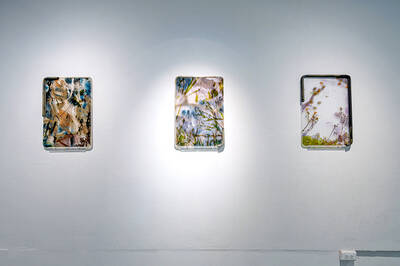
Located down a sideroad in old Wanhua District (萬華區), Waley Art (水谷藝術) has an established reputation for curating some of the more provocative indie art exhibitions in Taipei. And this month is no exception. Beyond the innocuous facade of a shophouse, the full three stories of the gallery space (including the basement) have been taken over by photographs, installation videos and abstract images courtesy of two creatives who hail from the opposite ends of the earth, Taiwan’s Hsu Yi-ting (許懿婷) and Germany’s Benjamin Janzen. “In 2019, I had an art residency in Europe,” Hsu says. “I met Benjamin in the lobby


 RSS
RSS