


Swinging an antique sword wildly above his head as the rain bucketed down Sunday, Gregor Edmunds stood atop the podium, the newly crowned champion of the World Highland Games. For the first time in 12 years, the competition returned to Scotland, so it was only fitting for a Glaswegian to win it.
Of the 12 linebacker-sized men clad in Tartan kilts, the 193cm and 130kg Edmunds proved the most consistent over eight tests of strength. They ranged from throwing stones, weights and hammers for both distance and height to the iconic caber toss in which competitors try to flip a 6m, 55kg pole.
For a Scottish tradition that ranks alongside bagpipes and haggis - both in abundant supply last weekend - one detail seemed odd. Behind the podium, five American flags blew in the wind.
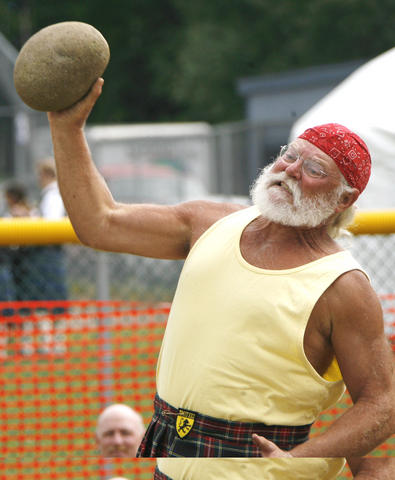
PHOTO: AP
They represented the five Americans in the field. Over the past century, Highland sports have found a niche in the US, which now produces some of the top competitors in the world. The US has more Highland Games and Scottish festivals than any country in the world with more than 200 events a year, blending the atmospheres of a track meet and a county fair.
"It's just really caught on in the US," said Harrison Bailey III, a Highland Games athlete and high school principal from Easton, Pennsylvania. "I think we have such a strong track and field presence in the US that a lot of guys make that transition."
In Scotland, however, the traditional sports have been on a steady decline. David Webster, the secretary general of the World Federation of Heavy Events, acknowledged that there was cause for concern, but no fear of Highland sports dying.
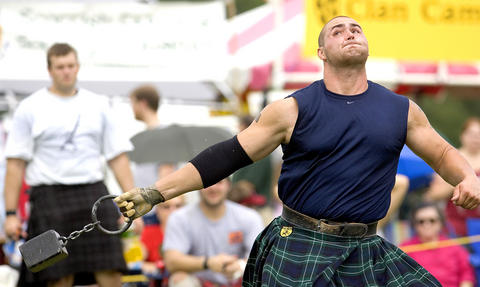
PHOTO: AP
"They've been around for 1,000 years and they'll keep on being with us," he said. "But it is getting harder and harder to find sponsorship."
Webster, a 78-year-old retired gym teacher, has been organizing games since 1946. Wearing a kilt, bonnet and woolly knee socks - complete with a hunting knife tucked in the side - he paced around the field, serving as commentator for the events and recounting the history of the games to anyone who would listen.
The earliest records of Highland games date to the 11th century when, as the story goes, King Malcolm Canmore of Scotland wanted to find the fastest man in his clan because he needed a messenger. So he organized a hill race and while the villagers waited for the runners to come down, they passed the time by throwing stones and weights.
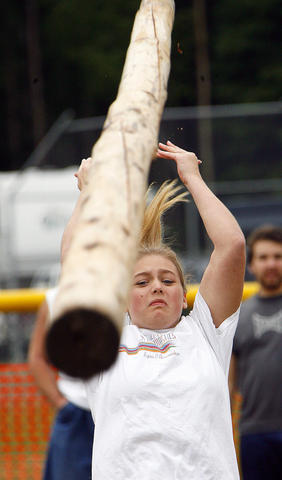
PHOTO: AP
Clan chieftains also used the games to find their strongest men, Webster said. That way, each chieftain had his champion and could challenge those in other clans as a substitute for battles.
Highland games were eventually formalized in the 19th century. Sir Walter Scott, author of Ivanhoe, arranged a display for the visit of King George IV to Edinburgh in 1822. It included a meeting of the clans, a piping competition, traditional dancing and the heavy throwing events, which are the four elements required for any games today.
The sport soon became a cultural export. In 1889, a party of Scots was invited to the Paris Exposition to put on a Highland games show. Sitting in the crowd was Baron Pierre de Coubertin, who created the modern Olympics five years later.
"He included putting the stone, throwing the weight for distance, the pole vault, throwing the hammer - all good Scottish things - having seen them there," Webster said.
Scottish immigrants spread their traditions as far as Canada, Australia and New Zealand. But Webster said it was Donald Dinnie who firmly established Highland games during tours in the US, inspiring a group of amateur athletes in New York.
Last weekend, there was one New Yorker taking on the Scots. David Barron, a Manhattan lawyer, competes in 10 to 15 games a year.
"The guy who wins this weekend will make £1,000 (US$2,032), maybe £2,000," he said. "And that's on the high end. You've got to be doing it for the love of it."
His fellow American Sean Betz, a personal trainer from Omaha, Nebraska, said that even without the high stakes of most world-class sporting events, Highland games provided a better atmosphere for competition.
"There's no animosity at all," he said. "You're not as nervous and you're not rooting for people to mess up."
The caber toss was the last event on the schedule and the rain-sodden fans were rewarded with a Scottish victory Sunday. Edmunds's throw was good enough to defeat the five-time champion Ryan Vierra, a professional Highland games athlete of Hilmar, California. What the championship lacked in prize money, it more than made up for by staying true to the sport's local roots. Edmunds put down his sword for a moment and waved his trophy in the air: a bottle of 25-year-old Scotch.
The only thing threatening to overshadow the championships was a caber thief. Last week, while the poles were being soaked in a local loch to attain the necessary weight, one of them was stolen. The perpetrator and 6m pole are still at large.

In late October of 1873 the government of Japan decided against sending a military expedition to Korea to force that nation to open trade relations. Across the government supporters of the expedition resigned immediately. The spectacle of revolt by disaffected samurai began to loom over Japanese politics. In January of 1874 disaffected samurai attacked a senior minister in Tokyo. A month later, a group of pro-Korea expedition and anti-foreign elements from Saga prefecture in Kyushu revolted, driven in part by high food prices stemming from poor harvests. Their leader, according to Edward Drea’s classic Japan’s Imperial Army, was a samurai

Approaching her mid-30s, Xiong Yidan reckons that most of her friends are on to their second or even third babies. But Xiong has more than a dozen. There is Lucky, the street dog from Bangkok who jumped into a taxi with her and never left. There is Sophie and Ben, sibling geese, who honk from morning to night. Boop and Pan, both goats, are romantically involved. Dumpling the hedgehog enjoys a belly rub from time to time. The list goes on. Xiong nurtures her brood from her 8,000 square meter farm in Chiang Dao, a mountainous district in northern Thailand’s

Located down a sideroad in old Wanhua District (萬華區), Waley Art (水谷藝術) has an established reputation for curating some of the more provocative indie art exhibitions in Taipei. And this month is no exception. Beyond the innocuous facade of a shophouse, the full three stories of the gallery space (including the basement) have been taken over by photographs, installation videos and abstract images courtesy of two creatives who hail from the opposite ends of the earth, Taiwan’s Hsu Yi-ting (許懿婷) and Germany’s Benjamin Janzen. “In 2019, I had an art residency in Europe,” Hsu says. “I met Benjamin in the lobby
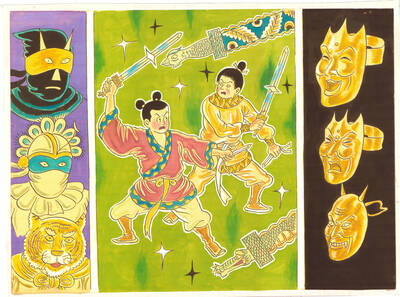
April 22 to April 28 The true identity of the mastermind behind the Demon Gang (魔鬼黨) was undoubtedly on the minds of countless schoolchildren in late 1958. In the days leading up to the big reveal, more than 10,000 guesses were sent to Ta Hwa Publishing Co (大華文化社) for a chance to win prizes. The smash success of the comic series Great Battle Against the Demon Gang (大戰魔鬼黨) came as a surprise to author Yeh Hung-chia (葉宏甲), who had long given up on his dream after being jailed for 10 months in 1947 over political cartoons. Protagonist


 RSS
RSS