


Kelli Smith was nervous as she walked into the Philadelphia treatment center, seeking help at last for her anorexia. Looking around at the other patients, she was struck by how young they seemed.
"I just kind of looked around and I thought, 'Oh, where is someone my age?'" recalls Smith. At age 31, she found herself face-to-face with teenagers and 20-somethings.
Eating disorders such as anorexia and bulimia have long been considered diseases of the young, but experts say in recent years more American women have been seeking help in their 30s, 40s, 50s, and older. Some treatment centers are creating special programs for these more mature patients.
Most of the women in this age group who seek treatment have had the problem for years, said Donald McAlpine, director of an eating disorders clinic at Mayo Clinic in Rochester, Minnesota.
"The epidemiology is pretty clear that anorexia and bulimia both peak in the late teens, early 20s," yet "a lot of (patients) continue to be symptomatic right on through to middle life."
People who study eating disorders suggest several reasons there might be more women over 30 seeking treatment for what is typically a young woman's problem: growing public awareness, social pressure to be thin and an aging group of baby boomers.
US national statistics on eating disorders are hard to come by, but data from some treatment centers suggest a steady increase.
In the Minneapolis suburb of St. Louis Park, Park Nicollet Health Services' Eating Disorders Institute saw 43 patients ages 38 and older in 2003 - about 9 percent of its total patients. For the first six months of this year, the institute has treated nearly 500 patients 38 and older, about 35 percent of its total.
The Renfrew Center, a network of treatment centers in the eastern US, said it saw a steady increase in the percentage of patients 30 and older who sought treatment at its Philadelphia center for eating disorders, peaking at 20 percent of 522 patients in 2005 before declining in 2006.
"Whatever this is -- if it's an increased awareness, if it's a response to being in midlife - those numbers are staggering," said Carol Tappen, director of operations for the Eating Disorders Institute.
Women over 30 who seek treatment tend to fall into three categories, said Holly Grishkat, who directs outpatient programs at Renfrew.
Some have had an eating disorder for years. Others had a disorder in remission that resurfaced because of new stress in life, such as a divorce or loss of a parent. A third group, the smallest of the three, includes women who develop an eating disorder late in life.
Of Renfrew's patients over age 30 in 2005, about 60 percent first suffered from an eating disorder at 18 or younger. Nearly 20 percent said they were 30 or older when they first encountered the problem.
While body image is an issue for any age group, women over 30 are dealing with problems that teens do not have, such as work, divorce, stepchildren and aging parents.
"It's not about wanting to be the cheerleader or being the homecoming queen," said Tappen. "It's much bigger than that."
They also are dealing with an aging process, or childbirth, that changes the way they look.
"One day, (a woman) wakes up and the kids are gone and she has a sense that nobody really needs her. She looks in the mirror and she says, 'My body is shot,'" said Tappen. "This woman says, 'You know, that's it. I'm going on a diet.'"
Tappen said the aging of the huge baby boomer population may be one reason the Eating Disorders Institute has seen more older patients. Not only are there now more people in this group, but this population has traditionally been image-conscious, she said.
"Baby boomers have always cared about how they looked, what they wear," she said. "I think a lot of eating disorders years ago went undiagnosed because it was the thing to do."
The Eating Disorders Institute is building a new facility, set to open in 2009, that will offer a treatment track for mature patients.
Grishkat, of The Renfrew Center, encourages older women to seek age-specific treatment programs. Some may be embarrassed to get help alongside very young women. Also, some older women may take on maternal roles for younger girls when they should be focusing on themselves, she said.
"It's not a lost cause at 30, 40, 50 years old," she said.
"You can still get better. In some sense, the older women do better in recovery than younger women. They tend to be more motivated."
For Smith, motherhood was a motivator. When she entered treatment, she was told she might have internal damage that could affect her ability to have children. Now 39 and out of treatment, she and her husband are parents to a 2-year-old boy and live in New Jersey. She says she is in recovery, and her primary goal these days is to be healthy.
"There's no question I put on weight because I wanted to have a baby," she said. "And I stay healthy right now for my baby."
On the Net:
National Institute of Mental Health: http://www.nimh.nih.gov/publicat/eatingdisorders.cfm
Renfrew Center: http://www.renfrewcenter.com/
Park Nicollet Eating Disorders Institute: http://www.parknicollet.com/methodist/edi/

Last week Joseph Nye, the well-known China scholar, wrote on the Australian Strategic Policy Institute’s website about how war over Taiwan might be averted. He noted that years ago he was on a team that met with then-president Chen Shui-bian (陳水扁), “whose previous ‘unofficial’ visit to the US had caused a crisis in which China fired missiles into the sea and the US deployed carriers off the coast of Taiwan.” Yes, that’s right, mighty Chen caused that crisis all by himself. Neither the US nor the People’s Republic of China (PRC) exercised any agency. Nye then nostalgically invoked the comical specter

Relations between Taiwan and the Czech Republic have flourished in recent years. However, not everyone is pleased about the growing friendship between the two countries. Last month, an incident involving a Chinese diplomat tailing the car of vice president-elect Hsiao Bi-khim (蕭美琴) in Prague, drew public attention to the People’s Republic of China’s (PRC) operations to undermine Taiwan overseas. The trip was not Hsiao’s first visit to the Central European country. It was meant to be low-key, a chance to meet with local academics and politicians, until her police escort noticed a car was tailing her through the Czech capital. The
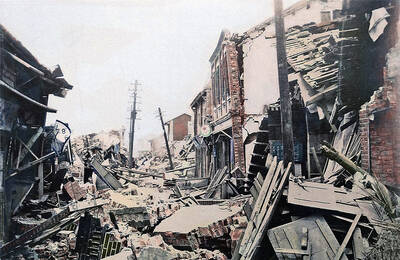
April 15 to April 21 Yang Kui (楊逵) was horrified as he drove past trucks, oxcarts and trolleys loaded with coffins on his way to Tuntzechiao (屯子腳), which he heard had been completely destroyed. The friend he came to check on was safe, but most residents were suffering in the town hit the hardest by the 7.1-magnitude Hsinchu-Taichung Earthquake on April 21, 1935. It remains the deadliest in Taiwan’s recorded history, claiming around 3,300 lives and injuring nearly 12,000. The disaster completely flattened roughly 18,000 houses and damaged countless more. The social activist and

Over the course of former President Ma Ying-jeou’s (馬英九) 11-day trip to China that included a meeting with Chinese Communist Party (CCP) leader Xi Jinping (習近平) a surprising number of people commented that the former president was now “irrelevant.” Upon reflection, it became apparent that these comments were coming from pro-Taiwan, pan-green supporters and they were expressing what they hoped was the case, rather than the reality. Ma’s ideology is so pro-China (read: deep blue) and controversial that many in his own Chinese Nationalist Party (KMT) hope he retires quickly, or at least refrains from speaking on some subjects. Regardless


 RSS
RSS