


On a muggy day in Kigali in 2003, some of the highest-ranking officials in the Rwandan government, including President Paul Kagame, flanked an American businessman, Greg Wyler, as he boldly described how he could help turn their small country into a hub of Internet activity.
Wyler, an executive based in Boston who made his fortune during the tech boom, said he would lace Rwanda with fiber optic cables, connecting schools, government institutions and homes with low-cost, high-speed Internet service. Until that point, Wyler, 37, had never set foot in Africa - he was invited by a Rwandan government official he had met at a wedding. Wyler never expected to start a business there; he simply wanted to try to help the war-torn country.
Even so, Wyler's company, Terracom, was granted a contract to connect 300 schools to the Internet. Later, the company would buy 99 percent of the shares in Rwandatel, the country's national telecommunications company, for US$20 million.
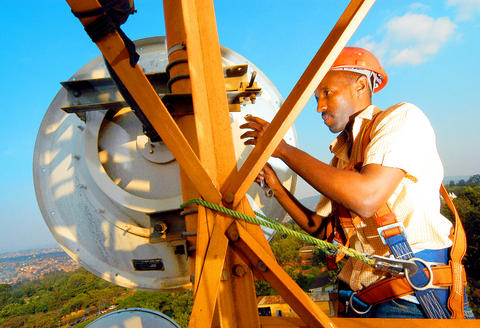
But after nearly four years, most of the benefits hailed by him and his company have failed to materialize, Rwandan officials say. "The bottom line is that he promised many things and didn't deliver," said Albert Butare, the country's telecommunications minister.
Wyler says he sees things quite differently, and he and Rwandan officials will probably never agree on why their joint venture has been so slow to get off the ground.
UNREALISTIC expectations
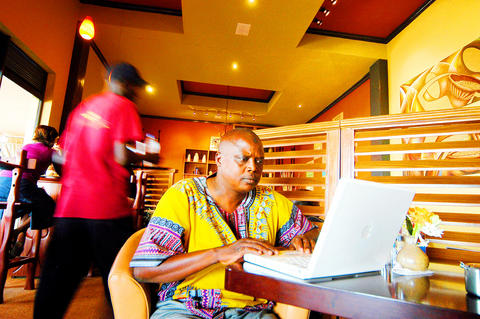
PHOTOS: NY TIMES NEWS SERVICE
Attempts to bring affordable high-speed Internet service to the masses have made little headway on the continent. Less than 4 percent of Africa's population is connected to the Web; most subscribers are in North African countries and the republic of South Africa.
A lack of infrastructure is the biggest problem. In many countries, communications networks were destroyed during years of civil conflict, and continuing political instability deters governments or companies from investing in new systems. E-mail messages and phone calls sent from some African countries have to be routed through Britain, or even the US, increasing expenses and delivery times. About 75 percent of African Internet traffic is routed this way and costs African countries billions of extra US dollars each year that they would not incur if their infrastructure was up to date.
As of this week, only one-third of the 300 schools covered in Terracom's contract had high-speed Internet service. All 300 were supposed to have been connected by 2006.
Overall, less than 1 percent of the population is connected to the Internet. Rwandan officials say the company seems more interested in tapping the more lucrative cell phone market than in being an Internet service provider. (In November, Wyler stepped down as chief executive of Terracom.)
In a telephone interview from his home in Boston, Wyler said there were some things he had not anticipated, particularly the technical challenges of linking Rwanda's Internet network to the rest of the world. The only way to do it is to buy bandwidth capacity on satellites, but there are not enough satellites to meet demand.
Wyler also says he believes that Terracom suffers from unrealistic expectations. "Terracom has done everything it can," he said. "Because of the technical challenges, the Internet service is as good as it's going to get."
The Rwandan government had hoped that the number of Web surfers would be much higher by now. Rwanda, which is about the size of Maryland, has little industry, and its infrastructure is still being rebuilt after the 1994 genocide in which 800,000 to a million people were killed.
the only option
"We have almost no natural resources and no seaports in Rwanda, which leaves us only with trying to become a knowledge-based society," said Romain Murenzi, the minister of science, technology and scientific research.
The situation came to a head late last year, when government officials contended that Terracom secretly tried to trade its shares in the Rwandan telecom to GV Telecom, a regional African telecommunications company incorporated in the British Virgin Islands. Rwandan officials were furious, saying this was a violation of the contract signed by the two parties.
The plan was scrapped and Wyler was widely criticized. Last month, the government fined Terracom nearly US$400,000 for failing to comply with its licensing obligations, failing to provide information about its operations and failing to pay several fees.
"We decided to penalize Terracom after they failed to fulfill their obligations for a long time," said Beatha Mukangabo, legal officer for the Rwanda Utilities Regulatory Agency. Terracom said it has paid the fines and is working with the government to meet all of its obligations.
Wyler said he has not been involved in Terracom for nearly 10 months and could not comment on its current operations.
Christopher Lundh, Terracom's new chief executive and a former executive of Gateway Communications in London, has worked in several African countries. He now lives and works full time in Rwanda, and many government officials say Terracom's performance has improved under his leadership.
Lundh acknowledged that there were problems with the company's operations in the past. "The former management did make some promises that they were not able to keep," he said. In addition, he said that many of the complaints about the company concerned things beyond its ability to control. Getting adequate bandwidth remains a constant challenge.
satellite service
Like most telecommunications companies in eastern Africa, Terracom depends on satellites for Internet service. Satellite service is much slower than cable because of delays in the signals. Satellites also provide less bandwidth than cable.
Adding to the problem is that most of the satellites serving Africa were launched nearly 20 years ago and are aging or going out of commission. A satellite set to go into service last year blew up on the launching pad. Power is also an issue, as intermittent power failures in Rwanda hamper efforts to provide a steady electricity source.
Despite these limitations and earlier setbacks, Lundh says Terracom is moving ahead with plans to give Rwanda the most advanced Internet infrastructure in Africa. A nationwide wireless connection should begin operating near year-end, he said, about the time a nonprofit group, One Laptop Per Child, based in Boston, is to introduce a US$100 laptop in the country.
And Terracom is continuing to lay fiber optic cables to connect Rwanda to several other African countries, eliminating a need for phone calls and Internet traffic to be routed via European or American networks.
In late October of 1873 the government of Japan decided against sending a military expedition to Korea to force that nation to open trade relations. Across the government supporters of the expedition resigned immediately. The spectacle of revolt by disaffected samurai began to loom over Japanese politics. In January of 1874 disaffected samurai attacked a senior minister in Tokyo. A month later, a group of pro-Korea expedition and anti-foreign elements from Saga prefecture in Kyushu revolted, driven in part by high food prices stemming from poor harvests. Their leader, according to Edward Drea’s classic Japan’s Imperial Army, was a samurai

Located down a sideroad in old Wanhua District (萬華區), Waley Art (水谷藝術) has an established reputation for curating some of the more provocative indie art exhibitions in Taipei. And this month is no exception. Beyond the innocuous facade of a shophouse, the full three stories of the gallery space (including the basement) have been taken over by photographs, installation videos and abstract images courtesy of two creatives who hail from the opposite ends of the earth, Taiwan’s Hsu Yi-ting (許懿婷) and Germany’s Benjamin Janzen. “In 2019, I had an art residency in Europe,” Hsu says. “I met Benjamin in the lobby

April 22 to April 28 The true identity of the mastermind behind the Demon Gang (魔鬼黨) was undoubtedly on the minds of countless schoolchildren in late 1958. In the days leading up to the big reveal, more than 10,000 guesses were sent to Ta Hwa Publishing Co (大華文化社) for a chance to win prizes. The smash success of the comic series Great Battle Against the Demon Gang (大戰魔鬼黨) came as a surprise to author Yeh Hung-chia (葉宏甲), who had long given up on his dream after being jailed for 10 months in 1947 over political cartoons. Protagonist

Peter Brighton was amazed when he found the giant jackfruit. He had been watching it grow on his farm in far north Queensland, and when it came time to pick it from the tree, it was so heavy it needed two people to do the job. “I was surprised when we cut it off and felt how heavy it was,” he says. “I grabbed it and my wife cut it — couldn’t do it by myself, it took two of us.” Weighing in at 45 kilograms, it is the heaviest jackfruit that Brighton has ever grown on his tropical fruit farm, located


 RSS
RSS