


There is something unnerving about watching a polar bear stalk across floating sea ice high in the Arctic and doing so from the frigid waters directly beneath the bear, the world's largest four-legged predator.
Overhead, through ice so thin that it is transparent, plate-size paws set down, one after the other, as the half-ton animal pursues its prey.
Gripping moments like this abound in Arctic Tale, a new film exploring challenges facing polar bears and walruses, two familiar denizens of the icy, but warming, seas at the top of the world. But Arctic Tale is not a typical addition to a lengthening line of somber documentaries on dangerous or endangered wildlife.

PHOTOS: NY TIMES NEWS SERVICE
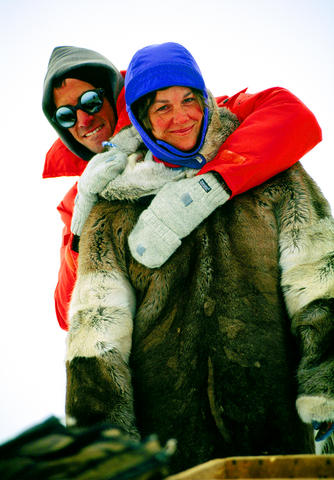
Instead, Adam Ravetch and Sarah Robertson, a husband and wife who have spent the better part of two decades filming the Arctic's hulking, reclusive and sometimes deadly mammals for television nature shows, sifted through more than 800 hours of their own footage and that of other filmmakers to assemble a fictional, family-friendly coming-of-age tale.
laughter and tears
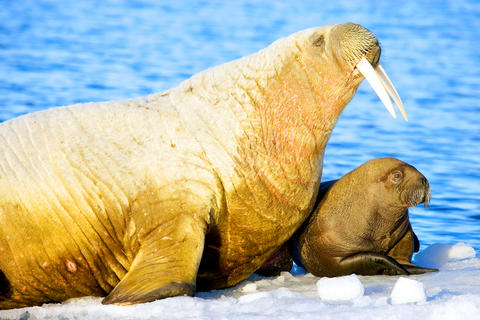
The film follows this unorthodox gambit to tell of the entwined lives and travails of two composite characters, Nanu, a young bear, and Seela, a walrus. Their stories are related, fable style, by Queen Latifah, and include scenes ranging from the wrenching, when a bear cub falters and fades in a relentless blizzard, to the comic, when a heap of basking walruses erupt into a flatulent chorus after bingeing on clams. (An adult can eat 4,000 a day.)
Arctic Tale is clearly aimed at the same audiences that flocked in unexpected numbers to An Inconvenient Truth, which chronicled Al Gore's climate campaign, and March of the Penguins, which followed the life cycle of rugged inhabitants from the other frozen end of the world. But Adam Leipzig, the president of National Geographic Films, which produced the film, said the project was conceived two years ago, before either documentary became a hit. The idea, he said, was to make a wildlife film "that really holds up as a movie." (Paramount Classics will release the film in the US in mid-August.)
Some early reviews have questioned the value of assembling footage of various animals at different life stages to construct artificial life stories complete with human-like villains and heroes, including a walrus Auntie who gives her life in defense of Seela.
The trade newspaper Variety noted that "the anthropomorphism is relentless, as animal communities are mined for their most recognizably human characteristics - not hard to do, given the outsized personalities of the main subjects."
Leipzig defended the approach, saying the goal was to create a new genre of "wildlife adventure" movies.
docu-soap
"It isn't fictionalized in the way that Transformers is fictionalized," Leipzig said. "This genre is movies about the creatures of the world as they actually exist, with their real behaviors documented by the foremost wildlife cinematographers in the world and crafted into stories that can entertain and educate audiences and where there are deep resonances that audiences can respond to."
Ravetch, like Leipzig, sees the emotional power of the film flowing from the images and moments more than the imagined story.
"When you see a mother hug an animal, that's undeniably an act of emotion and caring," he said. "In the scene where a mother polar bear has to cast off the baby because she can't fend for the both of them anymore, it's got sort of that tough-love feel. But you see that emotion in the footage."
Providing the characters with names, Robertson said, makes it easier to relate to the animals through the stages of their lives. The Hollywood tactics also ensure that the movie plays as a parable about adjusting to changing conditions on a warming planet.
The Arctic in recent decades has experienced sharp warming and a dramatic pullback of sea ice in summers, developments that many climate experts attribute at least in part to the buildup of carbon dioxide and other heat-trapping emissions in the atmosphere. Should these recent trends persist, they say, later this century the Arctic Ocean - routinely cloaked with sea ice for thousands of years - could be open blue water in summers.
The shifting conditions prompted federal scientists last December to propose a "threatened" listing for polar bears under the Endangered Species Act and a fresh assessment of the species' prospects is under way.
Polar bears, partly due to animated Coke ads and dozens of zoo exhibits, have carved out a cuddly place in popular culture, but up close and personal they are ferocious predators, making the task of collecting the raw footage for the movie a daunting exercise. All wildlife filming has its challenges, whether in the Amazon, Himalayas or Serengeti. But it would be hard to top the difficulty of filming polar bears outside the few spots where they congregate in significant numbers, like Churchill, Manitoba, except perhaps if one's quarry is walruses, which are even larger (big ones can exceed the dimensions of a Mini Cooper) and can be just as dangerous if spooked.
The challenges are amplified if the filmmaker's goal is to chronicle the lives of these species both above and under the floating ice, which is where Robertson and Ravetch, a seasoned diver as well as wildlife cinematographer, have gone repeatedly since the early 1990s.
shrinking world
Often with their children in tow, they spent season after season pursuing pivotal scenes in the lives of their quarry: the tentative first foray out of a snow-covered den by two polar bear cubs, after which one topples backward comically into the hole; the embrace of a walrus calf, umbilical cord still trailing, in the surprisingly dexterous flippers of its mother; the tutorials in which a mother polar bear shows cubs how to reach a seal cached in layered sea ice by rearing up to full height and hammering stiff forelegs downward; a chilling attack by a polar bear on a walrus amid a great jiggling panicked mass of the tusked marine mammals.
Ravetch said he has seen Arctic conditions shift starkly since 1990, when he and Robertson started filming in the far north. Around Baffin Island in northern Canada, he said, where thick ice was the norm in springtime years ago, seas are often a dangerous slushy mess.
In one scene a mother bear and cubs are seen tentatively crossing such disintegrated ice, which gives like a waterbed underfoot.
"We've seen these areas getting warmer to the point where this last year by April it had been raining for three months," Ravetch said.
Another reason for having named, if composite, animal characters, Robertson said, was "to give climate change a face."
"Climate change is a bunch of statistics for many people," Robertson said. "But regionally climate change is affecting not only people but animals. We wanted to really settle in on the moments and the decisions and reactions of animals when they are faced in regional areas with climate change."
Despite the challenges of the ice retreat (the ice helps polar bears, for example, stalk and ambush seals, and is a haven for walrus pups), she and Ravetch said they were convinced that both species would endure. "Polar bears and walruses are resourceful learners, so over the short term they'll find new ways to hunt and live," Ravetch said. "But they can't do the impossible, and in the long term we really don't know what will happen to them, which is true also for ourselves. It's going to be a journey for every creature on the planet."

Last week Joseph Nye, the well-known China scholar, wrote on the Australian Strategic Policy Institute’s website about how war over Taiwan might be averted. He noted that years ago he was on a team that met with then-president Chen Shui-bian (陳水扁), “whose previous ‘unofficial’ visit to the US had caused a crisis in which China fired missiles into the sea and the US deployed carriers off the coast of Taiwan.” Yes, that’s right, mighty Chen caused that crisis all by himself. Neither the US nor the People’s Republic of China (PRC) exercised any agency. Nye then nostalgically invoked the comical specter
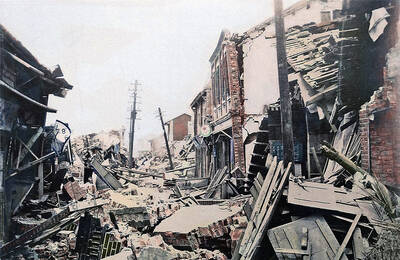
April 15 to April 21 Yang Kui (楊逵) was horrified as he drove past trucks, oxcarts and trolleys loaded with coffins on his way to Tuntzechiao (屯子腳), which he heard had been completely destroyed. The friend he came to check on was safe, but most residents were suffering in the town hit the hardest by the 7.1-magnitude Hsinchu-Taichung Earthquake on April 21, 1935. It remains the deadliest in Taiwan’s recorded history, claiming around 3,300 lives and injuring nearly 12,000. The disaster completely flattened roughly 18,000 houses and damaged countless more. The social activist and

Over the course of former President Ma Ying-jeou’s (馬英九) 11-day trip to China that included a meeting with Chinese Communist Party (CCP) leader Xi Jinping (習近平) a surprising number of people commented that the former president was now “irrelevant.” Upon reflection, it became apparent that these comments were coming from pro-Taiwan, pan-green supporters and they were expressing what they hoped was the case, rather than the reality. Ma’s ideology is so pro-China (read: deep blue) and controversial that many in his own Chinese Nationalist Party (KMT) hope he retires quickly, or at least refrains from speaking on some subjects. Regardless

Approaching her mid-30s, Xiong Yidan reckons that most of her friends are on to their second or even third babies. But Xiong has more than a dozen. There is Lucky, the street dog from Bangkok who jumped into a taxi with her and never left. There is Sophie and Ben, sibling geese, who honk from morning to night. Boop and Pan, both goats, are romantically involved. Dumpling the hedgehog enjoys a belly rub from time to time. The list goes on. Xiong nurtures her brood from her 8,000 square meter farm in Chiang Dao, a mountainous district in northern Thailand’s


 RSS
RSS