


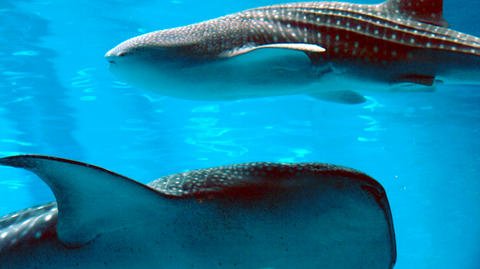
No visit to the Georgia Aquarium in downtown Atlanta is complete without a stroll through its most impressive feature, a transparent tunnel that transverses the world's largest fish tank. When viewed from inside, the 24-million-liter Ocean Voyager Exhibit teems with schools of predatory ronin, fleets of stingrays, goliath groupers and hammerhead sharks. The fanciful vista reveals many wonders, but none so magnificent as its four Taiwanese whale sharks, bus-sized fish on display for the first time anywhere outside Asia.
These gentle leviathans, named Alice and Trixie, Yushan and Taroko, are the Georgia Aquarium's star attractions. In its displays, press releases, Web site and talking points, the Georgia Aquarium - which has been visited by more than 5 million people and viewed in the media by millions more since it opened nearly two years ago - describes Taiwan as a beautiful country that cares for the environment. For a diplomatically isolated nation like Taiwan, publicity can't get much better than this.
But many within the conservation community, both in Taiwan and abroad, have argued against sending the whale sharks to Georgia. Pointing to statistics that show a steady decline in both the size and number of whale sharks observed in Taiwanese waters, they say the removal of even a few individuals could disrupt migration patterns and speed population decline. Paying for whale sharks, they say, encourages fishermen to capture more in the hopes of selling them to other aquariums and marine parks. And they note aquariums in Taiwan and Japan experienced problems keeping these delicate creatures healthy.
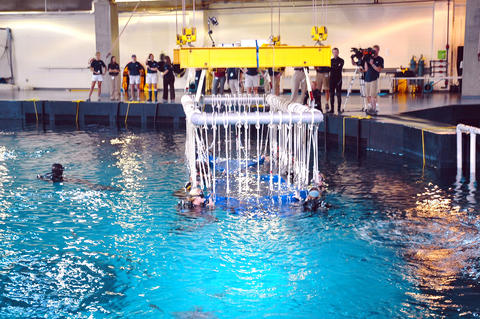
PHOTOS: AP AND AFP
"Catching whale sharks and sending them overseas is the wrong way to protect this threatened species," says Allen Chen (陳昭倫), a marine biologist at Academia Sinica. "This is the world's biggest fish. It's hard for them to survive in the ocean, much less an aquarium, no matter how big or technologically advanced it is. If they run into a fisherman's net, tag them and let them go, don't fly them 16,000km to Georgia, where their final destination is death. I don't think Georgia will ship them back to Hualien like Free Willy."
"The Georgia Aquarium is portraying itself as the rescuer of these whale sharks. We, the nice imperialist Americans, went in there and saved the whale sharks," said Naomi Rose, a marine mammal specialist at the Humane Society of the United States. "But when you pay fishermen big money for live animals, that creates an incentive for fisherman to go out and catch more and try to get more buyers," she added, citing the bottle-nosed dolphin as an example. Japanese fishermen, she said, catch them by the thousands because every year a few are sold for US$20,000 to US$30,000 to water parks in China and elsewhere. The rest, seen as competition for fish, are killed.
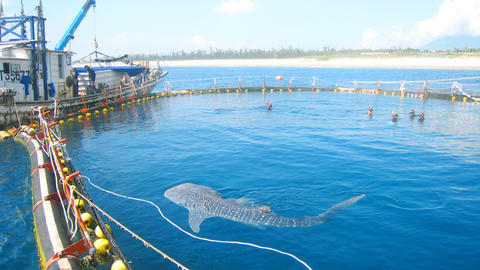
In Taiwanese waters, whale sharks are usually caught in position nets, which are designed to catch other large fish, such as bluefin tuna and mackerel. These nets funnel the fish into ever-smaller nets and cause minimal harm, making fish captured this way attractive candidates for an aquarium.
Whale sharks have long been occasional items on Taiwanese dinner plates. They're called "tofu sharks" (豆腐鯊魚) - though Taiwanese conservationists now seem to prefer the more politically correct "whale shark" (鯨鯊) - because, like tofu, their meat is soft and flavorless. It must be smoked and eaten with wasabi and soy sauce, or stir-fried with garlic, chili, and other heavy ingredients to make it palatable.
Fishermen traditionally did not fish for whale sharks, but media coverage of the big swimmers as an exotic food instigated commercial hunting a decade ago. The average price for whale shark meat in recent years was NT$200 per kilogram, meaning a typical specimen would sell for NT$200,000 to NT$300,000.
According to the World Wildlife Federation (WWF), Taiwan was possibly the world's largest market for whale shark meat. Some 32.5 tonnes of meat were obtained from legal harvests in 2004 in a survey of only two major wholesale fishery markets, one in Taipei, the other in Taichung. The same year, Taiwanese consumed 68.5 tonnes of whale shark.
Conservationists have long pushed for the government to ban the trade and consumption of whale shark meat. Data collected by the National Ocean University in Keelung shows that both the number and average size of whale sharks sighted in Taiwanese waters has declined slowly but steadily over the past six years. The Council of Agriculture's Fisheries Regulation Division says it has been monitoring the situation and decided in 2000 to phase out whale shark fishing, an official said.
Though there is some dispute, the Georgia Aquarium likely helped speed this process. This year saw the death of the first pair of Taiwanese whale sharks, males named Ralph and Norton after characters in the television series The Honeymooners. Ralph sank to the bottom of Ocean Voyager exhibit in January. Norton was euthanized under similar circumstances in June. Both had shown signs of illness and had been force-fed through PVC tubes for months. The aquarium is still investigating the cause of the deaths but has indicated that a chemical used to clean the tank may have been the culprit. Alice and Trixie, who arrived later, were not exposed to the chemical.
In addition to creating a public relations disaster for the Georgia Aquarium, Ralph's death threatened its agreement with Taiwan to import a final pair of whale sharks. There was an understanding that a total of six whale sharks would be sent to Atlanta, and three of the giant fish, named Alishan, Yushan and Taroko, were being held in the ocean just off Hualien while scientists monitored their health and decided which two were to go.
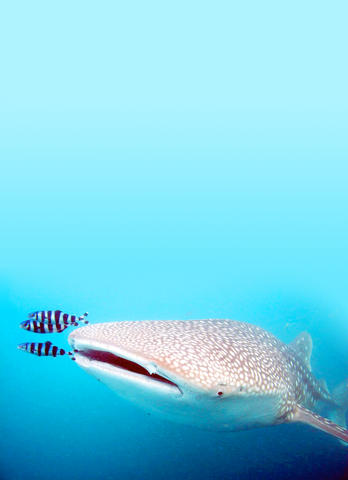
The three fish were among the 30 Taiwan allowed fishermen to catch and sell this year under a quota system. Originally set at 80, the quota has been steadily reduced until this year, when it was reached in March. In May the government announced it had banned the fishing, trade, and consumption of whale sharks entirely. If a Taiwanese aquarium should decide in the future that it wanted a whale shark, it would have to get one from another country.
Critics of the Georgia Aquarium in the US speculated that the final ban was related to Ralph's death. The Georgia Aquarium, however, has suggested its work with Taiwan helped push the government in the right direction. In an interview on Thursday, Georgia Aquarium President Jeff Swanagan said he believed the aquarium had "some influence." Elaborating on this comment Friday in an e-mail exchange, spokesman Dave Santucci wrote: "The role we played was to raise the global awareness of whale sharks by the 5 million guests we've had here in the first 18 months and the billions we've reached through the media."
Huang Ming-ho (黃明和), Director of the Council of Agriculture's Fisheries Regulation Division, says the complete ban had been a target for years and that neither Ralph's death nor advice from Georgia had anything to do with it. This opinion was seconded by Liu Kwang-ming (劉光明) a professor who specializes in shark research at the National Ocean University in Keelung, and a graduate student there.
Lin Tze-tong (林慈烔), who runs an air cargo service and helped transport the sharks, disagrees. "There was definitely a growing awareness that whale sharks needed to be protected," said Lin, who has also overseen the shipment of koalas and gorillas to the Taipei Zoo. "But when the government saw how much the Georgia Aquarium valued these fish, it made officials more serious about conservation." Ironically, he added, "the deaths of Ralph and Norton also aided conservation in Taiwan because they forced the government to investigate the issue and explain to Taiwan's media what they were doing to protect whale sharks."
The fisheries division postponed the transfer of the final two whale sharks until the Georgia Aquarium adequately explained Ralph's death and gave a more thorough explanation of how the sharks would be cared for and of the scientific value of keeping them in captivity.
Huang said the department ultimately approved the transfer of the final two whale sharks, Taroko and Yushan, because the Georgia Aquarium was conducting research that could not be done in the field, running a top-notch educational program, and had demonstrated that it could take better care of the giant fish than Taiwan's National Museum of Marine Biology and Aquarium in Hengchun (恆春), near Kaohsiung, where the whale shark population has fallen from three to one after one animal died and the other fell ill and was released.
Even though Norton died soon after Yushan and Taroko arrived, the transfer of the Taiwanese whale sharks to the Georgia Aquarium seems to have improved Taiwan's image abroad, US conservationists say. "The fact that this trade was going on and there was hunting going on prior to the ban was a negative thing," Rose said. "When the ban was put into place, it got pretty good coverage."
"We applaud Taiwan for its leadership in conservation," Swanagan said. "I think our affiliation has helped people understand the incredible commitment Taiwan has to environmental stewardship."

Last week Joseph Nye, the well-known China scholar, wrote on the Australian Strategic Policy Institute’s website about how war over Taiwan might be averted. He noted that years ago he was on a team that met with then-president Chen Shui-bian (陳水扁), “whose previous ‘unofficial’ visit to the US had caused a crisis in which China fired missiles into the sea and the US deployed carriers off the coast of Taiwan.” Yes, that’s right, mighty Chen caused that crisis all by himself. Neither the US nor the People’s Republic of China (PRC) exercised any agency. Nye then nostalgically invoked the comical specter

Relations between Taiwan and the Czech Republic have flourished in recent years. However, not everyone is pleased about the growing friendship between the two countries. Last month, an incident involving a Chinese diplomat tailing the car of vice president-elect Hsiao Bi-khim (蕭美琴) in Prague, drew public attention to the People’s Republic of China’s (PRC) operations to undermine Taiwan overseas. The trip was not Hsiao’s first visit to the Central European country. It was meant to be low-key, a chance to meet with local academics and politicians, until her police escort noticed a car was tailing her through the Czech capital. The

April 15 to April 21 Yang Kui (楊逵) was horrified as he drove past trucks, oxcarts and trolleys loaded with coffins on his way to Tuntzechiao (屯子腳), which he heard had been completely destroyed. The friend he came to check on was safe, but most residents were suffering in the town hit the hardest by the 7.1-magnitude Hsinchu-Taichung Earthquake on April 21, 1935. It remains the deadliest in Taiwan’s recorded history, claiming around 3,300 lives and injuring nearly 12,000. The disaster completely flattened roughly 18,000 houses and damaged countless more. The social activist and

Over the course of former President Ma Ying-jeou’s (馬英九) 11-day trip to China that included a meeting with Chinese Communist Party (CCP) leader Xi Jinping (習近平) a surprising number of people commented that the former president was now “irrelevant.” Upon reflection, it became apparent that these comments were coming from pro-Taiwan, pan-green supporters and they were expressing what they hoped was the case, rather than the reality. Ma’s ideology is so pro-China (read: deep blue) and controversial that many in his own Chinese Nationalist Party (KMT) hope he retires quickly, or at least refrains from speaking on some subjects. Regardless


 RSS
RSS