


Being naturally creative, artists often excel at more than just making art. In some cases they so excel that they double up or even switch professions. In most cases, the art world benefits, as two exhibitions testify.
At the Hirshhorn Museum and Sculpture Garden in Washington, the West Coast Conceptualist John Baldessari was invited to select works from the permanent collection - mostly painting and sculpture, it turned out - and arrange them in several large galleries. He played curator with a level of flair and insight that should be as enlightening to full-time museum mavens as it is to the general public. The show is the first in a series to be overseen by artists, and Baldessari's turn is a great start.
The other show was initiated by the New York realist painter Marilyn Minter at White Columns, the intrepid alternative space in Manhattan's West Village. It features artwork - videos, painting and whatnot - by six prominent art dealers. All date from their respective youths, before they decided that they would rather represent artists than be them.
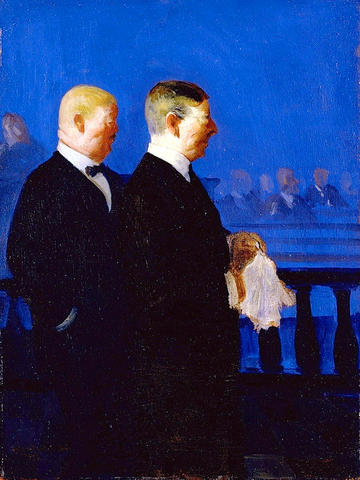
PHOTO: NY TIMES NEWS SERVICE
Together these shows affirm the value of artistic talent diverted onto other paths. Ways of Seeing: John Baldessari Explores the Collection makes excellent use of the Hirshhorn's mottled holdings, creating a visual daisy chain of about 65 works from 19th- and 20th-century Europe and America by artists both world-famous and completely forgotten. As with his own work, in which large dots of bright color disrupt blown-up black-and-white photographs and film stills with alternately sinister and wry results, Baldessari is equally attentive to abstraction and figuration, to form and narrative, but also has an eye for simpatico materials and textures. And his selections have the refreshing distinction of including very little in the way of Pop Art and no Abstract Expressionism or Minimal or Conceptual Art. You won't miss them.
The display is alternately lyrical and emphatic; it pirouettes through pale tones of cream and white, then breathes primary colors like fire. One way or another, everything is intensified and activated by its neighbors. In one area, a grouping of works by masters like Jasper Johns, Joseph Beuys and Bruce Nauman offers wonderful contrasts of pale waxy surfaces and ambiguous forms. But they are also ballyhooed by the kitschy irreverence of Emily Kaufman's nearby Girl on a Fainting Couch, a 1975 work in pinkish cast epoxy and fiberglass that melds an odalisque and her dainty chaise into a single, gleaming, undulant sheet of plastic-fantastic flesh.
In another sequence, the vivid blue in Oasis, a 1957 abstract painting by Philip Guston, draws out the matching color in Guy Pene du Bois' 1919 Lawyers. Then the fat-cat complacency of those men is countered by Thomas Eakins' astounding 1913 portrait of the anatomy professor Edward Anthony Spitzka, whose introspective face, defined by rough little patches of paint, seems at once flayed and Cubist.
A wood sculpture by Martin Puryear teeters like an elegant swan between a still life by Marsden Hartley and an inverted pair of trousers spread-eagled on a wire grid by Antoni Tapies, linking them through the use of wood, soft-toned shades of brown and pink and tilted postures.
Baldessari has clearly enjoyed himself, working with a passion that sometimes evades his own art. In the final sequences, he compares kinds of blackness in a painting by Ad Reinhardt, a sculpture by Anish Kapoor and another unusual Eakins study. He finishes with a striking arrangement of dark bronze or plaster portrait busts, including two tiny Daumiers, lined up in profile along the final wall.
Baldessari's effort is a valuable lesson in the relative nature of quality - anything can look good or at least interesting in the right company - and in the importance of visual surprise, especially through the use of forgotten, resonant works. The show also underscores the importance of a museum's permanent collection as a learning tool: When museums underutilize their holdings - which most do - they shortchange the growth of their curators as well as the public.
The attraction to art other than one's own can be so overwhelming that the need to continue making art evaporates. Early Work, the White Columns show, presents six examples and suggests that former artists may have a propensity for becoming art dealers. It allows them to remain close to the origin of new art, and to use their ability to understand, work with and, let's face it, have sustained contact with artists.
Minter, who collaborated on this show with the independent curator Fabienne Stephan and the White Columns staff, said their aim was to choose "good dealers who were also good artists." The works on view date from the late 1960s to the early 1990s. Konrad Lueg (1939-96), who gained fame as the Duesseldorf art dealer Konrad Fischer, is represented by a cheerfully patterned Pop-inspired abstract painting from 1966. In 1973 Maureen Paley, whose gallery, Interim Art, later helped jump-start the London art scene as we now know it, was in the swim of Post-Minimalism, documenting ephemeral installations by Polaroid.
Cheese Nips (Pathmark) - chain-store display as art - by Jeffrey Deitch, of Deitch Projects in SoHo, may qualify as Neo-Geo before the fact. A 1977 work recreated for this show, it dovetails with Deitch's admiration for artists like Andy Warhol, Jeff Koons and Haim Steinbach.
From Janice Guy, now a partner in the Chelsea gallery Murray Guy, we have images from around 1979 in which she aims a camera at a mirror while lying nude on a bed, a rudimentary reversal of the gaze. From about the same time are bondage videotapes starring Pat Hearn (1955-2000), a prominent New York dealer who began her art career as a flamboyant performance artist in Boston. Finally, Gavin Brown, whose gallery has been a fixture on the New York scene since 1994, made 7B/5E, five sweetly Conceptual pairings of photographs of similar rooms in two apartments in one building.
Although this work is no weaker than much of what routinely appears in gallery group shows devoted to young artists, it doesn't emit much heat. Perhaps the lesson is that anyone lucky enough to have a life centered on art should also have the courage to follow where art leads, even (or especially) if that is away from making the stuff. If you feel the love, the first responsibility is to spread it.

In late October of 1873 the government of Japan decided against sending a military expedition to Korea to force that nation to open trade relations. Across the government supporters of the expedition resigned immediately. The spectacle of revolt by disaffected samurai began to loom over Japanese politics. In January of 1874 disaffected samurai attacked a senior minister in Tokyo. A month later, a group of pro-Korea expedition and anti-foreign elements from Saga prefecture in Kyushu revolted, driven in part by high food prices stemming from poor harvests. Their leader, according to Edward Drea’s classic Japan’s Imperial Army, was a samurai

The following three paragraphs are just some of what the local Chinese-language press is reporting on breathlessly and following every twist and turn with the eagerness of a soap opera fan. For many English-language readers, it probably comes across as incomprehensibly opaque, so bear with me briefly dear reader: To the surprise of many, former pop singer and Democratic Progressive Party (DPP) ex-lawmaker Yu Tien (余天) of the Taiwan Normal Country Promotion Association (TNCPA) at the last minute dropped out of the running for committee chair of the DPP’s New Taipei City chapter, paving the way for DPP legislator Su
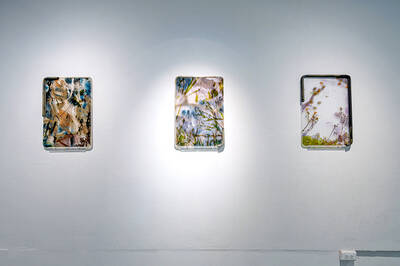
Located down a sideroad in old Wanhua District (萬華區), Waley Art (水谷藝術) has an established reputation for curating some of the more provocative indie art exhibitions in Taipei. And this month is no exception. Beyond the innocuous facade of a shophouse, the full three stories of the gallery space (including the basement) have been taken over by photographs, installation videos and abstract images courtesy of two creatives who hail from the opposite ends of the earth, Taiwan’s Hsu Yi-ting (許懿婷) and Germany’s Benjamin Janzen. “In 2019, I had an art residency in Europe,” Hsu says. “I met Benjamin in the lobby
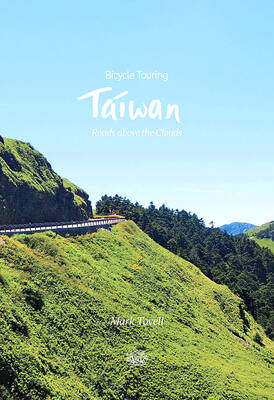
It’s hard to know where to begin with Mark Tovell’s Taiwan: Roads Above the Clouds. Having published a travelogue myself, as well as having contributed to several guidebooks, at first glance Tovell’s book appears to inhabit a middle ground — the kind of hard-to-sell nowheresville publishers detest. Leaf through the pages and you’ll find them suffuse with the purple prose best associated with travel literature: “When the sun is low on a warm, clear morning, and with the heat already rising, we stand at the riverside bike path leading south from Sanxia’s old cobble streets.” Hardly the stuff of your


 RSS
RSS