


Yang Soon-im says she began communicating with the spirits of mountains and ancient warriors more than 50 years ago, when she was only seven.
But it was decades after that, when her son miraculously survived a knife wound, that she decided she had no choice but to become the spirits' full-time channel with the living - a mudang, or shaman.
"I found her sitting on the roof chanting at 4am," her husband, Choi Jong-sam, 62, said of that day about 25 years ago. "She was puffing away at four packs of cigarettes. She said her mountain gods had saved our son in a sort of bargain. I slapped her face to help her get her wits back.
"Then her eyes blazed like those of a wild dog about to bite a man."
The deal Yang said she struck with her spirits eventually paid off in other ways.
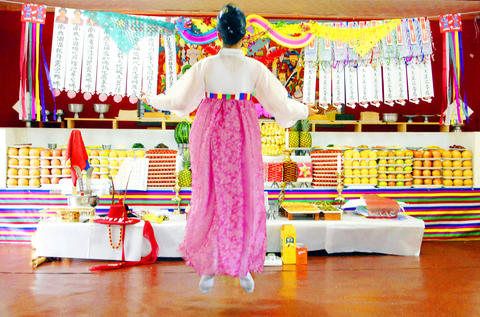
Now 60, she is one of the most sought-after shamans in Seoul - a leading member of a profession that has survived centuries of ridicule and persecution and is now enjoying a seemingly incongruous revival in one of the world's most technologically advanced countries.
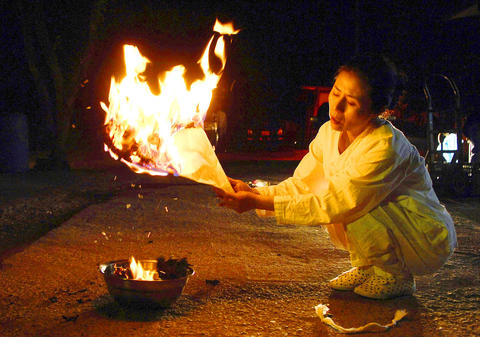
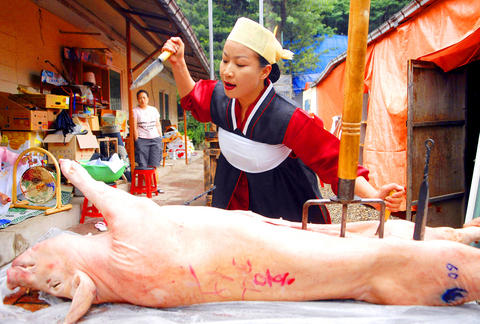
There are an estimated 300 shamanistic temples within an hour of Seoul's bustling city center, and in them, shamans perform their clamorous ceremonies every day. They offer pigs to placate the gods. They dance with toy guns to comfort the spirit of a dead child. They intimidate evil spirits by walking barefoot on knife blades.
high spirits
"We used to do our rituals in hiding," said Yang, who performs two or three rites on a busy day. "Our customers kept it secret from even their own relatives. Now we have no shame performing in public. I can hardly take three days off a month."
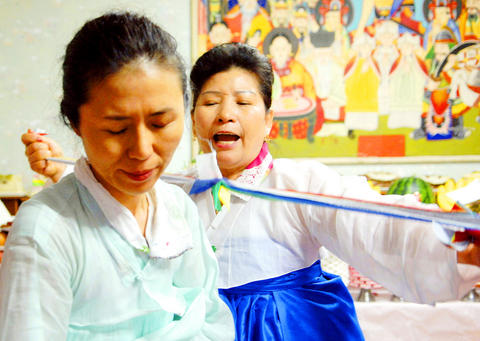
Korean shamanism is rooted in ancient indigenous beliefs shared by many folk religions in northeast Asia. Most mudangs are women who say they discovered their ability to serve as a mediator between the human and spirit worlds after emerging from a critical illness. They believe that the air is thick with spirits, including those of dead relatives, a fox in the hills behind a village, an old tree or even a stove. These spirits interact with people and influence their fortunes.
So when tradition-minded Koreans are inexplicably sick or have a run of bad luck in business or a daughter who cannot find a husband, they consult a shaman.
"If I contact the spirit of a man who died of stomach cancer, I get stomach pains for days," said Kim Hong-kyung, 33, who has conducted rituals with Yang. "If I deal with the spirit of a woman who died during labor, my belly balloons like a pregnant woman's."
PHOTOS: NY TIMES NEWS SERVICE
In an election year like this one, the most famous shamans are fully booked. Politicians, whether Christian or Buddhist, flock to them, asking, for instance, whether relocating their ancestors' remains to a more propitious site might ensure victory.
"Look around," said Kim Myung-soon, 41, a mudang who, in a recent ritual, decapitated a chicken with her bare hands. "So much of nature has been ruined. Spirits of trees and rocks are displaced and haunt humans because they have nowhere else to go. No wonder the country is a mess."
Shamans were demonized by Christian missionaries and driven underground during Japanese colonial rule. The military governments that came after the Korean War disparaged shamans as charlatans and often banished them from villages, burning their shrines. But today, even many who regard shamanism as superstition acknowledge it to be an important repository of Korean culture, because the rituals have preserved traditional costumes, music and dance forms. Recent governments have documented and promoted the rituals as "intangible cultural assets."
There are an estimated 300,000 shamans, or one for every 160 South Koreans, according to the Korea Worshipers Association, which represents shamans. They are fiercely independent, following different gods, sharing no one body of scriptures. And they are highly adaptable. When the Internet boom hit South Korea, shamans were among the first to set up commercial Web sites, offering online fortune-telling. Many younger shamans maintain Web logs.
"In our latest survey, we found 273 categories of gods venerated by Korean shamans. If you look into the subcategories, you find 10,000 deities," said Hong Tea-han, a professor at Chung-Ang University in Seoul who studies shamanism. "Korean shamanism is a great melting pot. It never rejected anything but embraced everything, making endless compromises with other religions and social changes. That explains why it has survived thousands of years."
There are shamans who venerate Jesus, the Virgin Mary, even Park Chung-hee, the late South Korean military strongman. Under the pro-American military governments of the 1970s, there were shamans who took General Douglas MacArthur as their deity. When MacArthur's spirit possessed them, they donned sunglasses, puffed on a pipe and uttered sounds that some clients took for English.
"Until perhaps 10 or 15 years ago, we had quite a few shamans who prayed before the MacArthur statue here," said Aegibosal, a shaman in Inchon, the port city where MacArthur's troops landed in 1950. "You don't see any of them any more."
MIX and MATCH
Shamanism's eclecticism has influenced Korean attitudes toward religion, helping make South Korea one of the world's most pluralistic countries - a place where Buddhism, Confucianism and Christianity coexist peacefully and often overlap, said Yang Jong-sung, a senior curator at the National Folklore Museum of Korea.
"Korean shamanism is very, very materialistic and this-worldly, as Koreans tend to be," the curator said. "I don't think a Christian pastor can succeed here if he only talks about heaven and does not hint at health and material prosperity."
In a recent ritual, Yang and two associates spent hours carefully stacking their altar with fruits, dried fish and rice cakes. They decorated their room with portraits of gods and unpacked a suitcase full of brightly colored costumes they changed into at different stages of the rite.
Their customer, a 51-year-old nurse, wanted the shamans' help in getting a divorce from her unfaithful husband. Instead, for 5 million won, or US$5,400, the shamans promised to help them reconcile.
Yang's diagnosis: the husband had turned into a "horsefly that sucks bone marrow out of your spine," because the couple had been cursed by a baby she had aborted, an uncle who committed suicide and a well her family had filled years before.
Yang and the nurse embraced and sobbed when the nurse's dead mother, whom she had not mentioned to the shamans, spoke through Yang.
Then Yang's younger associate, Chung Joon-ha, 42, a former army sergeant, danced with knives and a lump of raw pork in his mouth, his eyes rolling back into their sockets.
"We are like a hospital," he later said. "We do surgery on people's bad luck."
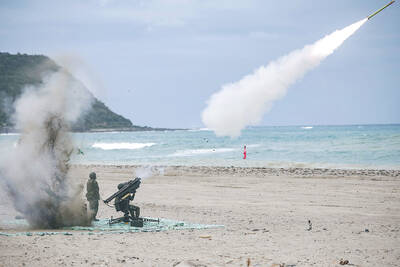
In late October of 1873 the government of Japan decided against sending a military expedition to Korea to force that nation to open trade relations. Across the government supporters of the expedition resigned immediately. The spectacle of revolt by disaffected samurai began to loom over Japanese politics. In January of 1874 disaffected samurai attacked a senior minister in Tokyo. A month later, a group of pro-Korea expedition and anti-foreign elements from Saga prefecture in Kyushu revolted, driven in part by high food prices stemming from poor harvests. Their leader, according to Edward Drea’s classic Japan’s Imperial Army, was a samurai

The following three paragraphs are just some of what the local Chinese-language press is reporting on breathlessly and following every twist and turn with the eagerness of a soap opera fan. For many English-language readers, it probably comes across as incomprehensibly opaque, so bear with me briefly dear reader: To the surprise of many, former pop singer and Democratic Progressive Party (DPP) ex-lawmaker Yu Tien (余天) of the Taiwan Normal Country Promotion Association (TNCPA) at the last minute dropped out of the running for committee chair of the DPP’s New Taipei City chapter, paving the way for DPP legislator Su
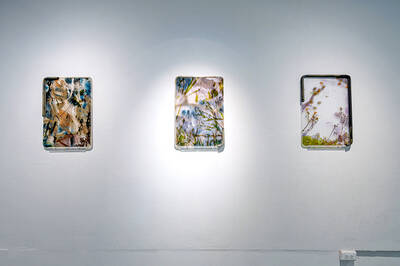
Located down a sideroad in old Wanhua District (萬華區), Waley Art (水谷藝術) has an established reputation for curating some of the more provocative indie art exhibitions in Taipei. And this month is no exception. Beyond the innocuous facade of a shophouse, the full three stories of the gallery space (including the basement) have been taken over by photographs, installation videos and abstract images courtesy of two creatives who hail from the opposite ends of the earth, Taiwan’s Hsu Yi-ting (許懿婷) and Germany’s Benjamin Janzen. “In 2019, I had an art residency in Europe,” Hsu says. “I met Benjamin in the lobby
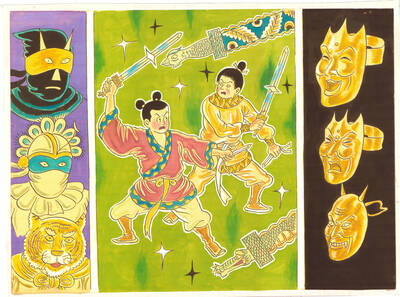
April 22 to April 28 The true identity of the mastermind behind the Demon Gang (魔鬼黨) was undoubtedly on the minds of countless schoolchildren in late 1958. In the days leading up to the big reveal, more than 10,000 guesses were sent to Ta Hwa Publishing Co (大華文化社) for a chance to win prizes. The smash success of the comic series Great Battle Against the Demon Gang (大戰魔鬼黨) came as a surprise to author Yeh Hung-chia (葉宏甲), who had long given up on his dream after being jailed for 10 months in 1947 over political cartoons. Protagonist


 RSS
RSS