


Until the pranks turned ugly, it was heartening to follow the dust-up between a bunch of street artists and their nemesis or nemeses, identity unknown. As the New York Times reported this week, for some time works of stenciled graffiti art and wheat-pasted posters slapped onto walls in Brooklyn and Lower Manhattan have been splashed with paint and scrawled with messages of protest.
Anonymous claimants have distributed various communiques taking responsibility for the sabotage, citing the Situationists of the 1950s and 1960s as inspiration. One manifesto declared street art "a bourgeois-sponsored rebellion," politically impotent, facilitating gentrification.
It was, if nothing else, good to hear that art was still being contested in the streets, not just marketed and sold in Chelsea. But then, earlier this month, as the summer silly season started, somebody lobbed a stink bomb into the opening of a show by Faile, a Brooklyn street art collective, on the Lower East Side. Everybody was forced to leave after fire engines arrived.
On June 21 at Shepard Fairey's opening in Dumbo, Brooklyn, a tall, 24-year-old Harry Potter look-alike named James Cooper was arrested after witnesses said he, along with another man, who got away, tried to light a similar bomb in a metal coffee canister. The police charged Cooper with reckless endangerment, criminal possession of a weapon, harassment and other crimes. He has denied the charges.
Guy Debord, the Situationist writer and spokesman who, before he died in 1994, couldn't resist responding to anybody who barely mentioned him, would no doubt be exercised by this latest invocation of his legacy.
A Situationist in Paris did once dress up as a Dominican priest and read an anti-theist tract to a baffled congregation at the Cathedral of Notre Dame.
In Copenhagen, in the 1960s, members of a group calling itself the Movement for a Scandinavian Bauhaus Situationniste were suspected by the police of being responsible for the decapitation of The Little Mermaid, the city's famous symbol, and absconding with the head.
Still, Situationist pranks were pointedly political. Across nearly half a century of random art world mischief, they seem almost scientific in their focus, by comparison with young people who toss stink bombs at gallery openings or splash paint on street art.
The current agitators, although they've got some of the revolutionary patter down, seem to lack clearly defined targets or priorities. Is the problem gentrification or the art market or artists or late capitalism? What's troubling them - the street art they're defacing or the fact that some of the street artists might also show in galleries?
And, by the way, what's wrong with artists, even street artists, making a buck? The spectacle, as Debord might have said, of the present art world in thrall to Mammon is incredibly depressing.
But selling art isn't selling out, necessarily, and making art for people on the street doesn't preclude showing (a different sort of) art in galleries. Physical endangerment in the form of bombs, stinky or otherwise, then crosses the line from mischief to mayhem.
I suspect the agitators have read history books about the 1980s, which for Cooper's generation must seem like the Dark Ages. The art market back then scooped up graffiti artists, a co-optation entailing, as the Princeton art historian Hal Foster has said, an element of racial appropriation.
The demographics are different now. Most graffiti artists of the 1980s, Keith Haring aside, ultimately flopped as commercial painters because context is everything. A subway car is not a living room.
Failure derived from a lack of private initiative and visual sense, not from anything to do with making public art, which during the 1980s art market craze was, despite the blight of many public spaces by graffiti and the criminal act itself, a useful counterpoint to all the lunacy of spending and hype.
Does street art gentrify neighborhoods? Graffiti didn't gentrify SoHo. Wall Street did. It didn't gentrify subways. From West Philadelphia to East Los Angeles, much of the best street painting is in poor neighborhoods that have resisted change. It's hard to feel sympathetic with vandals splashing paint on posters or stenciled pictures, notwithstanding that some of the splashes look kind of aesthetic.
All that said, public space and civic justice are difficult issues to which the brouhaha returns our attention. New York neighborhoods are indeed changing, not all for the better, as the city becomes more affluent and homogeneous, and art shouldn't exist in it simply as a symbol of wealth and privilege. It should seize public spaces where it can, to make itself more part of daily life, more relevant in the world, and to become a source of serendipity, pleasure, trouble, controversy and interest to people outside the art world, not just inside it.
Minus the incendiary devices, this latest little flap is proof that art can still matter.
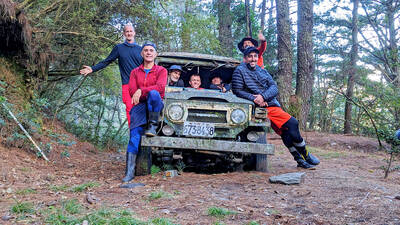
The year was 1991. A Toyota Land Cruiser set out on a 67km journey up the Junda Forest Road (郡大林道) toward an old loggers’ camp, at which point the hikers inside would get out and begin their ascent of Jade Mountain (玉山). Little did they know, they would be the last group of hikers to ever enjoy this shortcut into the mountains. An approaching typhoon soon wiped out the road behind them, trapping the vehicle on the mountain and forever changing the approach to Jade Mountain. THE CONTEMPORARY ROUTE Nowadays, the approach to Jade Mountain from the north side takes an

Last week Joseph Nye, the well-known China scholar, wrote on the Australian Strategic Policy Institute’s website about how war over Taiwan might be averted. He noted that years ago he was on a team that met with then-president Chen Shui-bian (陳水扁), “whose previous ‘unofficial’ visit to the US had caused a crisis in which China fired missiles into the sea and the US deployed carriers off the coast of Taiwan.” Yes, that’s right, mighty Chen caused that crisis all by himself. Neither the US nor the People’s Republic of China (PRC) exercised any agency. Nye then nostalgically invoked the comical specter

Relations between Taiwan and the Czech Republic have flourished in recent years. However, not everyone is pleased about the growing friendship between the two countries. Last month, an incident involving a Chinese diplomat tailing the car of vice president-elect Hsiao Bi-khim (蕭美琴) in Prague, drew public attention to the People’s Republic of China’s (PRC) operations to undermine Taiwan overseas. The trip was not Hsiao’s first visit to the Central European country. It was meant to be low-key, a chance to meet with local academics and politicians, until her police escort noticed a car was tailing her through the Czech capital. The
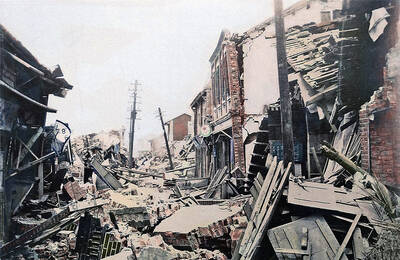
April 15 to April 21 Yang Kui (楊逵) was horrified as he drove past trucks, oxcarts and trolleys loaded with coffins on his way to Tuntzechiao (屯子腳), which he heard had been completely destroyed. The friend he came to check on was safe, but most residents were suffering in the town hit the hardest by the 7.1-magnitude Hsinchu-Taichung Earthquake on April 21, 1935. It remains the deadliest in Taiwan’s recorded history, claiming around 3,300 lives and injuring nearly 12,000. The disaster completely flattened roughly 18,000 houses and damaged countless more. The social activist and


 RSS
RSS