


Nothing is quite as refreshing in the summer as drinking a cold fizzy drink on a hot muggy day.
In Suao (蘇澳), a township in Ilan County, locals have taken carbon dioxide to the next level by tapping into the region's naturally occurring mineral water and constructing a cold spring spa.
Unique to Suao, mineral cold springs can be found nowhere else in Asia.
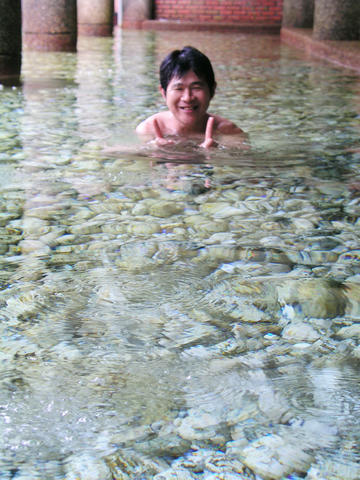
PHOTO: HSIEH WEN-HUA AND JIANG CHIH-XIONG, TAIPEI TIMES
"The island of Sicily off the coast of Italy is the only other place in the world featuring naturally occurring mineral cold springs," said Chen Chien-ke (陳建科), manager of Suao Cold Springs (蘇澳冷泉).
Ilan's abundant rainfall coupled with thick layers of underground limestone produce Suao's unique carbonated springs, he said.
Taiwan is known throughout Asia for its abundance of hot springs - first popularized by the Japanese in 1896 soon after establishing colonial rule over the island. Takenaka Shinkage (竹中信景), a Japanese soldier who was stationed in the area, discovered Suao's cold springs at around the same time as the hotter variety further to the north were beginning to be utilized. The springs became an instant hit with the soldiers stationed in the area.
According to the Suao Cold Springs Web site, locals avoided the springs because they feared the water was poisonous as dead insects and small animals were often found in the waters.
Today, enthusiasts say taking a cool spring bath can cure skin diseases and drinking the water can cure intestinal and stomach diseases - though Chen recommends avoiding doing so from the public pools.
Said to share the same dermatological healing properties as cold springs, hot springs are also believed to have the additional power of alleviating the symptoms of rheumatism and acne.
Suao's cold springs produce colorless, odorless bicarbonate water at 22°C, some 14°C below the average body temperature. Slipping into the cold water is, at first, a shock to the system. After a few minutes, however, the body adjusts to the temperature, gradually warming and, some claim, becoming hot. Indeed, of our party of four, three experienced a gradual warming sensation the longer we were submerged.
Admittance to the public baths is NT$100 and allows perspiring travelers to lounge throughout the day. To avoid the crowds, private baths are available to rent for 40 minutes a time at NT$150 for individuals and NT$400 for a group of four.
The private baths are tastefully finished with tile and cut stone. The large outdoor pools are linked by grottos.
Renting a private bath during July and August, says Chen, is recommended because the public baths are usually busy.
Constructed 10 years ago, Chen says the spa's existing 57 private baths and two large pools will be complemented by 28 private baths that open tomorrow. The increased number of baths will accommodate the cold spring's growing popularity and reduce the waiting lines that have become commonplace during the summer months.
However, unlike more high profile hot spring areas like Beitou, a resort industry has yet to spring up in Suao, which means busloads of tourists are kept to a minimum. The only other public bathing area for the cold springs is a public pond near Alishi Bridge (阿里史橋). It is free and divided into two sections for males and females.
Nestled at the bottom of Suao Cold Spring Park (冷泉公園), the springs can easily be reached on foot from Suao Train Station.
The park surrounds the bathing area and provides vistas of Suao. Wandering through the park is an efficient way of working up a sweat before entering the water. Just don't forget to shower before taking the plunge.

In late October of 1873 the government of Japan decided against sending a military expedition to Korea to force that nation to open trade relations. Across the government supporters of the expedition resigned immediately. The spectacle of revolt by disaffected samurai began to loom over Japanese politics. In January of 1874 disaffected samurai attacked a senior minister in Tokyo. A month later, a group of pro-Korea expedition and anti-foreign elements from Saga prefecture in Kyushu revolted, driven in part by high food prices stemming from poor harvests. Their leader, according to Edward Drea’s classic Japan’s Imperial Army, was a samurai

Located down a sideroad in old Wanhua District (萬華區), Waley Art (水谷藝術) has an established reputation for curating some of the more provocative indie art exhibitions in Taipei. And this month is no exception. Beyond the innocuous facade of a shophouse, the full three stories of the gallery space (including the basement) have been taken over by photographs, installation videos and abstract images courtesy of two creatives who hail from the opposite ends of the earth, Taiwan’s Hsu Yi-ting (許懿婷) and Germany’s Benjamin Janzen. “In 2019, I had an art residency in Europe,” Hsu says. “I met Benjamin in the lobby

April 22 to April 28 The true identity of the mastermind behind the Demon Gang (魔鬼黨) was undoubtedly on the minds of countless schoolchildren in late 1958. In the days leading up to the big reveal, more than 10,000 guesses were sent to Ta Hwa Publishing Co (大華文化社) for a chance to win prizes. The smash success of the comic series Great Battle Against the Demon Gang (大戰魔鬼黨) came as a surprise to author Yeh Hung-chia (葉宏甲), who had long given up on his dream after being jailed for 10 months in 1947 over political cartoons. Protagonist

A fossil jawbone found by a British girl and her father on a beach in Somerset, England belongs to a gigantic marine reptile dating to 202 million years ago that appears to have been among the largest animals ever on Earth. Researchers said on Wednesday the bone, called a surangular, was from a type of ocean-going reptile called an ichthyosaur. Based on its dimensions compared to the same bone in closely related ichthyosaurs, the researchers estimated that the Triassic Period creature, which they named Ichthyotitan severnensis, was between 22-26 meters long. That would make it perhaps the largest-known marine reptile and would


 RSS
RSS