


For the past six years, Chiang Chao-liang (江招良) traveled to work, like most Taipei area commuters, in a gas-guzzling vehicle. But three months ago he started leaving his car in the garage for something much smaller - a folding bicycle. The commute to his interior design firm takes longer, but Chiang likes the exercise and says his ride - which collapses to the size of a suitcase and is light enough to carry up a flight of stairs - is more convenient and more fun. He also saves NT$6,000 a month on gasoline bills.
"This has worked out well for several reasons," says Chiang, 48, who spent NT$38,000 for a top-of-the-line Birdy, a German-designed bike. "I started my own company so I have more time to play with. I like riding bicycles anyway. And commuting on a bicycle is cheaper and better for the environment."
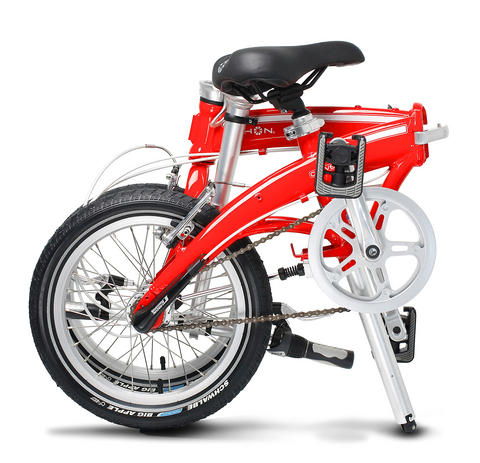
With their small wheels, low-slung frames and long seatposts, folding bicycles are easy to recognize. They might look like wimped-out versions of conventional bikes, but the latest folders deliver better performance in urban areas. Thanks to their smaller wheels, folders are more maneuverable, accelerate faster and require less pedaling energy on city streets. The gyroscopic effects of larger wheels - in other words the bigger the wheel, the more ground covered by a single turn - only make conventional bikes more efficient at Tour de France speeds.

Folding bikes are popular in Taipei because they take up less space in the city's cramped apartments. Their small size also makes them ideal to use on public transportation. You can fold one up, put it in a bag and take it on to any bus or into any stop in the city's MRT system. Passengers with conventional bicycles, on the other hand, are charged extra and can only enter and exit at certain MRT stations, mostly outside of Taipei's urban core.
Morris Liang (梁隆儀), a manager at the new Giant outlet across Nanjing East Road from the Brother Hotel, said folders account for "20 percent to 30 percent" of his store's sales.
"Sales are shooting forward, especially given the density of this city, the expanding MRT system, the river paths, and continuing - if a bit slowly - government efforts to promote bike riding," says Thomas Walk, sales representative at Dahon, a US folding bike company that was founded by a Chinese-American scientist.
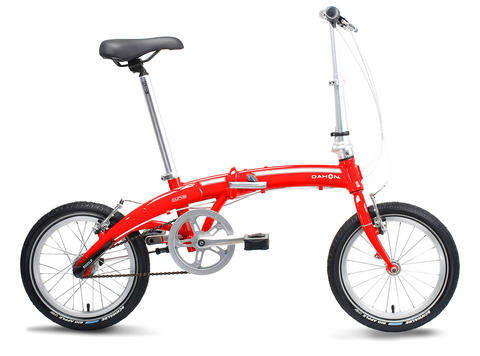
Aside from Giant, Birdy and Dahon, other major folding bike brands are Brompton, Breezer, Xootr, Bike Friday and Moulton. Factors to consider when choosing among brands and models include size and weight, especially if you live in a building without an elevator. Some advantages come with tradeoffs. A suspension system, for example, gives a smoother ride but absorbs more pedaling energy. Smaller wheels give a rougher ride but make the bike lighter and easier to store. It's a good idea to see which companies are supplying components like the brakes. Shimano, for example, makes brakes for several brands, including Birdy.
A review in last month's issue of US magazine Wired gave the US$1,000 Dahon Mu SL its highest overall score, praising the design but noting the bike has "no shocks, so you'll feel every bump." The slightly cheaper Brompton M6L came in second and was cited for its smaller size, faster folding and mudguards. In third place was the US$1,250 Birdy Silver. It scored lower because of its "strange aesthetics" and "frustrating" folding. Wired liked the Silver's "decidedly unbumpy ride" and its "powerful" and "precise" brakes.
Prices for some folding bikes are lower in Taiwan, since many manufacturers are based or have factories here. Giant, Taiwan's largest bicycle company, sells its cheapest Chinese-made models for NT$3,500. A folder that's sturdy enough to stand up to the stress of a daily commute will probably have been made in Europe or Taiwan and will cost at least NT$20,000 to NT$30,000.
PHOTOS: COURTESY OF DAHON
Most Taipei residents who purchase folding bikes aren't buying them to take on public transportation, according to an informal survey of employees at three bicycle shops and ticket booth clerks at several MRT stations. A clerk at the Tai Power Building station said he's only seen two people take folders through the turnstiles, though these two do so regularly.
"If the MRT didn't exist, we would still be selling the same number of folding bicycles," says Liang, the manager at Giant. "In Taipei, people buy folding bicycles because they fit inside their cars."
Even Chiang, who lives in Sindian, doesn't take his Birdy on the MRT. He tried once but found it too much of a hassle because the train was crowded. "It's not convenient," he says. Instead, he rides all the way from Sindian to his office near Taipei City Hall. The 18km trip takes him an hour each way. If it rains, he calls his wife and she drives him and his bike home in her car.
One reason you don't see more Taipei residents using a combination of folding bicycles and public transport to get to work is because many people live a short walk from a bus or MRT station.
Taipei has well-developed bicycle-only tracks that skirt the city, but it lacks similar infrastructure in the city's core where cycling on the street can be dangerous.
In addition, cyclists breathe in more tailpipe exhaust than other commuters. One British study even suggested that the benefits of the extra exercise are negated by filling your lungs with all that cancer-causing pollution.
An annual survey of 1,000 residents conducted by the city's Department of Transportation found that less than three percent of Taipei residents use bicycles as their main form of transportation.
"If Taipei could improve its bike lanes, we'd see more people riding bikes to work. We already see more people riding bikes since they started upgrading the bike lanes on the rivers. If you establish that same kind of network in the city, increase bike access on bridges, and introduce congestion charges, there would definitely be more people riding to work," said Dahon Vice President Josuha Hon (韓安石) in an e-mailed statement.
His company saw its UK sales jump 40 percent after London started charging motorists to enter the city center in 2003, according to Dahon's Web site.

In late October of 1873 the government of Japan decided against sending a military expedition to Korea to force that nation to open trade relations. Across the government supporters of the expedition resigned immediately. The spectacle of revolt by disaffected samurai began to loom over Japanese politics. In January of 1874 disaffected samurai attacked a senior minister in Tokyo. A month later, a group of pro-Korea expedition and anti-foreign elements from Saga prefecture in Kyushu revolted, driven in part by high food prices stemming from poor harvests. Their leader, according to Edward Drea’s classic Japan’s Imperial Army, was a samurai

Located down a sideroad in old Wanhua District (萬華區), Waley Art (水谷藝術) has an established reputation for curating some of the more provocative indie art exhibitions in Taipei. And this month is no exception. Beyond the innocuous facade of a shophouse, the full three stories of the gallery space (including the basement) have been taken over by photographs, installation videos and abstract images courtesy of two creatives who hail from the opposite ends of the earth, Taiwan’s Hsu Yi-ting (許懿婷) and Germany’s Benjamin Janzen. “In 2019, I had an art residency in Europe,” Hsu says. “I met Benjamin in the lobby

April 22 to April 28 The true identity of the mastermind behind the Demon Gang (魔鬼黨) was undoubtedly on the minds of countless schoolchildren in late 1958. In the days leading up to the big reveal, more than 10,000 guesses were sent to Ta Hwa Publishing Co (大華文化社) for a chance to win prizes. The smash success of the comic series Great Battle Against the Demon Gang (大戰魔鬼黨) came as a surprise to author Yeh Hung-chia (葉宏甲), who had long given up on his dream after being jailed for 10 months in 1947 over political cartoons. Protagonist

The following three paragraphs are just some of what the local Chinese-language press is reporting on breathlessly and following every twist and turn with the eagerness of a soap opera fan. For many English-language readers, it probably comes across as incomprehensibly opaque, so bear with me briefly dear reader: To the surprise of many, former pop singer and Democratic Progressive Party (DPP) ex-lawmaker Yu Tien (余天) of the Taiwan Normal Country Promotion Association (TNCPA) at the last minute dropped out of the running for committee chair of the DPP’s New Taipei City chapter, paving the way for DPP legislator Su


 RSS
RSS