


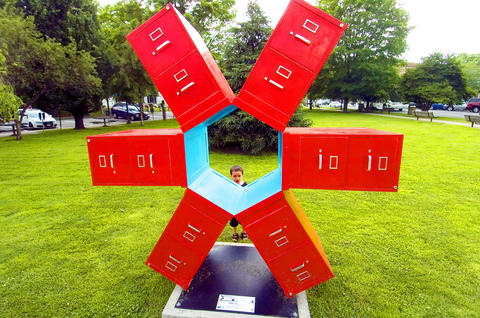
From afar, the giant object that appears to have cartwheeled into Latham Park looks like a bright-red starburst. On closer view, it consists of six metal filing cabinets that have been welded in an acrobatic design that almost defies gravity.
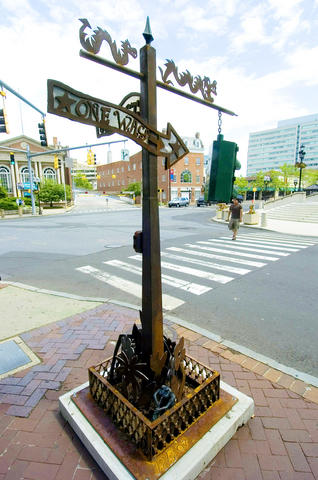
On the other end of the park, a new arrival called The Ancients consists of three sailboat rudders that have been transformed into faces. Hovering nearby is a snazzy space-age rocket called Fintasia 14, created from vintage car parts. A sister ship down the street emerged from the fusion of an air compressor tank, sprockets, and the chrome tailfins from a 1953 Packard.
These and other attempts to make art from cast-off materials have sprung up here as part of a summer show called Tossed and Found.

PHOTOS: NY TIMES NEWS SERVICE
Sponsored by Stamford's Downtown Special Services District, the exhibit features 40 or so objects made by some two dozen artists. Most have been installed outdoors in the downtown heart of this city, Connecticut's fourth largest, with a population of 117,000. So admission is free and access virtually unrestricted. In August, the collection is scheduled to be auctioned off, with some proceeds going to charity.
"Stuff like that, where you turn everyday objects into something different, that's pretty cool," said Sam Lavin, a 17-year-old from Westport who was skateboarding near the spaceship with the chrome tailfins.
Over by the file cabinets, a toddler wearing a nametag that read "My Name is Trouble," approached the towering structure, eager to explore.
Barbara Lubliner, 57, a longtime New York sculptor who is accustomed to creating work for cramped apartment dwellers, said the suburban show gave her an opportunity to work in a much larger scale. She went with file cabinets, she said, because she thought they suited Stamford's reputation as a corporate center. "I wanted to relate to the area, and I see filing cabinets as a symbol of business," she said. The design, which has the cabinets resting on two sliver-like edges, stands 2.3m tall and weighs about 272kg.
Another marvel of engineering that has more of a political bent sits outside of the University of Connecticut's Broad Street campus. Called Drums of War, it consists of seven oil drums, stacked precariously and painted to look like American Indian musical instruments. Antiwar quotes from people like Pascal, Will Rogers, and Albert Einstein decorate the flat surfaces. Richard Brachman, a Brooklyn, New York-based artist, said he made the piece in 2003 to suggest that invading Iraq had more to do with securing the world oil market than with fighting terror.
Other pieces in the show feature pansies made from pots and pans and an aproned chef whose stiff bow tie is made from a pair of eggbeaters. Another sculpture, by Morris Norvin, consists of a short-skirted, skeletal woman constructed mostly from steel remnants, her tousled hair made of barbed wire. The title, Trash, is as hard-edged as the all-too-visible components.

David and Ann Palladino, newlyweds out for a stroll, did not care for the Norvin. "Is that the Tale of the Crypt one?" asked Palladino. But she said she admired the inventiveness on display throughout town and thought, "maybe it will make people slow down and appreciate things."
While many of the sculptures were made by professionals, the show has also helped bring out the inner artist of people who ordinarily work as plumbers, scrap yard dealers, mechanics, and the like.
"Some of the artists are trained artists, and a lot have come into the field from working with materials they fell in love with," explained Eileen Heckerling, the show's curator.
Bill Cypher, 46, a plumber from Washingtonville, New York, a town of 6,000 about 105km from here, submitted a pirate ship whose steering wheel is a brass faucet, for display behind velvet ropes at the Stamford mall. "Most everything on that ship is from an electrical thing like a light fixture or a plumbing-related object," Cypher said.
Steve Heller, 62, who made the rocket ship sculptures, had put in many years as an auto mechanic. But ever since a childhood visit to the Museum of Modern Art, where he saw a baboon head that Picasso had fashioned from two toy cars, he said, "I knew I, too, could be an artist."
He is used to the odd stares he gets from neighbors in Boiceville, New York, a tiny Ulster County town near Woodstock, when he drags infected maple trees home, so he can take advantage of the wild-looking streaks in the blond wood, or loads up on old barn siding. "I save everything," he said. "If I didn't make stuff out of it, it would have been in the crusher, or it would have ended up in a Toyota."
Richard Benash, 53, a scrap yard dealer in Yonkers, New York, who does a lot of demolition work, completed three large sculptures for the show in less than four weeks. "I just go," he said, describing the process. "I lay the sheet of steel on my design table, and I just take a piece of chalk and draw my design, and then I cut it out."
His work has a cartoonish feel to it - in part, he said, to appeal to children. To make whimsical lettering, he uses an air-pressured plasma cutter.
One Benash on view is a funky taxi that has been parked on a stretch of Summer Street, as if awaiting a fare. The wooden wheels came off a 1915 Buick, Benash said. The taxi is the only piece in the collection that viewers can experience from the inside. "Wish I knew it was next to a automotive glass shop," said Benash of the taxi's placement. "I would have put a broken window on it."
He also contributed a loopy sign that says Main Street and sits, appropriately, on Main Street, just outside Stamford's old town hall.
After teaching leather crafts to fellow servicemen in the Army in the 1970s, Benash said, he began experimenting with metal after the Sept. 11 terrorist attacks. Friends who had helped with the downtown rescue effort in New York were making steel crosses from some of the found metal to honor the dead, and he was inspired.
Because of his day job, costs are minimal. "For the average artist, it's expensive to buy steel," he noted. "It's not expensive for me. I handle hundreds of thousands of pounds of metal a week."
He said some of his larger sculptures had fetched as much as US$20,000 and US$30,000, but he is not giving up his first career, yet. "I couldn't, because you don't sell art every day," he said. "To be honest with you, the scrap business is very hot right now, and I'm very busy."

Last week Joseph Nye, the well-known China scholar, wrote on the Australian Strategic Policy Institute’s website about how war over Taiwan might be averted. He noted that years ago he was on a team that met with then-president Chen Shui-bian (陳水扁), “whose previous ‘unofficial’ visit to the US had caused a crisis in which China fired missiles into the sea and the US deployed carriers off the coast of Taiwan.” Yes, that’s right, mighty Chen caused that crisis all by himself. Neither the US nor the People’s Republic of China (PRC) exercised any agency. Nye then nostalgically invoked the comical specter
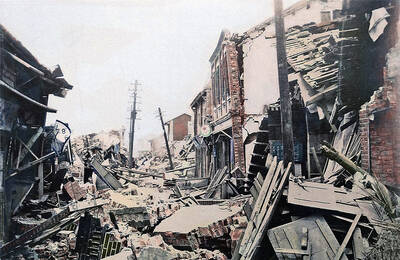
April 15 to April 21 Yang Kui (楊逵) was horrified as he drove past trucks, oxcarts and trolleys loaded with coffins on his way to Tuntzechiao (屯子腳), which he heard had been completely destroyed. The friend he came to check on was safe, but most residents were suffering in the town hit the hardest by the 7.1-magnitude Hsinchu-Taichung Earthquake on April 21, 1935. It remains the deadliest in Taiwan’s recorded history, claiming around 3,300 lives and injuring nearly 12,000. The disaster completely flattened roughly 18,000 houses and damaged countless more. The social activist and

Over the course of former President Ma Ying-jeou’s (馬英九) 11-day trip to China that included a meeting with Chinese Communist Party (CCP) leader Xi Jinping (習近平) a surprising number of people commented that the former president was now “irrelevant.” Upon reflection, it became apparent that these comments were coming from pro-Taiwan, pan-green supporters and they were expressing what they hoped was the case, rather than the reality. Ma’s ideology is so pro-China (read: deep blue) and controversial that many in his own Chinese Nationalist Party (KMT) hope he retires quickly, or at least refrains from speaking on some subjects. Regardless

Approaching her mid-30s, Xiong Yidan reckons that most of her friends are on to their second or even third babies. But Xiong has more than a dozen. There is Lucky, the street dog from Bangkok who jumped into a taxi with her and never left. There is Sophie and Ben, sibling geese, who honk from morning to night. Boop and Pan, both goats, are romantically involved. Dumpling the hedgehog enjoys a belly rub from time to time. The list goes on. Xiong nurtures her brood from her 8,000 square meter farm in Chiang Dao, a mountainous district in northern Thailand’s


 RSS
RSS