


When Truman Capote became an Oscar-worthy movie character and In Cold Blood bounced back onto bestseller lists, The New Yorker sportingly published yet another Woody Allen instant classic. Titled Above the Law, Below the Box Springs, it mimics the absurd solemnity and keen attention to minutiae that color self-important crime reporting in rural settings, lampooning a style well known to New Yorker readers.
"The land is arable and found primarily on the ground," Allen writes, about a lonely burg located "just above the bluffs that form Planck's constant." (Physicists, take note.) The victims were members of the Washburn family. "She loved fresh lightbulbs," a former housekeeper says of Mrs Washburn. "The linens we did once a year." As to the perpetrators of this heinous crime, the story concludes: "Whether the death penalty acts as a deterrent remains questionable, although studies show that the odds of criminals committing another crime drops by almost half after their execution."
Allen's writing has been this funny for 50 years. And his comic essays, like his films, have tried gambit after gambit, changing tone and subject matter without really altering their point of view. Just as Allen brought his own New York with him when he recently began making films in Europe, so he has sustained a writing style that remains impervious to the changing world around him.
As a young man he was just as likely to bring up the Gish sisters, Trotsky, Alma Mahler or "the glinting eyes of a claim jumper in a Republic Western" as he is today. Phrases like "a no-talent zombie momser," which appears in his new collection, Mere Anarchy, might have turned up anywhere in the Allen canon.
This summer Random House has had the temerity to bring forth dueling Allen volumes. In addition to the relatively new work in Mere Anarchy (about half of which is reprinted from The New Yorker), there is The Insanity Defense, a reprint of the dazzling, triple-decker anthology that combines his three other humor collections (Without Feathers, Side Effects and Getting Even).
Without question the best of these old pieces outshine the new work. The lightning bolts that created The Whore of Mensa (about prostitutes paid to discuss The Waste Land or explain Noam Chomsky) and The Kugelmass Episode (a pre-postmodern vision of Emma Bovary transported to New York to meet her new lover, a professor named Kugelmass, who suddenly finds himself dropped into Flaubert's classic) are not likely to strike again.
But when read in the shadow of his old stories Allen's new ones hold their own. Even when it creaks, Mere Anarchy is nostalgically enjoyable, and most of it sounds timelessly bright. It would be impossible to discern, even from a close reading of the piece called Calisthenics, Poison Ivy, Final Cut, where carbon dating would place it in the Allen comedy timeline. There, in the Borscht Belt, is Camp Melanoma, a haven for budding filmmakers, or, as the disgruntled parent of one camper puts it, "the ramshackle little Hooverville represented in your brochure as Hollywood in the Catskills."
This parent is wondering why he should have to split the US$16 million paid by Miramax for the summer project of his son, Algae, with the camp's director. The piece is structured as an exchange of increasingly heated letters between the parent and the proprietor, who will not let the film out of his possession. The proprietor writes ominously of his 6-year-old nephew: "He loves to take the negative out of the can and scrape the emulsion off with a penknife. Why? Do I know? I just know he scrapes and he kvells."
Typically, this piece is so full of Yiddishisms ("a tsimmes of talentless trombeniks"), bilious invective and ancient history ("Are you aware your instructor Silverfish was fired for editing a Hollywood movie because Henry Fonda was repeatedly cut in upside down?") that it sounds like vintage Allen. Only in the heat of filmmaker-financier tensions is there any whiff of Allen's recent history.
The stories in Mere Anarchy deliver the same joys and foibles that have been with its author from the start. Take his women: please. Allen still writes about hot babes and wifely harridans with very little in between. And he is funniest, not surprisingly, when he can be seen working hard rather than coasting. It has always been second nature for Allen to Mad-Lib a phrase while on autopilot ("a long dream in which Rodgers and Hart appeared at his window as parrots and simonized his car") without breaking a sweat.
But more often than not, the analogies fit. ("Actually I'd never seen a book remaindered in the kindling section before.") And when the thoughtfulness shows (as with a renovation estimate that "waxed to the girth of the Talmud while rivaling it in possible interpretations"), the effort pays off.
Among the more indelible lines in Mere Anarchy is this exchange, about a proposed musical on geniuses rattling around 19th-century Vienna:
"Freud unblocks Mahler so he can write again, and as a result Mahler triumphs over his lifelong fear of death."
"How does Mahler triumph over his lifelong fear of death?"
"By dying. I figured it out – it's really the only way."
Or, as the levitating lecher named Max in To Err Is Human — to Float, Divine says to the blond "apparition with the state-of-the-art pout":
"Here's my address. I'll be home tonight after eight. Drop in. I'll have you off your feet in no time."
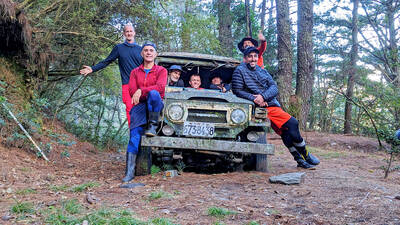
The year was 1991. A Toyota Land Cruiser set out on a 67km journey up the Junda Forest Road (郡大林道) toward an old loggers’ camp, at which point the hikers inside would get out and begin their ascent of Jade Mountain (玉山). Little did they know, they would be the last group of hikers to ever enjoy this shortcut into the mountains. An approaching typhoon soon wiped out the road behind them, trapping the vehicle on the mountain and forever changing the approach to Jade Mountain. THE CONTEMPORARY ROUTE Nowadays, the approach to Jade Mountain from the north side takes an

Relations between Taiwan and the Czech Republic have flourished in recent years. However, not everyone is pleased about the growing friendship between the two countries. Last month, an incident involving a Chinese diplomat tailing the car of vice president-elect Hsiao Bi-khim (蕭美琴) in Prague, drew public attention to the People’s Republic of China’s (PRC) operations to undermine Taiwan overseas. The trip was not Hsiao’s first visit to the Central European country. It was meant to be low-key, a chance to meet with local academics and politicians, until her police escort noticed a car was tailing her through the Czech capital. The

Last week Joseph Nye, the well-known China scholar, wrote on the Australian Strategic Policy Institute’s website about how war over Taiwan might be averted. He noted that years ago he was on a team that met with then-president Chen Shui-bian (陳水扁), “whose previous ‘unofficial’ visit to the US had caused a crisis in which China fired missiles into the sea and the US deployed carriers off the coast of Taiwan.” Yes, that’s right, mighty Chen caused that crisis all by himself. Neither the US nor the People’s Republic of China (PRC) exercised any agency. Nye then nostalgically invoked the comical specter
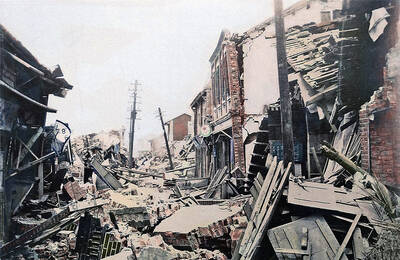
April 15 to April 21 Yang Kui (楊逵) was horrified as he drove past trucks, oxcarts and trolleys loaded with coffins on his way to Tuntzechiao (屯子腳), which he heard had been completely destroyed. The friend he came to check on was safe, but most residents were suffering in the town hit the hardest by the 7.1-magnitude Hsinchu-Taichung Earthquake on April 21, 1935. It remains the deadliest in Taiwan’s recorded history, claiming around 3,300 lives and injuring nearly 12,000. The disaster completely flattened roughly 18,000 houses and damaged countless more. The social activist and


 RSS
RSS