


It's another gloomy year for heavyweight pop idols as alternative music once again predominates over the mainstream on the nomination lists for the 18th Golden Melody Awards (金曲獎), which are scheduled to take place at Taipei Arena (台北巨蛋) next Saturday. With folk rock outfit Sodagreen (蘇打綠) garnering the most nominations (Best Album, Best Band, Best Producer, Best Lyricist, Best Songwriter and Best Composer categories), followed by Hakka musician Lin Sheng-xiang (林生祥) with six and singer/songwriter Deserts Chang (張懸) with four, the annual music event seems to reaffirm musical quality rather than pandering to popular taste, in theory at least.
The shift is most evident in the Best Mandarin Album category that sends Jolin Tsai's (蔡依林) Dancing Diva (舞孃) up against indie productions such as Sodagreen's Microcosmos (小宇宙), Deserts Chang's My Life Will and Blue in Love by Puyuma duo Hao-en (昊恩) and Jiajia (家家).
While the presence of alternative music is clearly felt in most categories, the Mandarin performer nominations are nevertheless dominated by pop acts. Six-time nominee David Tao (陶吉吉) is vying for the Best Mandarin Male Singer trophy with a younger generation of pop idols including Ken Wu (吳克群), Gary Tsao (曹格) and Lin Jun-jie (林俊傑), who won the title of Best Mandarin Newcomer in 2004. As for the female leads, teen idols Jolin Tsai and Angela Chang (張紹涵) face fierce competition from veteran Hong Kong singer Sandy Lam (林憶蓮) and eight-time nominee A-mei (張惠妹) along with Malaysia-born songstress Penny Tai (戴佩妮) and Taiwan's emerging jazz musician Jyotsn'a Pang (彭靖惠).
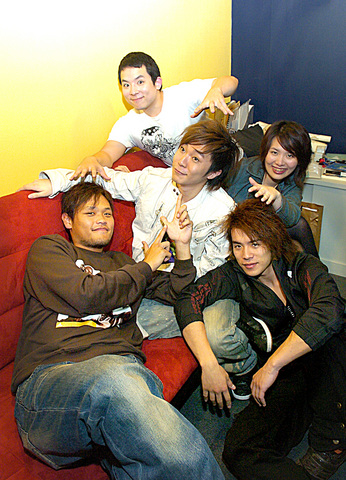
PHOTO: TAIPEI TIMES
It is commonly agreed that the awards began leaning toward the alternative scene in 2000 as Luantan (亂彈) walked home with the Best Band title and the Best Mandarin Male Singer went to Puyuma musician Chen Jien-nien (陳建年).
"The emergence of indie bands and musicians was related to a change in the jury structure as more musicians, critics, producers and other professionals were on board to hand the awards to the best, not the most popular," said Jamie Won (翁嘉銘), veteran music critic and a jury member in 2000 and 2004.
His view is shared by Ho Tung-hung (何東洪), assistant professor at the department of psychology of Fu Jen Catholic University (輔仁大學) and past GMA jury member. "Unlike other music events in Asian countries that collude with record companies and the entertainment industries, the Golden Melody Awards stress the independence of musical spirit rather than bowing to the market," said Ho, though admitting that the jury members oftentimes resolve to reach a "balance" between the mainstream and the alternative.
PHOTO: TAIPEI TIMES
In the eyes of Ho and Won, such problems can be eliminated if there is a permanent jury system with clear guidelines that encourage diversity in music and the awards are readjusted to reflect different music genres instead of the current language categorization.
Viewed by Ho as the application of political correctness, the linguistic classification is "backward, [and] acts as [an] affirmative action for the mainstream," said Chung She-fong (鍾適芳), director of Trees Music & Art (大大樹音樂圖像, TMC).
Both Ho and Chung agree that the current design confines non-Mandarin musicians to certain categories when they could easily become strong contenders in other major categories. "A piece of good music is a piece of good music. You can't hand the major awards to others just because, say, Lin Sheng-xiang wins the Best Hakka Singer title," said Ho, a scholar specializing in Taiwan's pop music industry.

The binary division of pop and traditional music further implies people have a limited perception of what music is, just as all the rock, folk, hip-hop acts are cooped up in the Best Band Awards competing with each other.
"The definition of popular music has become broader and there exists a great variety of genres between the two ends of the spectrum … . Yet, most people still believe the myth that pop music equals stars," said Chung, adding that even though Lin Sheng-xiang has been a frequent GMA titleholder, local media still describe the accomplished musician as a "dark horse" since they think anyone who is not featured in the entertainment news is a surprise winner.
As the music industry has been experiencing declining album sales, the idea that pop and indie music can be defined and divided in terms of record sales is increasingly becoming obsolete; indie productions often have matching, if not greater, sales to those of pop stars, according to Ho and Chung.
In light of the changes in the industry itself, music professionals believe GMA should adapt itself to the current trend and encourage the burgeoning indie music scene and the flourishing diverse genres that are not geared to the market.
While the nominations are generally considered to reflect musical creativity and talent, the ceremony itself is often denounced as a hollow show for big-ticket pop idols, rather than praised as a music event celebrating the achievement of the nominees. "For musicians, it's an awkward place to be," Chung said.
To avoid the marginalization of non-mainstream musicians, this year's Golden Melody Awards sees the first separation of the award ceremony into traditional and artistic music as a separate event from that of pop music. Held at Liberty Square's Convention Center (自由廣場大樓國際演藝廳) last Saturday, the starless event nevertheless failed to attract the media's attention, which determines what the general public can and can not have access to. It's a dilemma without a solution if GMA is continuously perceived as a piece of entertainment for the pop audiences.
"If the media clings to its market-oriented logic, then members of the general public can never learn about those music talents that are overlooked ... by the entertainment apparatus," Ho said.
In the eyes of Canadian environmentalist and musician Matthew Lien, the split acts out as a form of segregation that further ghettoizes non-pop musicians and alienates artistic audiences. It's a retrogressive move away from the event's duty to foster a healthy environment for all music and artistic communities to be recognized and received with respect.
"We should go back to the basic question of what the music awards celebrate: the glittering commodities or the music and what is valued and what is not? It's a question that all organizing entities involved in the event need to ask themselves," Lien said.

The year was 1991. A Toyota Land Cruiser set out on a 67km journey up the Junda Forest Road (郡大林道) toward an old loggers’ camp, at which point the hikers inside would get out and begin their ascent of Jade Mountain (玉山). Little did they know, they would be the last group of hikers to ever enjoy this shortcut into the mountains. An approaching typhoon soon wiped out the road behind them, trapping the vehicle on the mountain and forever changing the approach to Jade Mountain. THE CONTEMPORARY ROUTE Nowadays, the approach to Jade Mountain from the north side takes an

Last week Joseph Nye, the well-known China scholar, wrote on the Australian Strategic Policy Institute’s website about how war over Taiwan might be averted. He noted that years ago he was on a team that met with then-president Chen Shui-bian (陳水扁), “whose previous ‘unofficial’ visit to the US had caused a crisis in which China fired missiles into the sea and the US deployed carriers off the coast of Taiwan.” Yes, that’s right, mighty Chen caused that crisis all by himself. Neither the US nor the People’s Republic of China (PRC) exercised any agency. Nye then nostalgically invoked the comical specter

Relations between Taiwan and the Czech Republic have flourished in recent years. However, not everyone is pleased about the growing friendship between the two countries. Last month, an incident involving a Chinese diplomat tailing the car of vice president-elect Hsiao Bi-khim (蕭美琴) in Prague, drew public attention to the People’s Republic of China’s (PRC) operations to undermine Taiwan overseas. The trip was not Hsiao’s first visit to the Central European country. It was meant to be low-key, a chance to meet with local academics and politicians, until her police escort noticed a car was tailing her through the Czech capital. The
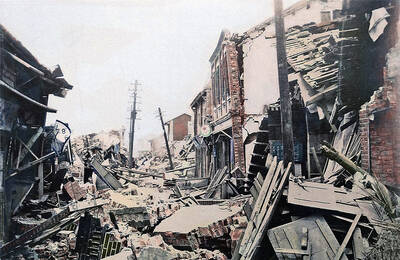
April 15 to April 21 Yang Kui (楊逵) was horrified as he drove past trucks, oxcarts and trolleys loaded with coffins on his way to Tuntzechiao (屯子腳), which he heard had been completely destroyed. The friend he came to check on was safe, but most residents were suffering in the town hit the hardest by the 7.1-magnitude Hsinchu-Taichung Earthquake on April 21, 1935. It remains the deadliest in Taiwan’s recorded history, claiming around 3,300 lives and injuring nearly 12,000. The disaster completely flattened roughly 18,000 houses and damaged countless more. The social activist and


 RSS
RSS