


When you travel from Vietnam into Cambodia, you cross one of Asia's most significant divides. Behind you lies the pan-Chinese world. Vietnam may today use the French-imposed Western alphabet but its culture essentially comes from China, and you see Chinese characters everywhere in Vietnamese temple inscriptions. Cambodia, by contrast, once lay under India's influence. Its script is Indian-derived (as is Thai's), and the Lunar New Year, universally observed in Vietnam as Tet, passes almost unnoticed in the Cambodian countryside. More importantly, Chinese-style industriousness, so evident in Ho Chi Minh City, appears remote indeed from the Cambodian national psyche.
Driving along the straight, tree-lined road from the Vietnamese border at Bavet towards Phnom Penh, the landscape is uniformly flat and brown, at least in the dry season. There are few cars, just motorbikes, the occasional truck, and local buses with passengers sitting on the roof. There's no sign of the light-industry factories visible on the Vietnamese side of the border, and pigs and calves cross the road at leisure in the still, sunny weather.
Soon you reach the Mekong. Young boys are washing down small horses, some submerged up to their nostrils. The bus, however, goes across on a modern ferry. Then you're churning your way along a muddy track, necessitated by the construction of a new highway. Six hours after leaving Ho Chi Minh City you finally reach Phnom Penh.
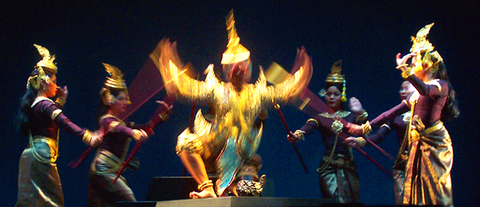
PHOTO: COURTESY OF KHMER DANCE ACADEMY, PHNOM PENH
All hotels in Phnom Penh display signs prohibiting the admission of under-age girls and boys into the rooms, except in the company of a parent. "That's OK," goes a local joke. "The mother comes along too to collect the cash." But the reality isn't funny. Child prostitution is merely the latest plague to afflict a country so badly mauled over the last 30 years that some commentators believe it'll soon disappear altogether, divided up between Vietnam and Thailand.
As it is, Phnom Penh offers beauties and horrors in roughly equal measure.
At the center stands the truly magnificent Royal Palace, something all visitors should make sure they see. But one block away, overlooking the confluence of the Mekong and Tonle Sap rivers, there's a prominent pavilion which could also be splendid, but isn't. Coils of plastic hose-piping are stacked in one corner, some ancient recliners are chained together, and two rickety desks are wired to some dodgy-looking electric cable. Children play soccer with an old slipper, somebody urinates into a flowerbed, and vendors pick their teeth under tacky umbrellas waiting for customers to gain merit by releasing caged swallows. The whole area has a gummy air, and you sit on the balustrade at your peril.
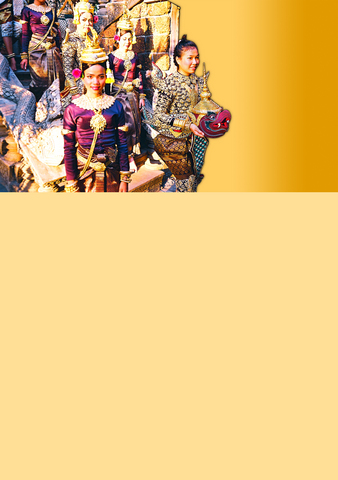
PHOTO: BRADLEY WINTERTON
Why the banks of the Mekong should present this almost derelict aspect when nearby there are side-streets giving off an air of relaxed luxury under tropical skies is initially unclear. The reason becomes apparent, however, as soon as you encounter the Cambodian middle classes.
They greet each other with the most ceremonious of hand gestures, then proceed to their seats to watch ancient dance dramas of insufferable tedium. Their off-spring, I was told, have little problem gaining admission to college, while the poor have to be brilliant indeed if they don't have money to back up their applications.
A large number of splendid Phnom Penh villas are advertised everywhere, starting at a monthly rental of some US$1,000. Expatriate embassy staff, someone who worked for a rental agency told me, earn as much as US$5,000 a month, and most NGO staff get around US$3,000 (though volunteers as little as US$250). By contrast, the usual monthly wage for Cambodians working in factories is US$40, he said. (When the UN was in Cambodia, its soldiers received allowances of US$145 a day).
At Prek Ho, half an hour outside Phnom Penh, stands the roofed but otherwise outdoors performance venue of the Khmer Arts Academy. Angkor-style statues pose in the declining afternoon light, dancers get sewn into their costumes in the searing heat, and right next door is the villa where Gary Glitter lived during his brief Cambodian sojourn. It's now up for rent and you can look over it anytime. There are billiard tables, a smallish swimming pool, and a fine view over a muddy river. The asking monthly rent is US$1,500 a month, I was told.
Back in town, a waiter showed me his English textbook. First published in 1941, it contained a detailed history of the clerihew ("invented by Edward Clerihew Bentley, 1875 to 1956") and a selection of the author's favorite poems — My Love's Like a Red, Red Rose and What is this life, so full of care. The waiter knew several of these poems by heart, he said, and planned to learn more.
You can, if you want, book yourself a city tour, taking in the Royal Palace, Wat Phnom, Tuol Sleng, Choeuuk Eik, the Independence Monument, and a sunset cruise on the Mekong. As I'd been advised not go to Choeung Eik, the infamous pile of human skulls 15km from Phnom Penh, and only to visit the Khmer Rouge torture-chamber of Tuol Sleng, now the Museum of Genocidal Crime, if I had a strong stomach, I avoided the tour altogether.
Instead I went to Sovanna Phum, a theater presenting a popular mix of traditional dance items, including a shadow-puppet show with added dance numbers. Housed in a wooden auditorium with makeshift benches, it was great fun — simultaneously charismatic and audience-friendly. Sovanna Phum performs every weekend for mainly tourist audiences, but is nonetheless highly recommended.
Many people choose to stay along Sisowath Quay, overlooking the broad but treeless Mekong. There you'll soon discover the Foreign Correspondents' Club (363 Sisowath Quay; www.fcccambodia.com), no longer a club at all but an exceptionally pleasant up-market bar and restaurant. The ceiling fans all work, there's draught beer, pizzas (US$5 to $7.50), Fajita Barbequed Chicken (US$6.50), and ice cream at US$1.80 a scoop. At street level is the same management's Cafe Alfresco.
Excellent Khmer food is available at Frizz (335 Sisowath Quay; www.frizz-restaurant.com) — dinner is about US$8 a head. A comfortable place to stay at around US$20 is the California Guesthouse (317 Sisowath Quay, www.cafecaliforniaphnompenh.com), pleasant and efficient, but often fully-booked. The Riverside Hotel (1 Sisowath Quay) is unprepossessing to say the least, with a reception desk out of the ark and slatternly assistants. Only Myanmar, I thought, was worse than this.
If your tastes run to the luxurious, sample the Phnom Penh Hotel (53, Monivong Boulevard, Sangkat Srah Chok, Khan Daun Penh; www.phnompenhhotel.com). It's one of those places where the staff greet you in English round every corner. Rooms are from US$140 upwards (Presidential Suite US$1,500), though the front desk quickly informed me there was "a 50 percent discount, operational at all levels." The French, Chinese and American restaurants are sumptuous indeed, and along the passage there's a casino for guests to play games with money that, only meters away, naked children fight for in the dust.
I stayed at three hotels in Phnom Penh. The first was Manor House (8B, Street 266; e-mail: info@manorhousecambodia.com), a boutique guesthouse located in an affluent area popular with NGO workers. The nearest restaurant offered French haute cuisine and priced its delights in US dollars. The nearby streets were leafy, and the houses comfortable and dignified. The motorbike-taxi hadn't wanted to take me there because he wasn't sure he'd get a commission, a fear that proved justified. The room, at US$30 a night, was exceptionally comfortable, though the Western breakfast was rather bland.
The second hotel I sampled was the Renakse (40, Samdach Sothearos Boulevard; e-mail: renaske-htl@camnet.com.kh), a rundown French colonial building directly opposite the Royal Palace. "Our rooms are US$40," announced a sharp-tongued assistant, "but if you stay the price will be US35." In the Renakse everything creaks — the doors, the windows, the beds. Lugubrious and echoing, it has atmosphere (of a sort) without being able to claim any discernable charm.
The best hotel I found, the Golden Bridge (7CD, Street 278, Sangkat Beoung Keng Kang 1, Khan Chamkamon; www.goldenbridgehtl.com), was also the cheapest. The secret was that it was Chinese-owned and Chinese-run. It cost a mere US$13 — one hi-tech Japanese guest had been tapping away on his computer there for two months. The street also boasts some good but inexpensive restaurants — try the EU Food at 11 — and an Internet coffeeshop. The Lucky Supermarket nearby shows you, under one roof, how Phnom Penh's rich really live.
"Cambodia's amazing!" a young British businessman had told me in a Ho Chi Minh City cafe. "I saw a railway that only had one train a week, and the rest of the time people work their way along the line in a wicker contraption on wheels." And as I got ready to leave I thought that perhaps I wasn't giving Cambodia a chance. What about Angkor, Battanbang, and all the villages where the Cambodian riel rather than the US dollar is the unit of currency? Shouldn't I take a look at these as well? I concluded, however, that the world's a big place and you can't see everything. More than that — understanding that you can't see it all is one of the secrets of happiness. Besides, I missed the films of Almodovar and Ho Chi Minh City's Chinese circuses and Catholic splendors, and could, in truth, hardly wait to get back to Vietnam.
The two most shocking books I know on Cambodia are William Shawcross's Sideshow: Kissinger, Nixon and the Destruction of Cambodia (Chatto, 1979) and Amit Gilboa's Off the Rails in Phnom Penh; Into the Dark Heart of Guns, Girls, and Ganja (Asia Books, 1998). Both tell similar stories, of the hideous exploitation of an innocent, but also strangely passive and acquiescent, people.

In late October of 1873 the government of Japan decided against sending a military expedition to Korea to force that nation to open trade relations. Across the government supporters of the expedition resigned immediately. The spectacle of revolt by disaffected samurai began to loom over Japanese politics. In January of 1874 disaffected samurai attacked a senior minister in Tokyo. A month later, a group of pro-Korea expedition and anti-foreign elements from Saga prefecture in Kyushu revolted, driven in part by high food prices stemming from poor harvests. Their leader, according to Edward Drea’s classic Japan’s Imperial Army, was a samurai

The following three paragraphs are just some of what the local Chinese-language press is reporting on breathlessly and following every twist and turn with the eagerness of a soap opera fan. For many English-language readers, it probably comes across as incomprehensibly opaque, so bear with me briefly dear reader: To the surprise of many, former pop singer and Democratic Progressive Party (DPP) ex-lawmaker Yu Tien (余天) of the Taiwan Normal Country Promotion Association (TNCPA) at the last minute dropped out of the running for committee chair of the DPP’s New Taipei City chapter, paving the way for DPP legislator Su

Located down a sideroad in old Wanhua District (萬華區), Waley Art (水谷藝術) has an established reputation for curating some of the more provocative indie art exhibitions in Taipei. And this month is no exception. Beyond the innocuous facade of a shophouse, the full three stories of the gallery space (including the basement) have been taken over by photographs, installation videos and abstract images courtesy of two creatives who hail from the opposite ends of the earth, Taiwan’s Hsu Yi-ting (許懿婷) and Germany’s Benjamin Janzen. “In 2019, I had an art residency in Europe,” Hsu says. “I met Benjamin in the lobby
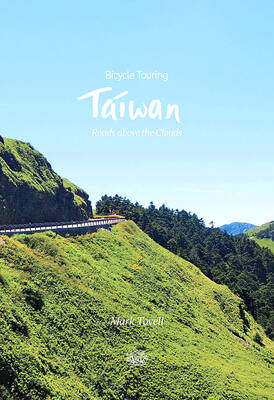
It’s hard to know where to begin with Mark Tovell’s Taiwan: Roads Above the Clouds. Having published a travelogue myself, as well as having contributed to several guidebooks, at first glance Tovell’s book appears to inhabit a middle ground — the kind of hard-to-sell nowheresville publishers detest. Leaf through the pages and you’ll find them suffuse with the purple prose best associated with travel literature: “When the sun is low on a warm, clear morning, and with the heat already rising, we stand at the riverside bike path leading south from Sanxia’s old cobble streets.” Hardly the stuff of your


 RSS
RSS