


Amazing Grace, a prettified take on the life and times of the 18th-century reformer William Wilberforce, carries a strong whiff of piety. It isn't a bad smell; there are notes of roses and treacle in the mix, but also elements of sweat and pain. Wilberforce, born in 1759, was an abolitionist for much of his adult life and helped bring about the end of the slave trade in the British Empire and then slavery itself. He was an evangelical Christian and social conservative who rallied for animal rights and against trade unions, which makes him a tough nut to crack. It's no wonder he makes a first-rate movie saint.
Serious-minded and squeaky clean, Amazing Grace is an imperfect look at an imperfect soul. It has been confidently directed by Michael Apted, who invests Wilberforce's fight with a strong sense of conviction, and written by Steven Knight, whose other credits include Dirty Pretty Things. The overall effect is part BBC-style biography, part Hollywood-like hagiography, and generally pleasing and often moving, even when the story wobbles off the historical rails or becomes bogged down in dopey romance. Wilberforce often comes across as too good to be true, which may be why the fine Welsh actor Ioan Gruffudd, doubtless with the encouragement of his socially minded director, plays him with a hint of madness in his eyes.
The film's overly complicated narrative traces Wilberforce's journey from strapping young reformer to nearly broken member of Parliament, with periodic skips back and forth in time. The only son of a wealthy merchant, he studied at Cambridge, where he met his close friend William Pitt the Younger, the future British prime minister, brought to extraordinary life by the young British actor and relative newcomer Benedict Cumberbatch. Eventually he will also meet a woman, his future wife, Barbara (the rather too saucy Romola Garai), which pushes the story into the less engaging domestic realm. But it is his intimate, prickly relationship with Pitt that warms the action and talk, partly through the chemistry between the actors, and brings the personal firmly to bear on the political.
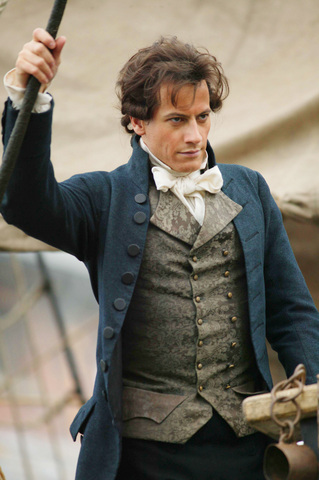
PHOTO: COURTESY OF LONG SHONG
Biographical films are generally tricky, since the on-screen personality rarely matches the real one; they're even trickier when the subject is shrouded in misty time and debate. In some quarters, Amazing Grace will succeed better as a diversion than as a nuanced record of Wilberforce's life. Historians have been divided on his legacy, with one damning him as "the mouthpiece of the party of order and of the business world." A contemporary asked Wilberforce, after he introduced a law that set back the cause of trade unions, why he paid more attention to African slaves than to Britain's working poor, whose interests he probably helped obstruct for years. Religious writers, not surprisingly, are more charitably disposed toward him.
It's equally unsurprising that the filmmakers don't address these sharper criticisms. The film's Wilberforce is a fanatic, a true believer, a crusader, a man of action and God, of stirring principle and tireless will. He's at once pure and seductive, a dashing, romantic figure with a long black coat who talks to God while lying in his garden and keeps rabbits for pets. This matinee idol version might be wildly simplistic, even borderline caricature, but there is also something unfailingly attractive about a film character so wholly devoted to good. The screenplay doesn't poke into the nature of that good — whether Wilberforce's fight against slavery was truly selfless or flattered a sense of moral superiority — but it does make you think.
It would be easier to dismiss Amazing Grace for its historical elisions if it weren't also filled with so many great British actors larking about in knee breeches and powdered wigs; if it weren't, in other words, an entertainment. Among the more valuable players is Rufus Sewell as Thomas Clarkson, a reformer whose passion seems to tip into zealotry when he speaks about the French Revolution; you half expect him to pull on some wellies so he can wade through the blue blood about to spill over the Place de la Concorde. And no matter how stuffy the room or the speeches, the reliably brilliant Michael Gambon, who plays Lord Charles Fox with trembling jowls and flashing eyes, brings a sense of the world and its sensual pleasures with him.
The actors Toby Jones, who plays one of King George III's many sons, and Ciaran Hinds are also on hand for much of the parliamentary proceedings, delivering withering commentary and general amusement as two of Wilberforce's most powerful foes. Albert Finney also blusters in every so often as Wilberforce's mentor, John Newton, who wrote the song that gives the film its title. In many respects, Amazing Grace offers a snapshot of the British Empire at the beginning of its long decline as the dominating world power. It takes nothing away from Wilberforce and his stunning achievements to note that this film, at its best, is another reminder that no matter how diminished that political might, no one sells old-fashioned, Hollywood-style history and manners better than those acting royals across the pond.

Last week Joseph Nye, the well-known China scholar, wrote on the Australian Strategic Policy Institute’s website about how war over Taiwan might be averted. He noted that years ago he was on a team that met with then-president Chen Shui-bian (陳水扁), “whose previous ‘unofficial’ visit to the US had caused a crisis in which China fired missiles into the sea and the US deployed carriers off the coast of Taiwan.” Yes, that’s right, mighty Chen caused that crisis all by himself. Neither the US nor the People’s Republic of China (PRC) exercised any agency. Nye then nostalgically invoked the comical specter
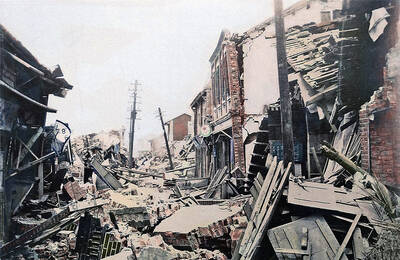
April 15 to April 21 Yang Kui (楊逵) was horrified as he drove past trucks, oxcarts and trolleys loaded with coffins on his way to Tuntzechiao (屯子腳), which he heard had been completely destroyed. The friend he came to check on was safe, but most residents were suffering in the town hit the hardest by the 7.1-magnitude Hsinchu-Taichung Earthquake on April 21, 1935. It remains the deadliest in Taiwan’s recorded history, claiming around 3,300 lives and injuring nearly 12,000. The disaster completely flattened roughly 18,000 houses and damaged countless more. The social activist and

Over the course of former President Ma Ying-jeou’s (馬英九) 11-day trip to China that included a meeting with Chinese Communist Party (CCP) leader Xi Jinping (習近平) a surprising number of people commented that the former president was now “irrelevant.” Upon reflection, it became apparent that these comments were coming from pro-Taiwan, pan-green supporters and they were expressing what they hoped was the case, rather than the reality. Ma’s ideology is so pro-China (read: deep blue) and controversial that many in his own Chinese Nationalist Party (KMT) hope he retires quickly, or at least refrains from speaking on some subjects. Regardless

Approaching her mid-30s, Xiong Yidan reckons that most of her friends are on to their second or even third babies. But Xiong has more than a dozen. There is Lucky, the street dog from Bangkok who jumped into a taxi with her and never left. There is Sophie and Ben, sibling geese, who honk from morning to night. Boop and Pan, both goats, are romantically involved. Dumpling the hedgehog enjoys a belly rub from time to time. The list goes on. Xiong nurtures her brood from her 8,000 square meter farm in Chiang Dao, a mountainous district in northern Thailand’s


 RSS
RSS