


Taipei's first experiment with a public bicycle program in 1998 was a lesson in how not to run a public bicycle program.
For an NT$50 deposit -- the price of a cheap lunch -- anyone could borrow a bike. The results were predictable.
"People threw them into rivers. Children rode them down stairwells and crashed them into walls. Other people just stole them," recalls Ho Li-chin (
Soon, less than one-fifth of the initial 526 bikes remained in working condition. The program was quickly put out of its misery.
"We embarked on the project with the principle that `man is basically good,'" Jack Chen, then Cycleland's vice chairman, told the Taipei Times in a 2000 interview. "It was a test."
So they tried again. In 2000, a more ambitious program was launched by the Taipei City Government and the non-profit foundation, then associated with but now independent from Giant, Taiwan's largest and best-known bicycle brand. Giant donated 1,000 bikes. Rental stations were set up at four city parks. This time precautions were taken: a deposit of NT$1,500 or an ID are required to rent a bike; there are hourly fees; and vandals are fined.
The results have been spectacular. Now, some 5,000 bikes can be rented at 18 locations in Taipei City and Taipei County. The rental lots are open seven days a week and many lie within walking distance of MRT stations and access points to Taipei's riverside bicycle tracks. It is possible to rent a bicycle, take it by MRT to Xindian, ride it all the way to Bali (
Taiwanese companies like Giant and Merida have long led the world in bicycle production, not only in quantity but also in quality and innovation. But only in the past decade have significant numbers of Taiwanese -- who usually zip around on scooters -- discovered the joys of bicycling.
Initiatives like Cycleland's and races organized by groups like the Taiwan Cyclist Federation have helped a small but growing cycling culture take root. City and county governments are laying down bicycle lanes, encouraging children to ride bicycles, and stepping up enforcement of safety rules. There is now an average of one cycling race each month, often along the island's scenic east coast.
Last summer, former premier Su Tseng-chang (
"Taiwan is perfect for cycling," said Ho, who now heads the Taiwan Cyclist Federation (
Ho, whose group has supplied 2,000 illustrated bicycling books for children to Taipei City schools, said Taiwanese began to take up bicycling after the introduction of the two-day weekend allowed for more leisure time. Better awareness of health issues has also helped, and the SARS crisis scared many Taiwanese into taking better care of their health.
On the government side, Taipei City has led the way. In the 1990s, it built its first bicycle lane on Dunhua North Road. By 2001, there were 40km of connected bicycle tracks along the giant "U" shape formed by the Keelung (
Cyclists credit current Chunghwa Telecom (
"Hopefully, this won't affect his attitude towards bicycles," joked former champion racer Chang Sheng-kai (
Last Sunday, Ah Hsin (
Ah Hsin said that, currently, the only obstructions he faces are the boat ride and the Zhongzheng Bridge (
Cyclists say Taipei City and County governments promptly removes detritus after floods, though a major inundation four years ago in Dazhi closed a section of the track for several months. There was so much debris that local residents planted gardens in the mud.
Recently, when riding around in Taipei, Ah Hsin has noticed police officers have started paying more attention to bicycle safety. Last September, the city announced it would begin fining bicyclists who run red lights and violate other traffic laws, a move cyclists say will improve conditions for them. Enforcement begins this September.
"Taipei just keeps getting better and better for cyclists," Ah Hsin said.

Last week Joseph Nye, the well-known China scholar, wrote on the Australian Strategic Policy Institute’s website about how war over Taiwan might be averted. He noted that years ago he was on a team that met with then-president Chen Shui-bian (陳水扁), “whose previous ‘unofficial’ visit to the US had caused a crisis in which China fired missiles into the sea and the US deployed carriers off the coast of Taiwan.” Yes, that’s right, mighty Chen caused that crisis all by himself. Neither the US nor the People’s Republic of China (PRC) exercised any agency. Nye then nostalgically invoked the comical specter

Relations between Taiwan and the Czech Republic have flourished in recent years. However, not everyone is pleased about the growing friendship between the two countries. Last month, an incident involving a Chinese diplomat tailing the car of vice president-elect Hsiao Bi-khim (蕭美琴) in Prague, drew public attention to the People’s Republic of China’s (PRC) operations to undermine Taiwan overseas. The trip was not Hsiao’s first visit to the Central European country. It was meant to be low-key, a chance to meet with local academics and politicians, until her police escort noticed a car was tailing her through the Czech capital. The
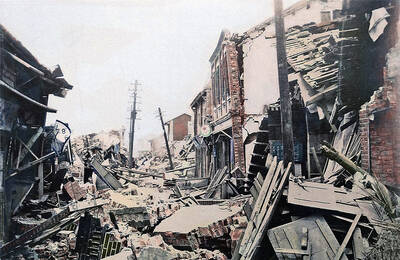
April 15 to April 21 Yang Kui (楊逵) was horrified as he drove past trucks, oxcarts and trolleys loaded with coffins on his way to Tuntzechiao (屯子腳), which he heard had been completely destroyed. The friend he came to check on was safe, but most residents were suffering in the town hit the hardest by the 7.1-magnitude Hsinchu-Taichung Earthquake on April 21, 1935. It remains the deadliest in Taiwan’s recorded history, claiming around 3,300 lives and injuring nearly 12,000. The disaster completely flattened roughly 18,000 houses and damaged countless more. The social activist and

Over the course of former President Ma Ying-jeou’s (馬英九) 11-day trip to China that included a meeting with Chinese Communist Party (CCP) leader Xi Jinping (習近平) a surprising number of people commented that the former president was now “irrelevant.” Upon reflection, it became apparent that these comments were coming from pro-Taiwan, pan-green supporters and they were expressing what they hoped was the case, rather than the reality. Ma’s ideology is so pro-China (read: deep blue) and controversial that many in his own Chinese Nationalist Party (KMT) hope he retires quickly, or at least refrains from speaking on some subjects. Regardless


 RSS
RSS