


In many ways, this brunch was like a million others I'd had before: poached eggs with hollandaise sauce, fresh orange juice, coffee, buttered toast. The sun was glowing somewhere over the comfy outdoor sofas, and no one seemed in a hurry to finish up and get home.
But here at Shakespeare and Company, a cozy cafe in Dubai's Village Mall, there were a few vital differences from my usual Sunday-morning routine. First of all, it was Friday, the Muslim Sabbath in the United Arab Emirates. Second, on a nearby couch, a mustachioed, white-robed Emirati man and a woman (in black garb that concealed everything but her gorgeous face) were on a date, chatting and flirting far from the eyes of their families — a testament to Dubai's liberal attitudes. Finally, there was the sand. A dust storm had been kicking all day, blowing grit in from the desert just a few miles away. It coated my hollandaise like finely ground black pepper.
But even in the world of Friday brunches, Shakespeare and Company's stood out — because it was cheap. My friend Samira Mesbahi, a curly-haired actress from Paris, and I had spent just 113.12 dirhams, or US$30.82 at a fixed exchange rate of 3.67 dirhams to the US dollar.
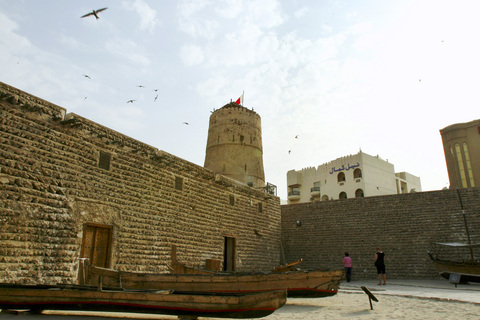
PHOTO: NY TIMES NEWS SERVICE
The typical Dubai brunch, by contrast, is an affair of ritualistic excess, held in the restaurant of a five-star hotel, with an all-you-can-eat buffet of gravlax, coddled eggs, a foie gras bar, and tuna belly sliced by an eighth-generation sushi chef from Osaka. Such indulgence can easily run 300 dirhams a person, not including the unlimited-champagne surcharge.
Of course, this shouldn't surprise anyone who's ever heard the word Dubai. The emirate is synonymous with over-the-top artifice: the "seven-star" hotel, the skyscrapers rising from what moments before had seemed to be only tracts of sand, the man-made island chains, the indoor ski area. Frankly, I wondered how I'd afford anything at all. My wallet held only US$500, or 1,835 dirhams, for the weekend, and while a host of budget options — easyHotels, a low-cost-airline terminal — are set to open in the near future, none had broken ground by mid-March, when I visited. Even the cheapest stopover deals offered by Emirates, the flag carrier, would have eaten up more than half my budget.
But searching the Web, I found a fabulous deal: Villa 08. Owned by a pair of European expatriates, the three-bedroom house is in Arabian Ranches, a gated community on the distant southern edge of Dubai. On one side of the fence are swimming pools, a supermarket, a country club and rows of nearly identical villas in the style of Arabian forts. On the other side, the vast desert and burgeoning dust storm.
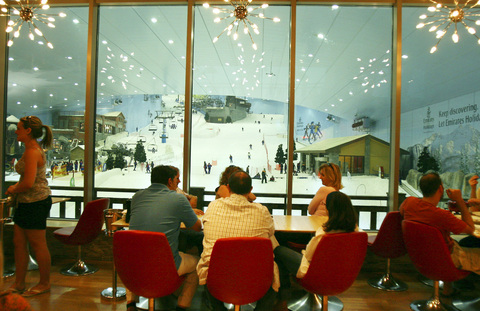
PHOTO: NY TIMES NEWS SERVICE
Villa 08's cheapest room was US$60 a night.
From Shakespeare and Company, Mesbahi and I drove my sand-colored Toyota Echo along Jumeira Road — a thoroughfare that reminded me of the strip-mall-saturated outskirts of Albuquerque — to Bur Dubai, the ancient heart of the city. It was here, on the banks of the Dubai Creek, that the city grew from a tiny Persian Gulf trading hub into a megalopolis fed by the idea that human beings, whatever their religion, will put aside their differences in pursuit of profit.
My destination was the Dubai Museum, housed in an 18th-century fort with tall, square "wind towers" that channel breezes to cool the interior. Three dirhams bought me entry to a series of dioramas about life in old Dubai: mannequins selling diamonds; mannequins building a dhow, the traditional Arab boat; mannequins studying the Koran. An exhibit on Bedouins blandly proclaimed that the nomads "love good deeds and hate evil." Surrounded by simulacra, I wondered: Where was Jean Baudrillard when I needed him?
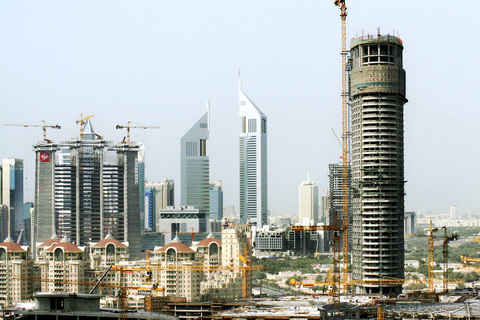
PHOTO: NY TIMES NEWS SERVICE
Nearby, Mesbahi and I found a subtler refurbishment of old Dubai: the Bastakiya neighborhood. A labyrinth of low, neat buildings, Bastakiya is home to several art galleries, such as XVA Gallery, a couple of boutique hotels and the Basta Art Cafe, in whose calm, tree-filled courtyard we refueled with fresh lemonade and a strawberry shake (29 dirhams). As the sun began to set, we headed out into the evening, wandering through Bastakiya's narrow, yellow-lighted passageways to the Creek, where motorboats were ferrying people across for a single dirham.
We stayed on our bank, however, and wound up in the souk, the modernized version of what might once have been an atmospheric marketplace. Most of the stalls — selling everything from textiles to mobile phones — were shutting down, but Mesbahi managed to find amazing tchotchkes: a pink plastic mosque-shaped alarm clock and a stuffed camel that sings Arabic pop songs. Each cost 10 dirhams, but I couldn't bring myself to buy them; instead, I munched pakoras and drank mango nectar (4 dirhams) from Al Balad Cafeteria, an Indian snack stall.
The population around the souk was overwhelmingly male, and Mesbahi was attracting too much attention, so we drove somewhere she'd be more comfortable: the Cigar Lounge on the 10th floor of the Jumeirah Emirates Towers. As I drank a Manhattan and she a fruit shake (63 dirhams), we gazed at the blinking lights of the city. But which city — Dubai, Hong Kong, New York?
Our next stop was a birthday party for one of Mesbahi's friends. In the 33rd-floor apartment, young people drank beer, gossiped and stared out at the typically Dubai landscape — a highway lined with construction sites and dark, empty apartment towers. The curious thing was the mix: Filipino nurses plus Arabs from across the diaspora. A Jordanian guy told me of his family's business troubles in Saudi Arabia; meanwhile, a Saudi guy in full robes and headscarf popped open another tallboy. It was a tantalizing hint that Dubai harbored more than I'd expected.
It's probably very normal for people to wake up in Dubai, realize they have money in their pockets, and set out to spend it. But for the Frugal Traveler, it's a rare and nerve-wracking moment.
Souk Madinat Jumeirah would, I hoped, calm me. A sprawling complex encompassing a shopping center, restaurants, a theater, a resort, a nightclub and a spa, Madinat is modeled after traditional Arab fort architecture, with lots of plazas and fountains, a color scheme that ranges from sandy to beige to khaki, and "wind tower" structures that house modern HVAC units.
I began by inquiring into things I couldn't possibly afford, like a 15,300-dirham wristwatch by Nouvelle Horlogerie Calabrese. The salesman said he'd let it go for 11,475; I said I'd think about it. At a carpet store, I asked if they carried tribal gabbeh styles; the salesman said no and turned his attention to wealthier clients. Finally, I arrived at Vivel Patisserie: The pastries had lots pistachios and almonds, and a double-layer box cost only 40 dirhams. Sold! Instead of gorging myself right there, I had a bowl of Malaysian laksa noodles at the chic Noodle House (64 dirhams with lime soda and a side of spicy eggplant), and drove off in search of more places to thin my wallet.
Halfway across town I discovered Five Green, a bright shop that sold Edwin jeans from Japan, fancy sneakers and lots of Paul Frank T-shirts — all of which I could get cheaper back home
By evening, I arrived at the Mall of the Emirates, the biggest in Dubai, where I wandered among the rich tourists and richer locals (one of whom was carrying, for no discernible reason, a riding crop), hoping I would stumble upon a Zen Buddhist monastery and spend the rest of the weekend in thrifty, silent meditation.
Instead, I came face to face with Ski Dubai, the indoor ski center with a vertical drop of 60m, and I knew that, before the weekend was out, I would have a face full of fake snow.
I zipped over to the Mall of the Emirates, plunked down 160 dirhams for a two-hour pass (ski pants, socks, jacket and locker rental included), bought a cheap pair of gloves (60 dirhams), and was on the lift in five minutes. Less than an hour later, I was done — the joy of snowboarding in the desert couldn't make up for the dullness of the terrain.
What I wanted from Dubai was not preconceived amusements but the accidental by-products of globalization.

In late October of 1873 the government of Japan decided against sending a military expedition to Korea to force that nation to open trade relations. Across the government supporters of the expedition resigned immediately. The spectacle of revolt by disaffected samurai began to loom over Japanese politics. In January of 1874 disaffected samurai attacked a senior minister in Tokyo. A month later, a group of pro-Korea expedition and anti-foreign elements from Saga prefecture in Kyushu revolted, driven in part by high food prices stemming from poor harvests. Their leader, according to Edward Drea’s classic Japan’s Imperial Army, was a samurai

Located down a sideroad in old Wanhua District (萬華區), Waley Art (水谷藝術) has an established reputation for curating some of the more provocative indie art exhibitions in Taipei. And this month is no exception. Beyond the innocuous facade of a shophouse, the full three stories of the gallery space (including the basement) have been taken over by photographs, installation videos and abstract images courtesy of two creatives who hail from the opposite ends of the earth, Taiwan’s Hsu Yi-ting (許懿婷) and Germany’s Benjamin Janzen. “In 2019, I had an art residency in Europe,” Hsu says. “I met Benjamin in the lobby
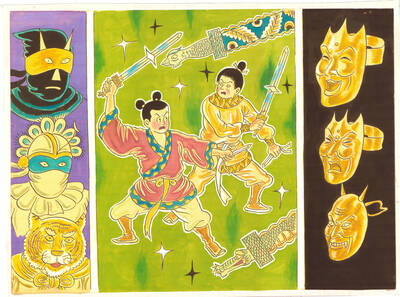
April 22 to April 28 The true identity of the mastermind behind the Demon Gang (魔鬼黨) was undoubtedly on the minds of countless schoolchildren in late 1958. In the days leading up to the big reveal, more than 10,000 guesses were sent to Ta Hwa Publishing Co (大華文化社) for a chance to win prizes. The smash success of the comic series Great Battle Against the Demon Gang (大戰魔鬼黨) came as a surprise to author Yeh Hung-chia (葉宏甲), who had long given up on his dream after being jailed for 10 months in 1947 over political cartoons. Protagonist

Peter Brighton was amazed when he found the giant jackfruit. He had been watching it grow on his farm in far north Queensland, and when it came time to pick it from the tree, it was so heavy it needed two people to do the job. “I was surprised when we cut it off and felt how heavy it was,” he says. “I grabbed it and my wife cut it — couldn’t do it by myself, it took two of us.” Weighing in at 45 kilograms, it is the heaviest jackfruit that Brighton has ever grown on his tropical fruit farm, located


 RSS
RSS