


Eti Khuman's face lies cradled on her mother's shoulder, her cheek resting in against Mina's collarbone. Eti is beautiful, but she is poorly: her breathing is heavy, and Mina has the distracted look of a mother who is very worried indeed. Eti's illness — first vomiting, then diarrhea — struck without warning. Like all mothers in Bangladesh, Mina knew to fear diarrhea: in this country, diarrhea can kill. So she wasted no time in bringing her eight-week- old daughter here, to the main diarrhea hospital near her home in the capital, Dhaka.
Eti was admitted, and now she and Mina are in the main ward, a sweltering room so packed with beds that there is barely space to walk between them. It's a general ward, but most of the patients are babies. Some, like Eti, are being held by their mothers: others lie quietly on their beds attached to drips. Not one is crying: they are all much too weak for that.
Twenty-five years ago, when Iqbal Kabir first came to work at this hospital, small babies were almost unknown as patients. Today, he says, infants make up as many as 70 percent of admissions.
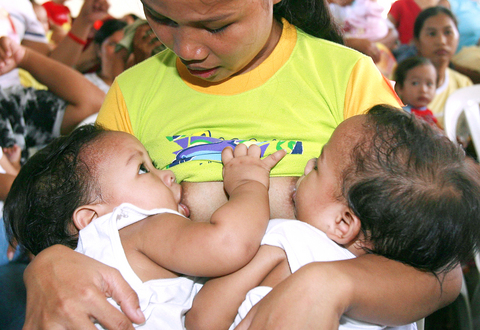
PHOTOS: AGENCIES
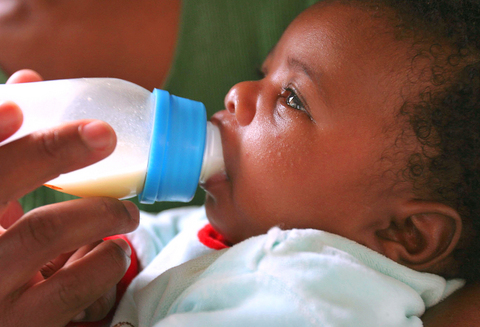
The reason? Kabir shakes his head, and points to a poster on the wall above Eti's bed. The same poster is displayed, many times, around the ward. It shows a baby's bottle, with a big cross drawn heavily through it. The message is clear. "Bottle-feeding is harmful," says Kabir. "Because bottle-fed babies get diarrhea, since their formula is mixed with dirty water and since their bottles are not sterile. Do you know how many breast-fed babies are admitted here with diarrhea? The number is almost zero." Eti has been bottle-fed almost since birth: Mina says she wanted to breast-feed, but when she had difficulties there was no one to give advice or support. Mina's story was typical of those of many of the mothers I met in Bangladesh: when she hit problems and went to a doctor, the suggestion was to try formula. In doctors' surgeries and pharmacies across the country, it seems, health professionals are quick — far too quick, say breast-feeding campaigners — to suggest bottle-feeding as the way forward.
Kabir is appalled by her tale, as he has been appalled many times before: in a perfect world, he'd like to see formula milk and bottles removed from general shops, and available only as a last resort, on prescription. "It sounds extreme — but then, it sounded extreme when people first talked about banning smoking. This is the same issue — only with bottle-feeding in my country it's not consenting adults who die, it's tiny babies."
For the moment, though, Kabir's anger is directed at the manufacturers of baby formula. Like many of his fellow health professionals, he believes these manufacturers push their products too aggressively, sometimes breaching the stipulations of an international code on the marketing of formula milk drawn up in 1981, ratified by member states of the World Health Organization, and enshrined in law in Bangladesh since 1984.
That code, in turn, had been prompted by public support of an international boycott of the products of the company that seemed most culpable 30 years ago: Nestle. The code could have ended the boycott, but campaigners continue to flag it up because, they claim, the company — and many other baby-milk manufacturers — fail to abide by its requirements. Despite the safeguards it affords, they say, mothers in developing countries — the most vulnerable of mothers anywhere, the ones least able to afford formula milk, the ones whose babies most need the breast milk they could and should be getting for free — were being, and continue to be, targeted by corporate giants bent on carving out their share of a valuable market. Save the Children, which on Tuesday published a report on the baby-milk industry, reckons that the total value of baby-milk and baby-food imports is worth almost ?16 million (NT$1.1 billion) a year in Bangladesh alone — but the potential, if more mothers were bottle-feeding, is a lot higher than that.
So, three decades on from the boycott's inception, I have come to Bangladesh to find out whether Nestle has — as it claims — changed its behavior, and is now a reformed organization, or whether the campaigners have been right to keep up the pressure all these years, not just on Nestle but on other formula manufacturers too.
Down the road from the diarrhea hospital is the whitewashed Sajida hospital, a private hospital like the one in which Eti was born. Giving birth in a private hospital in Bangladesh isn't just for the wealthy — having a baby here costs only a few US dollars — but it is staff in hospitals such as this, say campaigners such as Munir Ahmed of Save the Children in Dhaka, who are targeted by reps from the formula companies. Khaliq Zaman is the pediatrician at the Sajida hospital: yes, he tells us, he receives frequent visits from milk manufacturers, including Nestle, makers of Lactogen, one of the leading brands in Bangladesh.
"The reps are very aggressive — there are three or four companies, and they come in every two weeks or so," he says. "Their main aim is to recommend their product. Sometimes they bring gifts — Nestle brought me a big cake at new year. Some companies give things like pens and notebooks, with their brand name on them. They try very hard — even though they know I am not interested, that I always recommend breast-feeding, still they come."
As we talk Zaman holds a pen with the name of a well-known brand of formula milk clearly imprinted on it: the pen isn't expensive, but the giving of all presents to health workers is prohibited under the code. So, too, is the direct promotion of their products to mothers: and yet, the evidence from Zaman is that Nestle and other manufacturers are getting their message through to mothers none the less.
Here's how: on Zaman's desk, lots of small pads lie scattered: each contains sheets with information about formula milk, plus pictures of the relevant tin. The idea, he says, is that when a mother comes to him to ask for help with feeding, he will tear a page out of the pad and give it to her. The mother — who may be illiterate — will then take the piece of paper (which seems to all intents and purposes a flyer for the product concerned) to her local shop or pharmacy, and ask for that particular product either by pointing the picture out to the pharmacist or shopkeeper, or by simply searching the shelves for a tin identical to the one in the picture on their piece of paper. "I'd never give these pieces of paper out — when I've got a big enough bundle, I take them home and burn them," says Zaman. But that does not mean every other health worker would do the same.
At least three types of Nestle formula are among the brands whose tear-off pads are on Zaman's desk. Nestle spokesman Robin Tickle denies that tear-off pads equate to promoting Lactogen. In fact, he says, the device is "essentially a safety measure. The pads are distributed as information to healthcare workers which ... is allowed under the code. Individual sheets of these are then indeed handed over to mothers, but only after the infant formula has been prescribed by a doctor." He does not accept that the code fails to distinguish between tear-off pads and other sorts of promotion, or that any piece of paper that features a picture of a product a company wants to sell is, arguably, de facto advertising.
The point, he says, is that doctors need — for safety reasons — to make clear to women whether they need Lactogen 1 (for younger babies) or Lactogen 2 (for older ones). So it isn't, then, simply a case of Nestle exploiting a loophole in the international code? Absolutely not, says Tickle: Nestle is, he says, one of the largest private distributors of information about the benefits of breast-feeding. And yet, as I tell him, I saw no evidence whatsoever of any Nestle-sponsored pro-breast-feeding literature, despite spending two days touring hospitals, maternity wards and pediatric clinics: doesn't it seem odd that Nestle is highly efficient at getting its tear-off slips into mothers' hands in Bangladesh (there were prescription pads in abundance in many of the places we visited), and yet fails, as far as I could tell, in getting them what they could really use, which is information on how to breast-feed? And anyway, campaigners question how realistic it is to think that a company such as Nestle — which has huge amounts of money tied up in formula milk sales — is going to be committed to spreading the "breast is best" gospel.
"The Nestle leaflets with the picture of Lactogen violates the Code if given to mothers," says Costanza de Toma, author of the Save the Children report. "The truth is that formula manufacturers are clever — they look for gray areas in the code, and they exploit them." Given that the code does not allow them direct access to mothers, she alleges, the companies have become adept at channeling their efforts into getting health workers on side. In any country, but particularly in a country such as Bangladesh where antenatal education is minimal, and where access to other sources of information is limited, the messages new mothers get from doctors, nurses and midwives are crucial. Many of the women I met said it was precisely these people who had suggested a move to not just formula in general, but a specific make — often Lactogen.
Even in the UK, formula companies exploit loopholes where they can. Last year, when the government here launched a new scheme, Healthy Start, to replace the Welfare Food Scheme, two of the biggest producers of formula in Britain — Cow & Gate and Heinz — tried to use it as a marketing opportunity. "Cow & Gate produced adverts saying its baby milk was 'closest to breast milk,' a claim which is disallowed under the code, until the UK Department of Health clamped down on them; and Heinz published a graph suggesting its formula was close to breast milk and better than competing brands. Both companies were not only violating the code, but also UK legislation," says De Toma.
One of the problems with the WHO code — apart from its many gray areas — is how it is policed. Many countries, Bangladesh and the UK included, have backed its requirements up with legislation. But, says Save the Children, WHO and Unicef could do more. "The WHO ... must be bolder in getting companies to comply," it says in today's report. "Unicef must ensure that compliance with the code becomes a measure of progress on countries' implementation of the UN Convention on the Rights of the Child."
Within Bangladesh, there is a feeling that if breast-feeding campaigners take their eye off the ball for even a moment, the formula companies will quickly gain ground. At the Institute of Public Health and Nutrition in Dhaka — the government body charged with implementing the curbs on formula manufacturers — director Professor Fatima Parveen Chowdhury is looking askance at several tins of formula milk piled up on her desk. She frowns at the cartoon pictures on the cover — too attractive, she says; too tempting — and frets over the wording on the cans. "The code requires companies to put words on the can saying there is no substitute for breast milk, but on this can those words are too small, it's written in tiny letters that it's a breast-milk substitute, and it won't do," she says.
There are other problems, too: many companies that sell formula milk in Bangladesh have failed in their legal duty to register with her department, and that makes it difficult to keep track of what they're up to. "I talk to companies and in front of me they seem to be reasonable," Chowdhury says. "But I'm not convinced. We have to be watchful. They are very technical, very sly."
Or even, sometimes, outrageously flagrant. Public advertising by baby-milk manufacturers is explicitly banned in the WHO code and in Bangladeshi law, but Ahmed takes me to a doctor's waiting room in a Dhaka suburb whose walls are adorned with posters showing healthy-looking babies, and the names of baby-milk manufacturers (not Nestle, in this case). Strangely, it seems to me, the babies in the posters are all Caucasian: but Ahmed has an explanation. "For many people here, what white people do is the right thing to do," he says. "So putting white people on posters like these sends out the message that it's the western way, the best way. It's one of the many subtle ways in which breast-feeding is undermined here."
So is breast-feeding declining in Bangladesh? It's difficult to tell, says Swapn Roy, secretary general of the Bangladeshi Breastfeeding Foundation, because the statistics are not reliable. Around 95 percent of mothers are believed to start breast-feeding, but by one month the figure is down to maybe around 89 percent, and at six months (the age to which, under WHO recommendations, all babies should be wholly breast-fed), the figure is maybe 25 percent, but could be as low as 16 percent. Anecdotally, many health professionals feel the tide is shifting against them.
For some families, the burden of buying formula milk is simply too much. "They can't afford to mix it at the required proportion, so to make it go further they use too little powder," says Roy. "Or they resort to using ordinary powdered milk, which is a lot cheaper to buy than branded baby formula. The result is babies whose milk is little more than what you might call white water."
According to Save the Children's report, infant mortality in Bangladesh alone could be cut by almost a third — saving the lives of 314 children every day — if breast-feeding rates were improved. Globally, the organization believes, 3,800 lives could be saved each day. Given that world leaders are committed to cutting infant mortality by two thirds by 2015 as one of the Millennium Development Goals, protecting and promoting breast-feeding is almost certainly the biggest single thing that could be done to better child survival rates.
But the formula companies, despite the international code, continue to undermine campaigners' efforts. Throughout the west as well as in the developing world, the amounts spent on "breast is best" campaigns are dwarfed by the amounts food manufacturers spend on promoting their products: in the UK, for example, Save the Children reckons that for every ?1 spent in 2006-2007 on breast-feeding promotion, ?10 was spent by manufacturers on advertising and promoting baby milk and foods. If companies such as Nestle genuinely wanted to do what Tickle says they want to do, which is support breast-feeding, there is a simple way forward: convert its efficient, and effective, network of sales reps into an equally efficient and effective network of breast-feeding advisors.
Back in Dhaka, at the diarrhea hospital, Eti is on the mend. She and her mother Mina have spent time with a breast-feeding counselor, and Mina has agreed to try to start breast-feeding again. Kabir is delighted — he says as many as 70 percent of mothers who give up breast-feeding can get their milk going again, given proper support and advice. All the same, it would have been infinitely better if women such as Mina never stopped breast-feeding in the first place
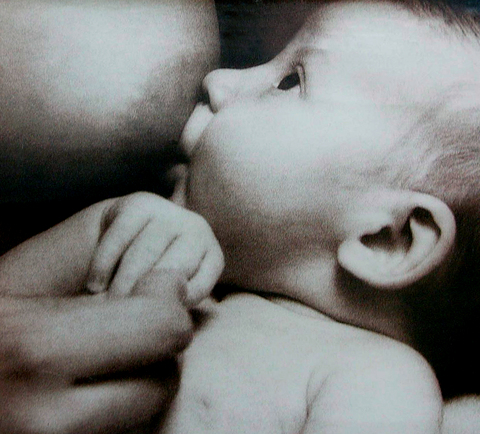
The truth at the center of this story is this: for babies such as Eti and Nur, in countries like Bangladesh, there is no healthy substitute for breast-feeding.

In late October of 1873 the government of Japan decided against sending a military expedition to Korea to force that nation to open trade relations. Across the government supporters of the expedition resigned immediately. The spectacle of revolt by disaffected samurai began to loom over Japanese politics. In January of 1874 disaffected samurai attacked a senior minister in Tokyo. A month later, a group of pro-Korea expedition and anti-foreign elements from Saga prefecture in Kyushu revolted, driven in part by high food prices stemming from poor harvests. Their leader, according to Edward Drea’s classic Japan’s Imperial Army, was a samurai

Located down a sideroad in old Wanhua District (萬華區), Waley Art (水谷藝術) has an established reputation for curating some of the more provocative indie art exhibitions in Taipei. And this month is no exception. Beyond the innocuous facade of a shophouse, the full three stories of the gallery space (including the basement) have been taken over by photographs, installation videos and abstract images courtesy of two creatives who hail from the opposite ends of the earth, Taiwan’s Hsu Yi-ting (許懿婷) and Germany’s Benjamin Janzen. “In 2019, I had an art residency in Europe,” Hsu says. “I met Benjamin in the lobby

April 22 to April 28 The true identity of the mastermind behind the Demon Gang (魔鬼黨) was undoubtedly on the minds of countless schoolchildren in late 1958. In the days leading up to the big reveal, more than 10,000 guesses were sent to Ta Hwa Publishing Co (大華文化社) for a chance to win prizes. The smash success of the comic series Great Battle Against the Demon Gang (大戰魔鬼黨) came as a surprise to author Yeh Hung-chia (葉宏甲), who had long given up on his dream after being jailed for 10 months in 1947 over political cartoons. Protagonist

Peter Brighton was amazed when he found the giant jackfruit. He had been watching it grow on his farm in far north Queensland, and when it came time to pick it from the tree, it was so heavy it needed two people to do the job. “I was surprised when we cut it off and felt how heavy it was,” he says. “I grabbed it and my wife cut it — couldn’t do it by myself, it took two of us.” Weighing in at 45 kilograms, it is the heaviest jackfruit that Brighton has ever grown on his tropical fruit farm, located


 RSS
RSS