


An important site in the history of the tangwai opposition movement in the 1980s, the Wistaria teahouse (紫藤盧) has long been a cultural and academic meeting point for artists, intellectuals, dissidents and idealists and reflects its founder Chou Yu's (周渝) liberal philosophy.
"Wistaria has been at the forefront of national social and academic activities and provided a cultural energy for people outside the system," said Chou, a connoisseur of tea who has been a highly respected figure of Taipei's social and cultural landscape for the past 30 years.
Chou hopes to lead a simpler life, ruminating on the contemporary cultural paradigm, at Teng (藤居), his newly opened teahouse tucked away in the labyrinthine of alleys off Linyi Street (臨沂街), and the temporary home for Wistaria as the old meeting place site undergoes renovations.
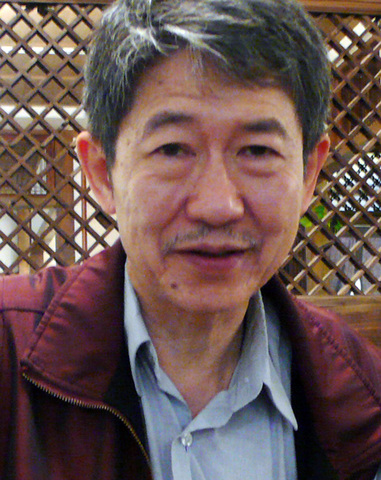
PHOTOS: HO YI, TAIPEI TIMES
The son of Chou Te-wei (周德偉), a Peking University graduate and an acclaimed economist who studied under Friedrich Hayek, his father was influenced by liberal and traditional Chinese intellectual traditions and often discussed politics and philosophy with other liberal thinkers and democratic pioneers such as Ying Hai-kuang (殷海光), Hsia Tao-ping (夏道平) and Chang Fo-chuan (張佛泉) at his Japanese-style house in the 1950s. Together the group began Free China (自由中國), a publication that advocated liberalism and was sharply critical of the Chinese Nationalist Party (KMT).
When his father moved to the US with the rest of the family, Chou became the sole custodian of the old house where he established Taiwan's first experimental theater, Tien Experimental Theater (耕莘實驗劇團), in 1976.
"The theater was a breakthrough at that time when all scripts were strictly censored and limited to either tales of feudalistic morality or propaganda about re-conquering China and vanquishing the Communists. Since the theater belonged to the Tien Cultural Institute (耕莘文教院), whose activities were exempt from governmental censorship, we were able to stage plays that reflected social reality," Chou explained.
Three years later, the Kaohsiung Incident (美麗島事件), a pro-democracy protest sparked by a police raid on the Formosa Magazine, inflamed radical sentiment and helped turn Chou's teahouse into a hotbed of political dissent. Chou took an active role in the opposition movement, circulating flyers on the streets, supporting political prisoners and their families and posting protest placards near his house on what became known as the "democracy wall."
Wistaria officially came into existence in 1981, formed in the tradition of 18th-century European salons and coffee houses.
Penniless artists, democracy activists, writers and academics all came to call the teahouse home. Chou not only provided a channel through which to air critical views but a place to sleep and dine.
In the martial law era when art venues and performance spaces were few and far between, Wistaria also served as a much needed cultural site sponsoring artists and showcasing their works, including that of painters Hung Tung (洪通), Cheng Tsai-tung (鄭在東), Chen Lai-hsing (陳來興) and Chiu Ya-tsai (邱亞才).
"When my father moved to the US, he left me only a few works of calligraphy and a painting by Chi Pai-shi (齊白石). As the cultural and social pursuits of my friends and myself left me broke, I sold the painting for around NT$60,000," Chou recalled.
Chou and his friends' form of politicized and liberal expression naturally attracted the attention of the authorities. Several unsuccessful attempts were made to shut the place down. In 1997, the Ministry of Finance (財政部) moved to take control of the property and a long rescue mission initiated by artists and academics ensued and eventually succeeded in preserving the teahouse as a designated heritage site under the supervision of The Taipei City Government's Department of Cultural Affairs.
As time progressed and Wistaria habitues made names for themselves in politics and the arts, Chou and his teahouse have remained an undisturbed corner of Taipei.
Long associated with Daoism, Confucianism and Chinese Buddhism and seen as a cultivated pursuit that refines one's moral character, tea-drinking culture aids self-enlightenment and spiritual cleansing, Chou believes.
"The values of tea culture are threefold: it's therapeutic to the body, self-cultivation and life-as-art. While the first is a basic requirement, self-cultivation is a core need and without it, the third aspect would be rootless and could easily fall prey to commercialism," said the gray-haired activist.
The gray-haired sophisticate aims to revive the refined cultural tradition of tea drinking that was renounced by Chinese intellectuals during the May Fourth Movement (五四運動).
"The denial of cultural heritage prevents us from understanding who we are ... . The creation of culture can't be rationally planned; it is without purpose, emerging from spontaneity and contingencies that are the manifestation of our cumulated pasts," said Chou, who, has entered a new phase of life striving to open a new cultural horizon nurtured by ancient Chinese ideals.
In the pre-democracy era when voices of dissent were silenced by the dictatorial regime, Chou stood up to be heard. Twenty years later, he chooses to quietly practice and cultivate the cultural aesthetics that are fast disappearing in the capitalist world.
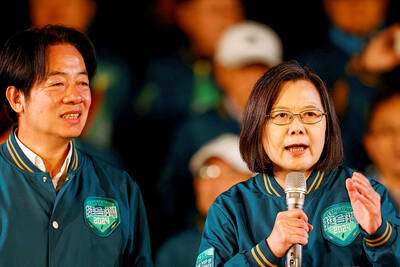
Last week Joseph Nye, the well-known China scholar, wrote on the Australian Strategic Policy Institute’s website about how war over Taiwan might be averted. He noted that years ago he was on a team that met with then-president Chen Shui-bian (陳水扁), “whose previous ‘unofficial’ visit to the US had caused a crisis in which China fired missiles into the sea and the US deployed carriers off the coast of Taiwan.” Yes, that’s right, mighty Chen caused that crisis all by himself. Neither the US nor the People’s Republic of China (PRC) exercised any agency. Nye then nostalgically invoked the comical specter
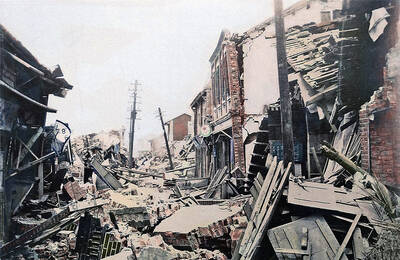
April 15 to April 21 Yang Kui (楊逵) was horrified as he drove past trucks, oxcarts and trolleys loaded with coffins on his way to Tuntzechiao (屯子腳), which he heard had been completely destroyed. The friend he came to check on was safe, but most residents were suffering in the town hit the hardest by the 7.1-magnitude Hsinchu-Taichung Earthquake on April 21, 1935. It remains the deadliest in Taiwan’s recorded history, claiming around 3,300 lives and injuring nearly 12,000. The disaster completely flattened roughly 18,000 houses and damaged countless more. The social activist and

Over the course of former President Ma Ying-jeou’s (馬英九) 11-day trip to China that included a meeting with Chinese Communist Party (CCP) leader Xi Jinping (習近平) a surprising number of people commented that the former president was now “irrelevant.” Upon reflection, it became apparent that these comments were coming from pro-Taiwan, pan-green supporters and they were expressing what they hoped was the case, rather than the reality. Ma’s ideology is so pro-China (read: deep blue) and controversial that many in his own Chinese Nationalist Party (KMT) hope he retires quickly, or at least refrains from speaking on some subjects. Regardless

Approaching her mid-30s, Xiong Yidan reckons that most of her friends are on to their second or even third babies. But Xiong has more than a dozen. There is Lucky, the street dog from Bangkok who jumped into a taxi with her and never left. There is Sophie and Ben, sibling geese, who honk from morning to night. Boop and Pan, both goats, are romantically involved. Dumpling the hedgehog enjoys a belly rub from time to time. The list goes on. Xiong nurtures her brood from her 8,000 square meter farm in Chiang Dao, a mountainous district in northern Thailand’s


 RSS
RSS