


William Langewiesche begins The Atomic Bazaar with a reference to Hiroshima and a chilling, methodical description of exactly how a nuclear blast destroys a city. Literally and figuratively this is overkill. He did not need such a drastic way of attracting attention to his book's true subject: the illicit and unstoppable spread of nuclear weapons to some of the world's most volatile nations. His book insightfully examines the perils created by this leveling of the global playing field.
The Atomic Bazaar originated in The Atlantic Monthly (where Langewiesche was a national correspondent before moving to Vanity Fair) and strings together four separate sections. Its opening glimpses of apocalypse do strike a unifying note of high-stakes danger. Elsewhere he writes about the specifics of smuggling and manufacturing nuclear material; the new kinds of saber rattling that have become possible among mutually antagonistic nations; and the hubris-propelled career of Abdul Qadeer Khan, Pakistan's foremost purveyor of nuclear technology. Thanks to Khan's enterprising thefts of information from Dutch centrifuge and uranium-enrichment companies, the same blueprints for disaster have found their way to Libya, North Korea, Brazil, Iraq and Iran.
It is Langewiesche's perspective on these ominous signs that makes his book unusual. "The nuclearization of the world has become the human condition, and it cannot be changed," he writes authoritatively. "Fear of it becomes dangerous when it detracts from realistic assessments of the terrain."
Among those realistic assessments is his idea that we may be entering a period of history when limited nuclear wars are possible. "That is the flip side of proliferation, rarely addressed in public debate," he writes. "The spread of nuclear weapons, even to such countries as North Korea and Iran, may not be as catastrophic as is generally believed and certainly does not meet the category of threat than can justify the suppression of civil liberties of the pursuit of preemptive wars."
What we need, he says, is the clear-eyed vision "to accept the equalities of a maturing world in which many countries have acquired atomic bombs, and some may use them."
Buried within that grim assessment is a curious kind of optimism, bolstered by the kind of tenacious reporting for which this author is well known. In the section of the book called "Nukes Without Nations" he examines the challenges faced by terrorists trying to conduct nuclear attacks. He finds this a tougher job than many an alarmist would expect.
Yes, dangerous information is widely available. About a documentary on raiding a Russian nuclear facility he learns "that a copy was requested by a certain Osama bin Laden, in Brussels, and that no copy was sent — but that's how far you have to go not to get it." As both Albert Einstein and J. Robert Oppenheimer predicted, the nuclear genie, once uncorked, will never return to its bottle.
But Langewiesche sees real deterrents to terrorist activities, starting with the thought that no government mindful of retaliation would want to see rogue weapons manufactured on its soil. And from the terrorists' viewpoint no government that did allow such activities could be trusted not to confiscate the weapons produced.
The big, noisy, impenetrable cities where bombs could be built — among them Mombasa, Kenya; Karachi, Pakistan; Mumbai, India, and Mexico City, in his estimation — "are urban collectives, ungovernable perhaps, but not necessarily uncontrolled." He suggests that there are as-yet-unexplored ways for battling terrorism by penetrating such places.
Much of The Atomic Bazaar deals with the slippery political realities of the nuclear underworld. It pays close attention to Pakistan — an illustration of the "nuclear poor" in the book's subtitle — as a country where pro forma deniability is a superficial goal and nuclear empowerment a real one. This leads to the exemplary career of Khan (in a chapter called "The Wrath of Khan") and the high level of flamboyance at which he operated, until the Musharraf government found it expedient to silence him in 2004. He now lives under house arrest in a state of despondency, according to the book.
Even if "Khan's rapid success came as a particular shock because it so quickly transformed this runt called Pakistan into something like a runt with a gun," it still had a disproportionately daunting effect.
"Though it would be politically inconvenient to admit this now," Langewiesche writes of events in 1991, "the US was aware not only of Khan's peddling of nuclear wares to Iran, but also of the likely involvement of the army and government of Pakistan." And the US' onetime leverage of a formidable nuclear arms supply became a liability in dealing with smaller countries seeking nuclear leverage of their own. Now, he suggests, such countries could readily spawn characters like Khan, who "did not create his nuclear-weapons network so much as discover it as a condition of the modern world."
The fourth section of The Atomic Bazaar, called The Point of No Return, is devoted to an American journalist, Mark Hibbs, who, according to Langewiesche, "is largely unknown to the public, but must rank as one of the greatest reporters at work in the world today."
Hibbs writes impenetrably technical stories for the small, elite publications Nucleonics Week and NuclearFuel. And he is uncommonly well equipped to fill in the blanks in the history of nuclear proliferation. Hibbs operates deductively, tracks the movements of fuel and centrifuge components, draws the obvious conclusions and operates as a kind of unmuzzled spy. His vigilance may not be glamorous, but it is vitally important, according to The Atomic Bazaar.
It is only with eyes wide open that we can fathom the workings of this new nuclear world.
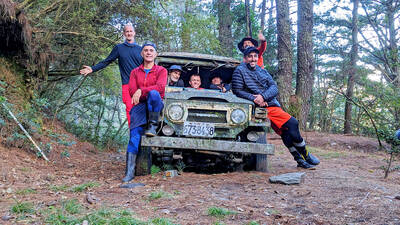
The year was 1991. A Toyota Land Cruiser set out on a 67km journey up the Junda Forest Road (郡大林道) toward an old loggers’ camp, at which point the hikers inside would get out and begin their ascent of Jade Mountain (玉山). Little did they know, they would be the last group of hikers to ever enjoy this shortcut into the mountains. An approaching typhoon soon wiped out the road behind them, trapping the vehicle on the mountain and forever changing the approach to Jade Mountain. THE CONTEMPORARY ROUTE Nowadays, the approach to Jade Mountain from the north side takes an

Last week Joseph Nye, the well-known China scholar, wrote on the Australian Strategic Policy Institute’s website about how war over Taiwan might be averted. He noted that years ago he was on a team that met with then-president Chen Shui-bian (陳水扁), “whose previous ‘unofficial’ visit to the US had caused a crisis in which China fired missiles into the sea and the US deployed carriers off the coast of Taiwan.” Yes, that’s right, mighty Chen caused that crisis all by himself. Neither the US nor the People’s Republic of China (PRC) exercised any agency. Nye then nostalgically invoked the comical specter
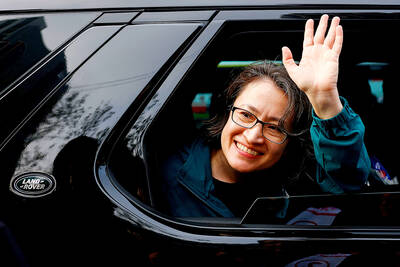
Relations between Taiwan and the Czech Republic have flourished in recent years. However, not everyone is pleased about the growing friendship between the two countries. Last month, an incident involving a Chinese diplomat tailing the car of vice president-elect Hsiao Bi-khim (蕭美琴) in Prague, drew public attention to the People’s Republic of China’s (PRC) operations to undermine Taiwan overseas. The trip was not Hsiao’s first visit to the Central European country. It was meant to be low-key, a chance to meet with local academics and politicians, until her police escort noticed a car was tailing her through the Czech capital. The
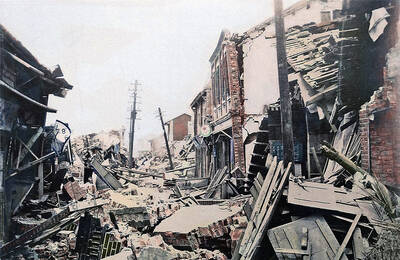
April 15 to April 21 Yang Kui (楊逵) was horrified as he drove past trucks, oxcarts and trolleys loaded with coffins on his way to Tuntzechiao (屯子腳), which he heard had been completely destroyed. The friend he came to check on was safe, but most residents were suffering in the town hit the hardest by the 7.1-magnitude Hsinchu-Taichung Earthquake on April 21, 1935. It remains the deadliest in Taiwan’s recorded history, claiming around 3,300 lives and injuring nearly 12,000. The disaster completely flattened roughly 18,000 houses and damaged countless more. The social activist and


 RSS
RSS