


Around 10 minutes drive from Sun Moon Lake (日月潭), Nantou County (南投縣), Yuchih Township (魚池鄉) lies a quiet agricultural community where many of its 10,000 or so inhabitants use the nearby mountain springs to grow high-quality mushrooms that are mostly exported to Japan. Four years ago, a big-city family settled down in the small town and two years of trial and error later, a new item was added to the local export list: natural vinegar made from certified organic vegetables, fruits, grains and herbs.
"When we first traveled to the mushroom town 700m above sea level, the locals told us crops rarely need pesticides or fertilizers, just lots of water from the natural reservoir in the mountain. I immediately said to myself 'this is it' since the brewing business is all about location, sun, fresh air and water," said the creator of Luyin natural vinegar, Yang Lu-yin (楊綠茵), who just wound up the busiest season of the year sealing newly harvested plums into pottery jars to ferment for two years.
With a postgraduate degree in sociology from Chinghua University (清華大學), Yang dedicated the first half of her life to cultural and social work stretching from her pioneering participation in the Integrated Community Development Project (社區總體營造), saving the abandoned historical railway line from Sanyi (三義) to Houli (后里), to establishing Taiwan's first railway art village Stock 20 (20號倉庫) in Taichung.
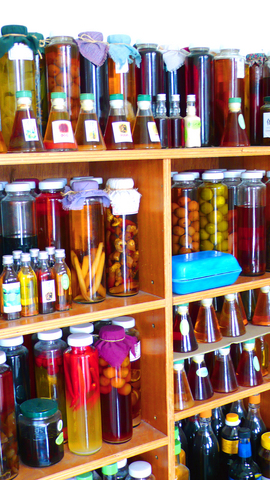
PHOTO: HO YI, TAIPEI TIMES
Yet the busy lives of Yang and her husband had left the couple exhausted and their son sent to his grandparents' far away from home.
"At one point of my life, I started to ask myself what happiness truly means," said the mother of two.
The answer is Yuchih and the traditional art of making vinegar. She tried out ingredients offered by organic farmers, friends, neighbors or even strangers and chose to make the base vinegar out of brown rice, which is more nutritious and costlier to produce than the traditional constituent glutinous rice.
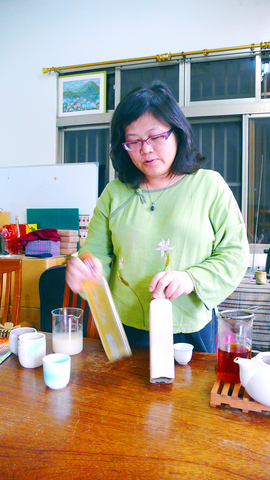
PHOTO: HO YI, TAIPEI TIMES
"My academic training comes in handy for my brewing adventures as I keep asking questions and am not afraid of experimenting. I have also learned a lot from my extensive reading of foreign clinical reports and medical studies on vinegar in the same way as I did my thesis and academic projects," Yang said.
The end result is over 40 kinds of novel vinegars lining Yang's shelves, 10 of which, including black bean, passion fruit, mulberry, pineapple, plum and old pine flavors, are produced on a large scale.
The first batch of Yang's natural vinegar came out in 2005, two years after the ingredients were sealed in jars. And during that time, the brewer divided her time studying vinegar, reading, having fun with her kids, exploring the countryside and visiting organic farmers much like "Marx's ideal man who reads poetry in the morning, ploughs in the afternoon and makes art at night," to use Yang Lu-yin's words.
Currently, the brewery can produce 50,000 to 100,000 bottles of vinegar a year, which are mostly exported to Singapore, Malaysia, US, Canada and Australia. The Yangs visit Singapore and Malaysia around five times a year to share their knowledge and tout the healthful benefits of their vinegars, which are certified by Singaporean authorities. Taiwan doesn't issue certification for vinegar since it is categorized as a food seasoning.
Rather than actively exploit new markets, the brewing family prefers to wait for buyers to stumble across its products. "All of our foreign distributors found us, not the other way around and I think it's better to sell my products abroad since I don't like the idea of taking part of the local, limited market away from other vinegar-makers," Yang said.
Often touted as an all-purpose medicine and supplement, natural vinegar's healing virtues have been extolled in both Western and Eastern civilizations.
According to Yang Lu-yin's own study, vinegar has been used as medicine in China since the Ming Dynasty.
"The use of vinegar as medicine started early in human history, but now it is reduced to a cheap flavor enhancer. My job is to restore vinegar to its original healing status," the 38-year-old brewer said.
Medical professionals are cautious on vinegar's healing properties since little scientific research has been done on its effects. "More studies need to be done before we can start to understand and analyze the vinegar's healing properties. Before that happens, it's only safe to say that natural vinegar is one of several beverage options containing nutrients and vitamins," said head of the dietetics department at National Taiwan University Hospital (台大醫院營養部), Cheng Chin-pao (鄭金寶), adding that people suffering from gastric ulcers or other digestive problems should drink vinegar after meals, but diluted with more water than is commonly suggested.
Yet in the eyes of Yang, rather than seeing vinegar as a too-good-to-be-true miracle cure, it is a supplementary source of vitamins, minerals, enzymes and amino acids, which contemporary diets rich in processed foods often lack.
On a site next to the vinegar brewery, Yang and her family's future house and a showroom for foreign buyers and distributors are under construction.
"Our friends and families were worried sick when we first moved here with little money in our pockets but we have found the ideal life," Yang said.
For more information on Luyin natural vinegar, visit www.luyin.com.tw.

In late October of 1873 the government of Japan decided against sending a military expedition to Korea to force that nation to open trade relations. Across the government supporters of the expedition resigned immediately. The spectacle of revolt by disaffected samurai began to loom over Japanese politics. In January of 1874 disaffected samurai attacked a senior minister in Tokyo. A month later, a group of pro-Korea expedition and anti-foreign elements from Saga prefecture in Kyushu revolted, driven in part by high food prices stemming from poor harvests. Their leader, according to Edward Drea’s classic Japan’s Imperial Army, was a samurai

Located down a sideroad in old Wanhua District (萬華區), Waley Art (水谷藝術) has an established reputation for curating some of the more provocative indie art exhibitions in Taipei. And this month is no exception. Beyond the innocuous facade of a shophouse, the full three stories of the gallery space (including the basement) have been taken over by photographs, installation videos and abstract images courtesy of two creatives who hail from the opposite ends of the earth, Taiwan’s Hsu Yi-ting (許懿婷) and Germany’s Benjamin Janzen. “In 2019, I had an art residency in Europe,” Hsu says. “I met Benjamin in the lobby

April 22 to April 28 The true identity of the mastermind behind the Demon Gang (魔鬼黨) was undoubtedly on the minds of countless schoolchildren in late 1958. In the days leading up to the big reveal, more than 10,000 guesses were sent to Ta Hwa Publishing Co (大華文化社) for a chance to win prizes. The smash success of the comic series Great Battle Against the Demon Gang (大戰魔鬼黨) came as a surprise to author Yeh Hung-chia (葉宏甲), who had long given up on his dream after being jailed for 10 months in 1947 over political cartoons. Protagonist

A fossil jawbone found by a British girl and her father on a beach in Somerset, England belongs to a gigantic marine reptile dating to 202 million years ago that appears to have been among the largest animals ever on Earth. Researchers said on Wednesday the bone, called a surangular, was from a type of ocean-going reptile called an ichthyosaur. Based on its dimensions compared to the same bone in closely related ichthyosaurs, the researchers estimated that the Triassic Period creature, which they named Ichthyotitan severnensis, was between 22-26 meters long. That would make it perhaps the largest-known marine reptile and would


 RSS
RSS